The 10 Best Centrifugal Juicers for Fast Home Juicing
Juicing at home usually starts with good intentions. You buy a bag of oranges and a bunch of carrots, picture a cold glass on a Sunday morning, and then the reality of chopping, feeding, and scrubbing sets in. That’s the moment most people start searching for the best centrifugal juicer — somewhere between the third carrot and the pile of pulp. You want something that keeps up with you instead of adding another chore to the day.
Centrifugal juicers are the fast, feed-and-go kind. They spin a cutting disc and a mesh filter at high speed, and juice runs out one side while pulp collects in a container behind. That speed is the whole appeal, and it’s also where the trade-offs live. These listings differ most on two things: how wide the feed chute is, which decides how much you pre-cut, and how much juice the jug holds, which decides whether you’re juicing for one glass or the whole family. Motor size, speed settings, and what’s included fill in the rest. This page walks through each machine’s own claims so you can match one to your counter, your produce, and your patience.
All 10 products side by side — scroll sideways to see every column.
| Top Pick | Best for Batch Juicing | Best for Safety Locks | Best for Variable Speeds | Best for Easy Cleanup | Best for Whole Fruits | |||||
| Preview |  |  |  |  |  |  |  |  |  |  |
|---|---|---|---|---|---|---|---|---|---|---|
| Product | Breville JE98XL Juice Fountain Plus | Breville BJE430SIL Juice Fountain Cold | QCen Juicer Machine Centrifugal Juicer | Airon Juicer Machines | KOIOS 1300W Centrifugal Juicer | NutriBullet Juicer Pro | NutriBullet Juicer | Hamilton Beach Big Mouth Juicer | Hamilton Beach HealthSmart Compact Juicer | GDOR 1200W Centrifugal Juicer |
| Brand | Breville | Breville | QCen | Airon | KOIOS | NutriBullet | NutriBullet | Hamilton Beach | Hamilton Beach | GDOR |
| Best for | Best Overall | Best for Batch Juicing | Best for Safety Locks | — | Best for Variable Speeds | — | — | Best for Easy Cleanup | — | Best for Whole Fruits |
| The listing says | Centrifugal juicer with 3 inch extra wide chute Dual speeds and quick operation | 850 watt motor processes tough fruits in seconds Cold Spin Technology with Italian-made mesh filter | 800W high speed motor 3 inch wide mouth saves cutting time | 1200W motor extracts juice in 5 seconds 3-inch chute takes whole fruits and vegetables | 1300W all-copper motor, up to 18000 RPM 3-inch feed inlet juices whole fruits in 10 seconds | High-torque motor with turbo speed 3 precision speeds | Dual speeds for soft and hard produce No-drip spout | 3-year limited warranty from Hamilton Beach 3 inch chute, 800 watts, 80 oz pulp bin | On/off button and spout pours juice into glass 2.4 inch chute reduces precutting by 50% | 3.2 inch feed chute saves prep time 1200W full copper motor with titanium blades |
| More information | Check Price on Amazon | Check Price on Amazon | Check Price on Amazon | Check Price on Amazon | Check Price on Amazon | Check Price on Amazon | Check Price on Amazon | Check Price on Amazon | Check Price on Amazon | Check Price on Amazon |
1. Breville JE98XL Juice Fountain Plus
Right for: The first-time juicer who wants a proven all-rounder.
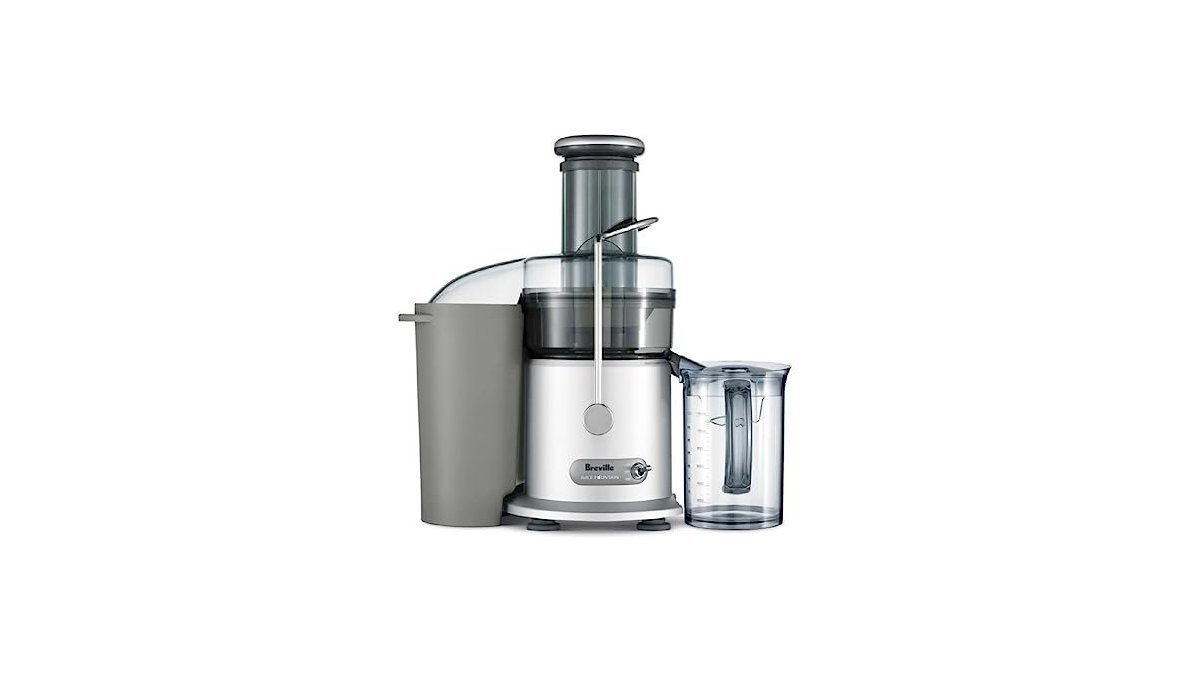
This is Breville’s entry into the category, and the listing leans on familiarity rather than extremes. It runs an 850W motor with two speeds — low for soft fruit and leafy greens, high for dense fruit and hard vegetables. The 3-inch extra-wide chute is the headline feature, and the listing says it lets you juice whole fruits and vegetables without pre-cutting. The extraction system pairs a titanium-reinforced disc with an Italian-made micro mesh filter basket, both stainless steel, which the seller says is built for juice and nutrient extraction. A 35.2 fl oz juice jug with a built-in froth separator catches the pour, and the pulp container holds 2.6 qt.
On an ordinary morning, that combination changes your routine in a specific way. You rinse produce, drop it in whole, and the froth separator means you pour juice rather than foam into the glass — a small thing that matters if you drink your juice straight. The cord wraps around the feet under the base and the pulp container detaches, so storage is tidier than the footprint suggests. Where it asks something of you: two speeds is a simpler choice than variable control, so you’ll be picking between low and high rather than dialing in a setting for every ingredient. And the 35.2 fl oz jug is the capacity the listing states, with no seal-and-store claim attached.
What works:
- 3-inch chute takes whole fruit, so prep stays short
- Titanium-reinforced disc and stainless mesh filter basket
- Froth separator built into the juice jug
- Cord wraps under the base for storage
- Includes juice jug and cleaning brush
Where it gives ground:
- Two speeds only, no variable or pulse setting
- 35.2 fl oz jug, the capacity the listing states
Skip it if: You need a large seal-and-store jug for several days of juice.
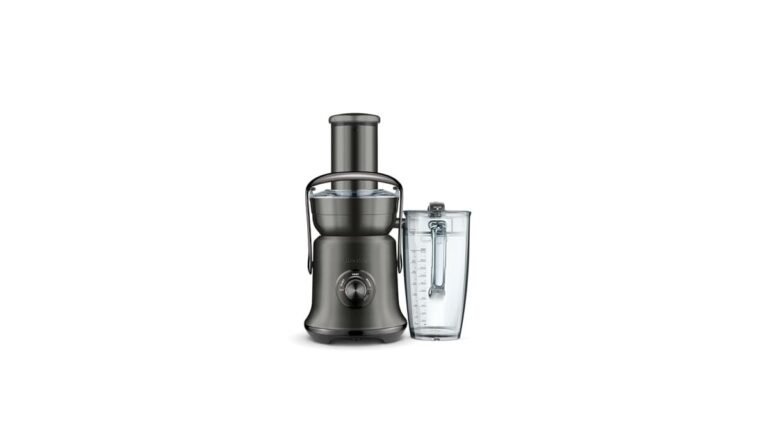
2. Breville BJE430SIL Juice Fountain Cold Fruit and Vegetable Juicer
Right for: The household juicing big batches to keep in the fridge.
This is the larger Breville, and the listing centers on two claims: Cold Spin Technology and capacity. The cold extraction system, paired with an Italian-made precision mesh filter, is described as avoiding damage to vitamins and minerals from heat and processing. The motor is 850W and the seller says it handles tough produce in seconds. The 3-inch chute lets whole carrots, apples, and oranges go in uncut, as the listing states. The real difference is the jug — a 70 fl oz seal-and-store container that the listing says keeps juice in the refrigerator for up to three days. The pulp container is 3.6 qt.
That capacity is what reshapes a week rather than a morning. You run a big batch once, seal it, and pour from the fridge for a few days instead of juicing daily. The easy-use nozzle inverts when you’re done to stop drips onto the counter, which matters more when you’re juicing nonstop into a large jug. There’s also an LED light that comes on if the motor stops from overloading — a preventative signal rather than a silent stall. The trade-off is capacity: a 70 fl oz jug and 3.6 qt pulp container. If you juice one glass at a time, this is more machine than the job needs.
What works:
- Cold Spin Technology with precision mesh filter
- 70 fl oz seal-and-store jug, listed for up to three days
- The feed opening is wide enough to juice whole carrots, apples, and oranges
- Inverting nozzle stops drips between glasses
- LED light signals motor overload
Where it gives ground:
- Large jug and 3.6 qt pulp container take counter space
- Batch juicing means more parts to clean each session
Skip it if: You only ever make a single glass and want minimal cleanup.
3. Juicer Machine 800W Centrifugal Juicer with Wide Mouth Feed Chute
Right for: The careful buyer who wants clear operating limits up front.
QCen’s listing is unusual in a useful way: it spends as much space on how to run the machine as on what it does. The motor is an upgraded 800W unit with two speeds — “1” for soft produce like watermelon, orange, and strawberry, “2” for hard produce like carrot, celery, apple, and pear. The 3-inch wide mouth takes whole produce, saving chopping time. Stainless steel construction with BPA-free parts, a locking arm that stops the machine running unless the cover is locked, and overload protection that switches off on overheating round out the safety side. Detachable parts make cleaning easier.
The listing also states its limits plainly, which is rarer than it should be. It warns against juicing things with low water content, tells you to grasp the edge of the filter basket and pull up to remove it, and gives instructions for seating the lid latch and locking the safety arm vertically — otherwise the machine may not run. Most importantly, it says not to operate continuously for more than 5 minutes, and to let it cool for 15 minutes if it stops from overheating. Those are real operating rules, not fine print. On an ordinary day, that means juicing in short bursts with a pause between, which suits a single glass or two far better than a long weekend batch session.
What works:
- 800W motor with settings for soft and hard produce
- The wide mouth reduces chopping
- Safety lock arm prevents running when unlocked
- Overload protection switches off on overheating
- Clear instructions for lid seating and filter removal
Where it gives ground:
- Listing caps continuous running at 5 minutes
- Overheat stop needs a 15-minute cooldown before restart
Skip it if: You want to run a long, uninterrupted juicing session.
4. Airon Juicer Machines
Right for: The buyer who wants a covered machine and a stated warranty.
Airon leads with power: a 1200W high-speed motor that the listing says extracts juice within 5 seconds. The 3-inch extra-wide chute accepts whole fruit and vegetables without pre-cutting or peeling. The filter is food-grade 304 stainless steel with anti-corrosion multi-blades, and the seller claims 30% more juice than ordinary models with less pulp residue. Dual speeds split soft produce — watermelon, oranges, strawberries — from hard produce like apple, celery, carrot, and kale. A fixed safety lock prevents leakage at high speed, and the included 35 oz juice jug is BPA-free with a built-in foam separator. The listing states UL certification and a 12-month after-sales service with 24-hour online support.
The practical read is that this is a full-size machine aimed at households rather than solo juicers. A 35 oz jug with a foam separator means one batch serves several people, and the self-contained pulp basin, no-drip spout, and dishwasher-safe components keep cleanup contained. The base wipes with a damp cloth. The listing’s own emphasis is on speed per batch rather than long sessions.
What works:
- 1200W motor, listed as juicing in about 5 seconds
- The chute takes whole fruit and vegetables
- 304 stainless steel filter with multi-blades
- 35 oz BPA-free jug with built-in foam separator
- UL certified, with 12-month after-sales service
Where it gives ground:
- 12-month after-sales service, as stated
- Large jug and basin suit batch juicing, not a single glass
Skip it if: You want a compact machine for one daily glass.
5. KOIOS 1300W Centrifugal Juicer Machine with 3″ Wide Chute
Right for: The hard-produce juicer who wants maximum power and speed.
KOIOS goes furthest on motor and speed. The 1300W all-copper motor is listed at up to 18000 RPM, with the seller claiming it extracts 75% more juice and 60% more nutrients than ordinary juicers and leaves drier pulp. There are three speed settings — soft, hard, and pulse — and the listing says a full 35 oz cup takes about 10 seconds. The 3-inch feed inlet takes whole apples, oranges, and cucumbers without pre-cutting. The filter is a titanium alloy-coated 304 stainless steel unit with precise pores, described as separating juice from foam for a smoother result.
Capacity is the other half of the pitch. A 35 oz juice cup with a drip-proof spout sits alongside a 100 oz pulp container, which the listing frames as enough for the whole family in one go without stopping to empty pulp. That’s the detail that changes a party or a big family morning — you’re not pausing mid-batch to clear the bin. Cleaning is described as a 5-minute job with a brush for the mesh filter, and all BPA-free parts detach. The safety lock won’t let it start unless sealed, and there’s overheat protection plus a non-slip base. The caveat is that three speeds and a pulse mode are more settings to choose from than a two-speed switch.
What works:
- 1300W all-copper motor, listed up to 18000 RPM
- Three speeds including a pulse mode
- Titanium alloy-coated 304 stainless steel filter
- 35 oz juice cup and 100 oz pulp container
- Safety lock, overheat protection, non-slip base
Where it gives ground:
- Three speeds and pulse ask more judgment than a simple switch
- Large 100 oz pulp container takes storage space
Skip it if: You want the simplest possible controls and a small footprint.
6. NutriBullet Juicer Pro Centrifugal Juicer Machine
Right for: The make-ahead juicer who wants bottles and freezer trays included.
The Juicer Pro is the fuller of the two NutriBullet machines here. A 1000W high-torque motor with turbo speed drives three precision speeds, and a no-drip spout keeps the counter clean. The 27 oz sealing juice pitcher is listed as storing fresh juice for up to 48 hours, which is the make-ahead promise in one line. A 3-inch feed chute with a dual-size food pusher lets you choose between wide and narrow feed openings depending on what you’re juicing. The kit is where this one separates itself: two glass to-go bottles, a 2 oz freezer tray, a 4 oz freezer tray, a stainless steel sieve, a pulp basin, a sealing lid with froth separator, and a cleaning brush.
What that means in practice is a routine built around grab-and-go rather than drink-now. You juice, seal, and either refrigerate for up to 48 hours or pour into the glass bottles for the commute. The freezer trays let you freeze portions of juice or purée, which is a genuinely different use than a plain jug. The self-contained pulp basin lifts off and goes straight to the sink, and the sieve, basin, pitcher, bottles, and trays are all dishwasher-safe.
What works:
- 1000W motor with three precision speeds and turbo
- 27 oz sealing pitcher, listed for up to 48 hours
- Includes glass to-go bottles and freezer trays
- Dual-size food pusher for wide or narrow feed
- Sieve, basin, pitcher, bottles, and trays dishwasher-safe
Where it gives ground:
- Many accessories mean more parts to wash and store
- 27 oz pitcher is smaller than large-jug models
Skip it if: You want one jug and nothing else to keep track of.
7. NutriBullet Juicer
Right for: The everyday juicer who wants the least fuss possible.
This is the simpler NutriBullet, and its listing opens by answering the obvious objection: “Who said juicing was complicated.” An 800W motor drives dual speeds for soft and hard produce, with a no-drip spout. The 27 oz sealing pitcher stores juice for up to 48 hours. The 3-inch feed chute takes whole fruits and vegetables, so no slicing or dicing. The self-contained pulp basin lifts off and goes to the sink, and the sieve, pulp basin, and juice pitcher are dishwasher-safe. The kit is deliberately short: motor base, 1.5L pulp basin with the 3-inch chute, stainless steel sieve, 27 oz pitcher, sealing lid with froth separator, food pusher, cleaning brush, and guides.
The point of this machine is that nothing about it needs a decision. Two speeds, one pitcher, one basin, and a brush. On a weekday morning you rinse, feed, pour, and rinse the parts — no accessory sorting, no freezer trays to track. The 27 oz pitcher is the stated capacity, and the 48-hour storage window means you can make it the night before. Where it gives ground is range: with two speeds and no pulse or turbo mode, you’re working within simpler controls than the Pro or the three-speed machines here. It’s also the smaller-capacity option, so a family batch means running it more than once.
What works:
- 800W motor with dual speeds
- 3-inch chute takes whole fruits and vegetables
- 27 oz sealing pitcher, listed for up to 48 hours
- Sieve, basin, and pitcher are dishwasher-safe
- Short parts list keeps cleaning simple
Where it gives ground:
- Two speeds only, no pulse or turbo mode
- 27 oz pitcher means more than one run for a family batch
Skip it if: You need three speeds and a full accessory kit out of the box.
8. Hamilton Beach Centrifugal Juicer Machine With Big Mouth 3” Feed
Right for: The buyer who wants a long stated warranty and simple parts.
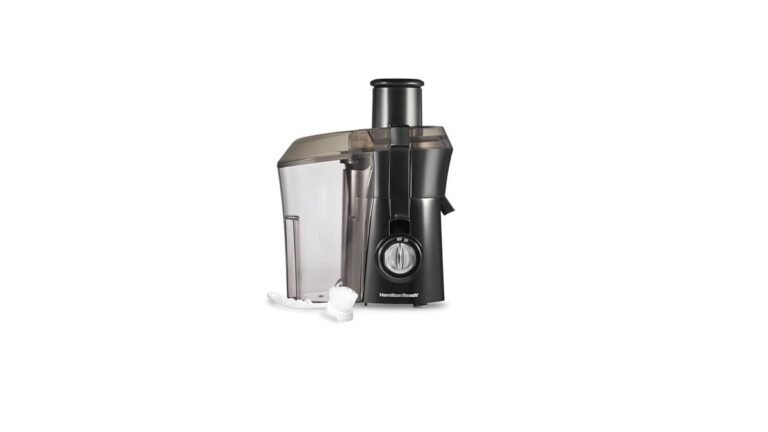
Hamilton Beach leans on two things here: brand history and a stated warranty. The listing calls it America’s #1 juice extractor brand and backs the machine with a 3-year limited warranty. The motor is 800W, the chute is an extra-large 3-inch Big Mouth that fits a whole apple, a bunch of celery, or a handful of carrots, and the pulp bin holds 80 oz. The removable parts — pulp bin, juice bowl, lid, and pusher — are dishwasher safe, and a strainer cleaning brush is included. The seller frames the whole package as a compare-and-choose: chute size, wattage, pulp bin, and warranty, all stated plainly.
That 3-year limited warranty is the standout line, because it’s the longest stated term on this list. For a machine that runs a spinning disc and a mesh filter, a longer covered window is a real consideration. On an ordinary day, this is a machine you feed whole produce into and rinse afterward without much thought. The trade-off is that 800W sits below the 1200W and 1300W machines on this list.
What works:
- 3-year limited warranty, the longest stated here
- 3-inch Big Mouth chute fits whole apples and celery bunches
- 80 oz pulp bin
- Pulp bin, juice bowl, lid, and pusher dishwasher-safe
- Includes a strainer cleaning brush
Where it gives ground:
- 800W sits below the higher-wattage machines here
- Large 80 oz pulp bin takes up storage room
Skip it if: You’re chasing maximum wattage for the toughest produce.
9. Hamilton Beach HealthSmart Compact Centrifugal Juicer Machine
Right for: The small-kitchen cook juicing a glass at a time.
The HealthSmart is the compact option, and the listing is upfront about what that means. A 400W motor drives a stainless steel strainer, with a motor protection system the seller says helps extend motor life. The chute is a round 2.4 inches, which the listing says reduces pre-cutting by 50% compared to the leading competitor — a smaller opening than the 3-inch machines, so larger produce needs some trimming. The design is explicitly space-saving: it takes less counter room and fits into a cabinet for storage. A simple on/off button runs it, and the spout sends juice straight into your glass, cup, or pitcher. Removable parts are dishwasher safe and the base wipes down.
The one detail worth catching: the listing states plainly that a juice cup isn’t included. So you’ll be juicing into your own glass, which the spout is designed for. That’s fine for a single serving and awkward for a batch. Where this machine earns its place is the small-kitchen case — if counter space is the thing stopping you from juicing at all, a compact unit that stores in a cabinet removes that obstacle. The trade-off is capacity and power: 400W and a 2.4-inch chute mean soft produce and smaller pieces, and there’s no large jug to fill. It’s a starter machine, honestly described as one.
What works:
- Compact design fits a cabinet for storage
- 2.4-inch chute, listed as reducing pre-cutting by 50%
- 400W motor with a motor protection system
- Simple on/off button and direct-to-glass spout
- Removable parts are dishwasher safe
Where it gives ground:
- Listing states a juice cup isn’t included
- 400W and 2.4-inch chute suit soft produce and smaller pieces
Skip it if: You want to juice whole apples and large batches.
10. GDOR Powerful 1200W Juicer with Larger 3.2″ Feed Chute
Right for: The whole-produce juicer who wants a wide chute here.
GDOR’s listing is built around three claims. First, a 3.2-inch chute, which the seller says keeps the machine stable during high-speed rotation and lets whole produce go in without prep. Second, a maximum 1200W full copper motor with enhanced titanium blades, described as spinning faster and holding high torque even at low speeds for more thorough extraction — and as less likely to overheat or burn out. Third, a reinforced titanium disc paired with a culinary-grade stainless steel micro mesh filter. Dual speeds split soft fruit like oranges and tomatoes from hard fruit like apple, celery, carrot, and kale. All detachable parts are dishwasher safe, and a 22 oz juice jug is included.
The 3.2-inch chute is the practical differentiator. At that width, more of what you buy goes in as-is, which shortens prep and reduces the chance of produce spilling as you feed it. The full copper motor claim is about durability under load rather than peak speed alone, and the listing frames it as longer lifespan and greater reliability. The 22 oz jug is the smallest capacity on this list, though — so this machine is about feeding convenience, not batch size. If your habit is one or two glasses at a time with minimal chopping, that pairing makes sense. If you’re filling a large jug for the week, you’ll be running it more than once.
What works:
- 3.2-inch chute for whole produce
- 1200W full copper motor with enhanced titanium blades
- Reinforced titanium disc and stainless micro mesh filter
- Dual speeds for soft and hard produce
- All detachable parts are dishwasher safe
Where it gives ground:
- 22 oz juice jug
- Small jug means multiple runs for a large batch
Skip it if: You want a large jug to fill in one pass.
Also Worth Considering
NEWBULIG Centrifugal Juicer runs a 700W dual-speed motor listed at 18000 RPM, with a 3-inch feed chute for whole fruits and vegetables. Parts are BPA-free and dishwasher-safe. It sits below the higher-wattage machines here, so it’s a reasonable fit if you juice softer produce most days and want a straightforward machine with easy cleanup.
Breville BJE200XL Juice Fountain Compact is the space-saving Breville, with a 3-inch wide chute for whole produce and a 25 fl oz capacity. That’s the smallest jug among the Breville models here, which suits a single daily glass and a small kitchen rather than a family batch.
Breville BJE830BSS Juice Fountain Cold XL is the largest-chute Breville at 3.5 inches, with a 70 fl oz jug. The listing highlights juicing whole fruits, vegetables, and leafy greens quickly. If you want cold-extraction capacity and the widest Breville feed, this is the one to look at alongside the BJE430SIL.
How to Think Before You Choose
Chute Width and How Much You Chop
Chute width is the single biggest thing that decides whether juicing feels easy or feels like prep work. A 3-inch opening takes a whole apple, a whole orange, and a full carrot. A 2.4-inch opening takes those same items only after you cut them down, which adds minutes to every session and a cutting board to the cleanup. The gap between the two sounds small in print and feels large at 7 a.m. on a weekday.
Most people should lean toward the widest chute they can fit on their counter, because prep is the step that makes people quit juicing. The exception is soft produce. If your habit is oranges, watermelon, and strawberries, a narrower chute suits you fine, since those items are easy to halve anyway. The machines here range from 2.4 inches up to 3.2 inches, and that spread covers the whole decision.
Before you buy, check your own produce. Pull out the apples and carrots you normally buy and measure the widest one across. If it’s under your candidate chute’s width, you’ll feed it whole. If it’s wider, you’re cutting. Do the same with a stalk of celery and a beet. Two minutes with a ruler tells you more than any spec sheet, because it uses the food you actually eat.
Jug Size and Whether You Batch or Pour One Glass
Jug size decides your rhythm. A 22 oz or 27 oz pitcher is a single or two-person pour — you juice, you drink, you rinse. A 70 oz jug is a batch: you run produce for several minutes, seal the container, and pour from the fridge over the next few days. Both are right, but they’re right for different mornings, and picking the wrong one is how a juicer ends up in a cabinet.
Most households should lean toward the smaller jug unless they genuinely drink juice daily as a family. A large jug is only an advantage if you’ll fill it — otherwise you’re washing a big container to make one glass. If two people each have a glass every morning, the larger capacity starts to pay off, because one session covers both and leaves some for later. The listings here state storage windows too: one Breville lists up to three days in the refrigerator, and the NutriBullet models list up to 48 hours.
Check this at home by counting glasses. For one week, note how many glasses of juice your household actually drinks in a day. Multiply by seven. If the number is small and steady, a 27 oz pitcher covers it. If it’s large or you want juice ready without juicing daily, look at the 70 oz options. Also check your fridge: a 70 oz jug needs shelf height and door space that a 27 oz pitcher doesn’t.
Cleanup, Parts, and What You’ll Actually Wash
Cleanup is the second reason juicers get abandoned, and it varies more than the marketing suggests. Every machine here has a mesh filter or sieve, and that’s the part that takes real scrubbing — pulp packs into the holes and a quick rinse won’t clear it. Most listings include a cleaning brush for exactly this reason. Beyond the filter, you’re washing a pulp container, a lid, a pusher, and a jug, and the question is whether those parts go in the dishwasher or need hand washing.
Most people should lean toward machines whose removable parts are listed as dishwasher safe, and should plan on hand-scrubbing the mesh filter regardless. What differs is how many parts there are. A machine with two glass bottles, two freezer trays, and a sealing lid adds items to wash and store. A machine with a pitcher, basin, and brush keeps the list short. Neither is wrong, but the longer list is a commitment.
Before you decide, count the parts on your own counter. Look at your sink after a normal dinner and ask how many extra items you’re willing to wash. Then check the listing’s parts list and count what comes apart. If the number feels heavy, choose the simpler kit. One more check: measure your cabinet or counter space where the machine will live. A detachable pulp container and a wrap-around cord help storage, but the base and jug still need a home.
Who Should Skip These Altogether
These machines are good at what they do, but they’re not right for everyone — and knowing when to walk away saves you a cabinet full of regret.
- If you want juice once a month, a centrifugal juicer is more machine than you need.
- If you already own a masticating or cold-press juicer that works, these centrifugal models won’t add anything.
- If your main goal is leafy greens and wheatgrass, a slow juicer is built for that job.
- If you’d use it once for a party and then stop, borrow or rent instead.
Frequently Asked Questions
What can a centrifugal juicer handle well, and what should I keep out of it?
Centrifugal juicers are built for firm, watery produce: apples, carrots, oranges, cucumbers, celery, beets, and pineapple. The spinning disc and mesh filter extract juice from those quickly. What they handle poorly is low-water-content produce — QCen’s listing says directly to avoid juicing things with low water content — along with soft leafy greens and wheatgrass, which tend to clog a fine mesh filter rather than release juice. If leafy greens are your main goal, a slow juicer suits that job better.
How long can I run one of these before it needs a rest?
It depends on the machine, and the listing is where you find out. QCen states plainly that you shouldn’t operate continuously for more than 5 minutes, and that if the machine stops from overheating you should let it cool for 15 minutes before restarting. Several machines here list overheat protection as a feature, which means the motor shuts itself off rather than burning out. The practical habit is to juice in short runs and empty the pulp container between them.
What goes wrong first on a centrifugal juicer, and how do I avoid it?
The mesh filter and the cutting disc see the most wear, because they’re the parts doing the work at speed. Pulp packed into the mesh is the most common day-to-day issue, and it reduces yield if you don’t clear it — which is why most listings include a cleaning brush. The second common issue is the motor stopping from overload, which the listings address with protection systems and cooldown guidance. To avoid both: scrub the filter with the brush after every session, feed at a steady pace, and respect the running limits your listing states.
Is the simplest machine here enough, or do I need more speeds and power?
For most people, yes — the simplest machine is enough. Two speeds cover the real split in juicing: low for soft produce like oranges and watermelon, high for hard produce like carrots and apples. That’s the whole decision on a normal morning, and the NutriBullet Juicer and Breville JE98XL both work on exactly that basis. More speeds, pulse modes, and higher wattage help in specific cases: dense produce like beets, large batches run back to back, and juicers who want to dial in a setting per ingredient.
What should I confirm before ordering one of these juicers?
Four things. First, chute width against your actual produce — measure your typical apple and carrot, since a 2.4-inch chute and a 3.2-inch chute are very different mornings. Second, jug capacity against how many glasses your household drinks, and whether a large jug fits your fridge shelf. Third, the parts list: count what comes apart and needs washing, and confirm which parts the listing says are dishwasher safe. Fourth, the stated warranty and service terms, which vary here — Hamilton Beach lists a 3-year limited warranty and Airon lists 12-month after-sales service with 24-hour online support.
Closing
For most people, the Breville JE98XL Juice Fountain Plus is the pick — a 3-inch chute, two speeds, and a froth separator cover everyday juicing without asking much of you. If your case is harder, the Breville BJE430SIL Juice Fountain Cold is the one to look at, because its 70 fl oz seal-and-store jug and cold extraction system are built for batching ahead rather than pouring a single glass. Before you order, do two things: measure the widest apple and carrot you normally buy against the chute width, and count how many glasses your household drinks in a day. Those two numbers point to the right machine faster than any feature list.