The 5 Best Commercial Citrus Juicers for Fast, Easy Juice
You’re standing at the counter with a bag of oranges, a pitcher, and a recipe that says “juice 12 oranges.” Twenty minutes later your hands ache, the counter is sticky, and you’re wondering why you didn’t just buy the bottled stuff. That’s usually the moment people start searching for a commercial citrus juicer — not because they run a bar, but because they want the job done without the mess and the sore wrists.
The hard part is that these machines pull in two directions at once. Some are built to push through a hundred fruits an hour behind a counter, and some are built to sit quietly in a home kitchen and handle a weekend brunch. You have to weigh how much fruit you actually press against how much space and cleanup you’re willing to live with. This page sorts that out for you, one machine at a time.
All 5 products side by side — scroll sideways to see every column.
| Top Pick | Best for Small Spaces | Also Great | Best Manual Juicer | ||
| Preview |  |  |  |  |  |
|---|---|---|---|---|---|
| Product | Breville BCP600SIL Citrus Press | Waring Compact Citrus Juicer | Proctor Silex 66900 Juicer | Hamilton Beach 932 Juicer | Zulay Kitchen Cast Iron Juicer |
| Brand | Breville | Waring | Proctor Silex Commercial | Hamilton Beach Commercial | Zulay Kitchen |
| Best for | Best Overall | Best for Small Spaces | Also Great | — | Best Manual Juicer |
| The listing says | Motorized juicer squeezes fresh juice from lime to grapefruit One-handed operation of the juicer press | Compact size fits small spaces Heavy duty die-cast base with vibration-dampening feet | Induction motor runs virtually silently Housing made of cast aluminum with acid-resistant finish | Extractor arm exerts up to 2000 lbs. / 907 kg of force Metal components and enamel finish resist citrus acids | Extracts maximum juice, keeps seeds out, minimizes pulp 5-inch diameter bowl handles small limes to large grapefruits |
| More information | Buy on Amazon | Buy on Amazon | Buy on Amazon | Buy on Amazon | Buy on Amazon |
1. Breville BCP600SIL Citrus Press Motorized Orange Juicer
Right for: The home cook who presses citrus most mornings.
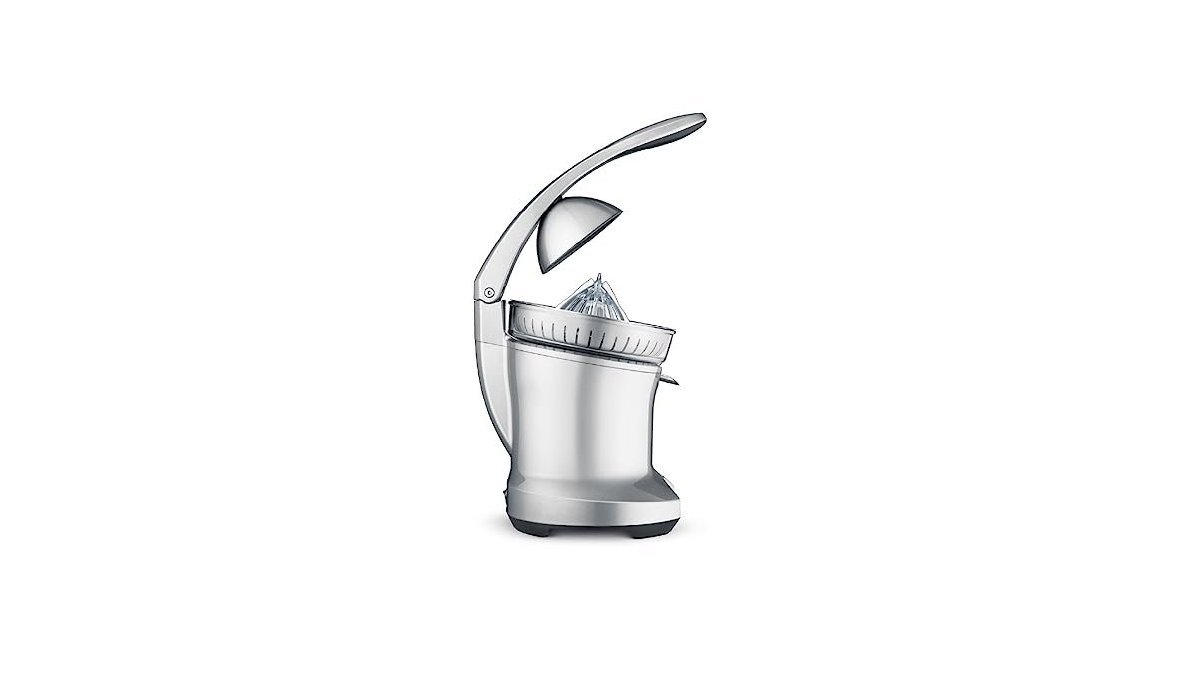
This is a motorized press with a one-size-fits-all cone and a finned juicing cone under a fruit dome. The listing says it handles everything from the smallest lime to the largest grapefruit. You lower the assisted arm by hand, and that downward pressure is what gets the juice out. A dual safety switch means the cone won’t spin until the arm is down and enough pressure is on top of it.
The finned cone and the dome work as a pair. The fins grip the fruit, the dome presses down on it, and between them you get maximum extraction instead of a half-crushed half left on the cone. That’s the whole reason the arm exists rather than a plain reamer.
On an ordinary morning, that changes your routine in a small but real way. You cut a grapefruit, drop a half on the cone, pull the arm down with one hand, and the motor does the squeezing. The drip stop spout holds juice back so it doesn’t run onto the counter between glasses. When you’re done, the juicing cone, juice collector, juice filter, and fruit dome all go in the dishwasher.
The trade-off is the arm itself. Everything runs through a single handle, so you’re still doing the pressing motion — the motor spins the cone, but your arm supplies the force. It’s rated at 110 watts and covered by a 1 year limited product warranty.
Where this bites is volume. One grapefruit is nothing. A pitcher for a crowd is a lot of arm cycles, and the arm is the part doing the work every time. If you juice for one or two people most days, the arm never becomes the problem. If you’re pressing for a brunch, it will.
What works:
- A cone that fits every fruit covers lime through grapefruit
- An assisted arm lets you press with a single hand
- Drip stop spout keeps the counter clean
- Cone, collector, filter and dome are dishwasher safe
- Dual safety switch stops the cone until the arm is down
Where it gives ground:
- 1 year limited product warranty
- 110 watts means you supply the pressing force
Skip it if: you need to press fruit all day behind a bar.
2. Waring Compact Electric Citrus Juicer with 120 Oranges per Hour
Right for: The small bar or café with limited counter space.
Waring built this one around volume in a small footprint. It sits on a heavy-duty die-cast base with vibration-dampening feet, so it stays quiet and stable while it runs. A universal reamer handles all types of citrus, and it’s TUVus certified.
Think about what 120 oranges an hour means on a busy shift. That’s two fruits a minute, sustained, which covers a brunch rush or a cocktail service without you standing there re-loading a hand press.
The dampening feet matter more than they sound. A machine that walks across the counter is a machine you stop using. And because the base is die-cast rather than plastic, it’s built for a surface that gets wiped down constantly.
The catch is the word “compact” in the name. This is designed for small spaces, and the listing treats that as the selling point.
So the choice comes down to your counter, not your menu. If you’re squeezing citrus behind a bar or on a café line where every inch is spoken for, the small footprint plus that throughput is the whole argument. If you have a dedicated juicing station with room to spare, a compact unit is the wrong shape for the job, no matter how fast the reamer turns.
One more thing worth checking before you buy: the universal reamer is what lets a single unit cover lemons, limes, oranges and grapefruit without swapping parts. That matters if your menu mixes drinks and food prep, because you aren’t stopping service to change a reamer mid-shift.
What works:
- Up to 120 oranges per hour
- Die-cast base with vibration-dampening feet
- Universal reamer handles all citrus types
- Compact footprint suits tight counters
- TUVus certified
Where it gives ground:
- Compact size is aimed at small operations, not large ones
Skip it if: you want a machine for occasional home weekend use.
3. Proctor Silex Commercial 66900 Electric Citrus Juicer
Right for: The café owner who wants quiet operation and easy cleaning.
This one is built around three ideas: a quiet motor, a housing that survives acid, and parts you can throw in the dishwasher. The induction motor is described as running virtually silently. The housing is cast aluminum with an acid-resistant finish, and the reamers are reinforced and interchangeable for oranges, lemons, limes, and grapefruit. There’s 6 inches of cup clearance, and you can remove the drip tray to fit taller glasses.
That clearance figure is the detail that decides whether this machine fits your setup. Six inches takes a tall juice glass or a pint glass, and pulling the drip tray buys you more. If you’ve ever juiced into a short cup and then poured it into something taller, you know why that matters. The sealed, illuminated on/off switch is liquid resistant, which protects the motor from moisture during a shift.
The quiet motor is the other thing you’d notice daily. A machine you can run while customers talk is a machine you’ll actually keep on the counter. It’s NSF certified, and the bowl, splash guard, strainer, and reamer are all dishwasher safe.
What works:
- Induction motor runs virtually silently
- Cast aluminum housing with acid-resistant finish
- Three interchangeable reamers for maximum extraction
- 6 inch cup clearance, more with drip tray removed
- Bowl, splash guard, strainer and reamer are dishwasher safe
Where it gives ground:
- Taller vessels need the drip tray taken out first
Skip it if: you’d rather have a manual press with no cord at all.
4. Hamilton Beach Commercial 932 Manual Citrus Juicer
Right for: The bar that wants force without electricity.
This is a manual juicer, and the number that defines it is 2,000 lbs. of force from the extractor arm. The listing says that force gives maximum juice output with minimum skin oil and pulp residue.
It’s made with metal components and an enamel finish that resist wear from citrus acids, and it has sure grip feet to stop it tipping during use. The stainless steel strainer cone and ABS plastic funnel come out for cleaning, and it’s NSF certified.
The listing ties high force to low oil in the glass. Skin oil is what makes a squeezed peel bitter, and the listing ties high force to low oil in the glass. For a bartender making cocktails, that’s the difference between fresh juice that tastes clean and juice that tastes like the pith.
The sure grip feet matter too. A press that slides while you lean on it’s a press that ends up on the floor, and the feet are what keep your weight going into the fruit instead of into a wobble.
The parts that touch the fruit come off. The stainless steel strainer cone and the ABS plastic funnel both lift out, so cleaning and sanitizing don’t require working around a fixed assembly. The enamel finish and metal components are there for the same reason: citrus acids wear things down, and this build is meant to take that.
NSF certification is the other thing worth knowing. NSF International is an independent organization that certifies food service equipment, and what it checks is that the equipment is designed and constructed in a way that promotes food safety. For a bar, that’s a box ticked before the health inspector arrives rather than during.
There’s no motor and no cord, so there’s nothing to plug in and nothing to burn out. The flip side is that every fruit is your arm’s work. Over a long shift, that adds up in a way a motorized unit never does.
What works:
- Extractor arm exerts up to 2,000 lbs. of force
- Metal components and enamel finish resist citrus acids
- Sure grip feet prevent tipping during use
- Stainless steel strainer cone and funnel remove for cleaning
- NSF certified
Where it gives ground:
- Every fruit is pressed by hand, with no motor assist
Skip it if: you’re pressing dozens of fruits back to back all day.
5. Zulay Kitchen Cast Iron Juicer
Right for: The home bartender who wants a press that lasts.
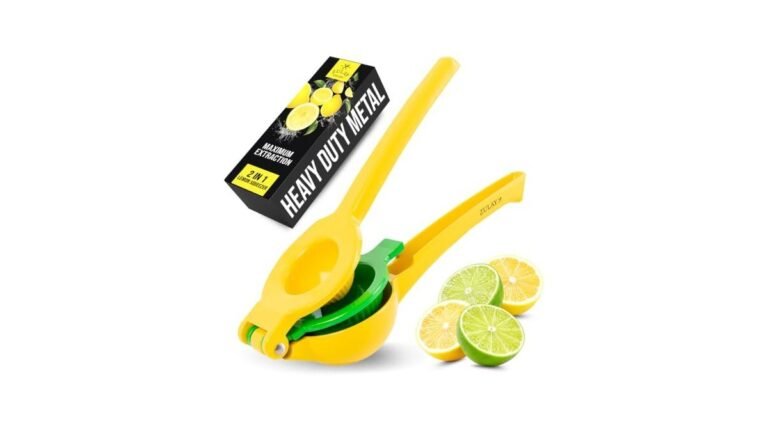
Zulay built this around cast iron and leverage. The 5-inch diameter bowl is sized mainly for citrus, from small limes up to large grapefruits, and the listing says it keeps seeds out and pulp to a minimum. The lever arm gives you mechanical advantage, so thick-skinned fruit gives way with one pull. Rubberized feet keep it planted on the counter. It comes in more than 20 colors.
That 5-inch bowl is the number to check against your fruit. It’s described as handling everything from small limes to large grapefruits, so if your citrus falls inside that range, one tool covers the lot. The listing describes the cast iron body as engineered to handle continuous, high-pressure use for years.
It’s also a manual press, so the volume you get out is the volume your arm puts in. The listing pitches it for busy bars and juice stands as well as home kitchens, and the honest read is that a home kitchen is where it fits best.
What works:
- 5-inch bowl handles limes through large grapefruits
- Cast iron lever arm powers through thick-skinned fruit
- Rubberized feet stop slipping and tipping
- Seeds stay out and pulp is minimized
- Available in more than 20 colors
Where it gives ground:
- Manual operation caps how much fruit you can press in an hour
Skip it if: you want a motor doing the work instead of a lever.
Also Worth Considering
The CO-Z Manual Citrus Juicer is a commercial grade cast iron press with a removable strainer, built for oranges, lemons, and pomegranates. It’s the same manual-press idea as the picks above, with a strainer you can lift out for cleaning.
Its reinforced cast iron is rated to withstand over 2300 psi, and every part that touches fruit is 304 food-grade stainless steel. The lever handle is extra long with a rubber grip, so tough fruit like pomegranates takes less hand strain than a short handle would.
A nonslip suction base holds it steady while you press, and the 5-inch funnel takes everything from small limes to large grapefruits. Detachable parts rinse clean or go in the dishwasher.
The OSTBA Iron Manual Citrus Juicer is another cast iron hand press, this one with a stainless steel cup and strainer, listed for oranges, lemons, limes, grapefruit, and pomegranates.
Its weighted base and comfortable grip handle are meant to keep it from wobbling or sliding during a press. The cup and strainer come out for serving and cleanup, and they’re dishwasher safe.
The VEVOR Commercial Orange Juicer Machine takes a different road entirely. It’s a slow masticating extractor rated at 100W, with a peel collecting bucket and a PC cover, listed for oranges, lemons, and pomegranates.
How to Think Before You Choose
Motor, Lever, or Your Own Arm
The first thing to settle is where the force comes from. A motorized press spins the cone, but on some models you still lower an arm to apply the pressure. A lever press turns your pull into mechanical advantage, and a plain hand press asks your wrist to do all of it. The listings here split cleanly along that line, and the split matters more than any other feature.
Most people should lean toward a motor if they press fruit several times a week, and toward a lever if they press in bursts. The reason is simple: a motor never gets tired, but a lever never needs a cord or a switch that can fail. If you’re pressing four oranges on a Sunday, your arm is fine. If you’re pressing forty on a Saturday, it isn’t.
Before you decide, count the fruits in your usual batch. Cut and press ten of them by hand, one after another, and see how your wrist feels at the end. That number tells you more about which machine suits you than any spec sheet will. If ten felt like work, a motor belongs on your counter.
Matching the Machine to Your Counter
The second trade-off is space and height. Some of these units are built compact for small counters, and one lists a 6 inch cup clearance that grows when you pull the drip tray out. That’s not a small detail — it decides which glass you can juice straight into, and whether you’re pouring from a short cup into a tall one every single time.
Most households should measure their counter first and their glasses second. A machine that doesn’t fit under your cabinets is a machine that lives in a cupboard.
Go and measure two things at home: the free counter depth where the juicer would live, and the height of the tallest glass you’d want to juice into. Write both down. Then check them against the clearance and footprint each listing gives you. That pair of numbers rules out more machines than any review can.
Cleaning, and Who Does It
The third trade-off is what happens after the juice. Some listings here promise dishwasher safe parts — cones, bowls, strainers, splash guards, and fruit domes that go straight in. Others describe removable strainer cones and funnels you rinse by hand. This is the trade-off people underestimate, and it’s the one that decides whether the machine gets used again next week.
Lean toward dishwasher safe parts if you’re the one cleaning up, because hand-washing a sticky strainer at the end of a long day is exactly how appliances end up abandoned. If you’re running a bar, the calculation flips a little: you want parts that come off fast and go back on fast, because you’re cleaning between customers, not after dinner.
Check your own dishwasher before you buy. Count how many of the juicer’s listed removable parts would actually fit on a rack alongside your plates. If the answer is “most of them,” a machine that advertises dishwasher safe parts is doing you a real favor. If the answer is “none,” that promise isn’t worth much in your kitchen.
Who Should Skip These Altogether
None of these machines is wrong — they’re just wrong for some people, and it’s kinder to say so up front.
If you juice two lemons a week for dressing, a simple handheld reamer or a fork does the job and takes up no counter space. The electric models here earn their footprint through volume, not through occasional use.
If you already own a blender or a food processor with a citrus attachment, you may already have what you need without adding another appliance.
Every press in this group is built around halved citrus, and the manual ones are sized for it: a 5-inch bowl or funnel takes everything from small limes to large grapefruits, and nothing wider.
One more case worth naming: if you want juice without any effort at all, the manual presses ask for a pull on the lever every time. The motorized models do that part for you, and the dual-switch safety on the Breville means the cone won’t spin until the arm is lowered with enough pressure on top of it.
And if you’re squeezing for a crowd rather than a glass, the numbers separate the field quickly. A compact electric juicer can run up to 120 oranges per hour, while a semi-automatic machine presses 132 to 176 pounds of fruit in the same hour.
The Breville BCP600SIL Citrus Press is the pick for most home buyers, because the assisted arm and dishwasher safe parts fit an ordinary kitchen routine. For the harder case — a bar or café pressing fruit all shift — the Waring Compact Citrus Juicer is the one built around throughput, with its commercial-grade pace and die-cast base. Whichever way you lean, check the cup clearance and the removable parts against your own counter and glasses before you order, since those two details decide whether the machine earns its place or ends up in a cupboard.
The Breville BCP600SIL Citrus Press suits most home kitchens. Its assisted arm lets you press one-handed, and the cone, collector, filter and fruit dome all go in the dishwasher. A drip stop spout holds juice back so it doesn’t run onto the counter.
For a bar or café pressing fruit all shift, the Waring Compact Citrus Juicer is built around throughput: up to 120 oranges per hour, on a heavy die-cast base with vibration-dampening feet that keep it quiet and stable.
Before you order either one, check two things against your own kitchen. Cup clearance decides whether your tallest glass fits under the spout. Removable parts decide how much cleanup you face after every shift.
Frequently Asked Questions
What do these juicers actually need from me to work?
It depends on the type. The Breville BCP600SIL Citrus Press has a motor, but the listing is clear that you lower the assisted arm and apply downward pressure yourself. The Hamilton Beach 932 is fully manual, with an extractor arm that exerts up to 2,000 lbs. of force. So the real question is whether you want to stand there pressing or just feed fruit in.
What tends to go wrong first with a machine like this?
The parts that move and the parts that get wet. The Zulay Kitchen Cast Iron Juicer is built from cast iron, and the Hamilton Beach 932 uses metal components and an enamel finish. The Proctor Silex 66900 uses a sealed, illuminated switch that’s liquid resistant. Keeping the removable parts clean is the simplest way to protect the rest.
Is the simplest pick here enough for me?
Often, yes. If you press a handful of citrus fruits a few times a week, the Breville BCP600SIL Citrus Press covers limes through grapefruits with one cone, and its parts go in the dishwasher. You don’t need a commercial unit for that. The Waring Compact Citrus Juicer makes sense when fruit goes through in batches, not pieces. Match the machine to your weekly count, not to the biggest number on the page.
What should I confirm before I order?
Three things. First, cup clearance: the Proctor Silex 66900 lists 6 inches, expandable by removing the drip tray, so check your tallest glass against that. Second, warranty: the Breville BCP600SIL Citrus Press carries a 1 year limited product warranty, so read the coverage on whichever model you pick. Third, certification and fit: the Hamilton Beach 932, the Proctor Silex 66900, and the Waring Compact Citrus Juicer all name independent certification, and the Waring is described as compact for small spaces.