The 10 Best Hand Juicers for Lemons and Limes
You’re halfway through a recipe and the lemon on the counter is just sitting there. Maybe you’re making a margarita, dressing a salad, or squeezing lime into a glass of water. Either way you need juice, and a hand juicer will get it out when a knife alone won’t.
That’s usually the moment people start searching for the best hand juicer. The hard part is that these tools split into two very different families — the plier-style squeezers you press together, and the reamer-and-bowl presses you twist or push down on. They also differ in what fruit they take, how they’re built, and whether they come with a warranty worth anything. This page walks through what each listing promises, who each one suits, and what to check before you decide.
All 10 products side by side — scroll sideways to see every column.
| Best Choice | Runner Up | Easiest Squeezing | Best No-Mess Design | Best Heavy-Duty Press | Also Great | Best with Measuring Cup | Also Great | Best for Arthritis Hands | Best Reamer-Style Juicer | |
| Preview |  |  |  |  |  |  |  |  |  | 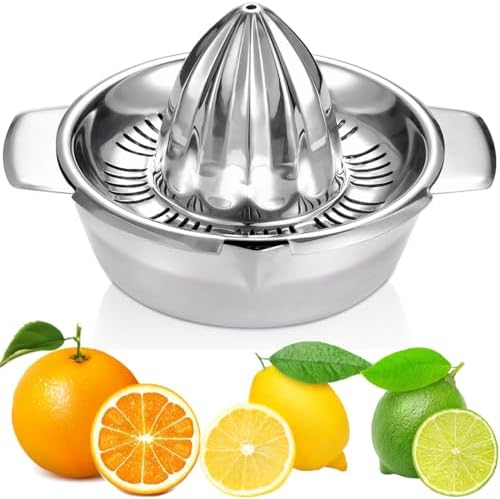 |
|---|---|---|---|---|---|---|---|---|---|---|
| Product | Zulay Kitchen 2-in-1 Squeezer | OXO Good Grips 2-in-1 Juicer | Chef'n FreshForce Squeezer | KitchenAid Citrus Juice Press | Zulay Kitchen Cast Iron Juicer | Rekix Lemon Squeezer | ChefVille 4-in-1 Juicer | RCMo Metal Manual Citrus Juicer | Kensington London Lemon Squeezer | Etinslant Citrus Juicer |
| Brand | Zulay Kitchen | OXO | Chef'n | KitchenAid | Zulay Kitchen | Rekix | ChefVille | RCMo | KENSINGTON LONDON | Etinslant |
| Best for | Best Overall | Best for Oranges and Lemons | Easiest Squeezing | Best No-Mess Design | Best Heavy-Duty Press | Recommended | Best with Measuring Cup | Recommended | Best for Arthritis Hands | Best Reamer-Style Juicer |
| The listing says | 2-in-1 squeezer wastes no drop Easy on hands, works with a soft squeeze | Small reamer for lemons and limes Large reamer for oranges and grapefruit | Dual-gear mechanism gives up to 20% more juice Durable nylon and stainless steel construction | Hopper keeps juice inside, spout for pouring Sits flat on the countertop for leverage | 5-inch bowl handles limes to large grapefruits Cast iron lever arm needs minimal effort | Extracts juice from limes, lemons, small oranges Dishwasher safe or rinse under the tap | 16.9OZ capacity, 40% larger than 12OZ Side-grip design with detachable handle | Produces 20% more juice than other citrus juicers Made of 304 stainless steel | Dishwasher safe or rinse clean Premium 304 stainless steel with reinforced joints | Made of 304 (18/8) stainless steel 11-tooth reamer extracts the juice |
| More information | Check Price on Amazon | Check Price on Amazon | Check Price on Amazon | Check Price on Amazon | Check Price on Amazon | Check Price on Amazon | Check Price on Amazon | Check Price on Amazon | Check Price on Amazon | Check Price on Amazon |
1. Zulay Kitchen Metal 2-in-1 Lemon Lime Squeezer
Right for: Someone juicing lemons and limes most days.
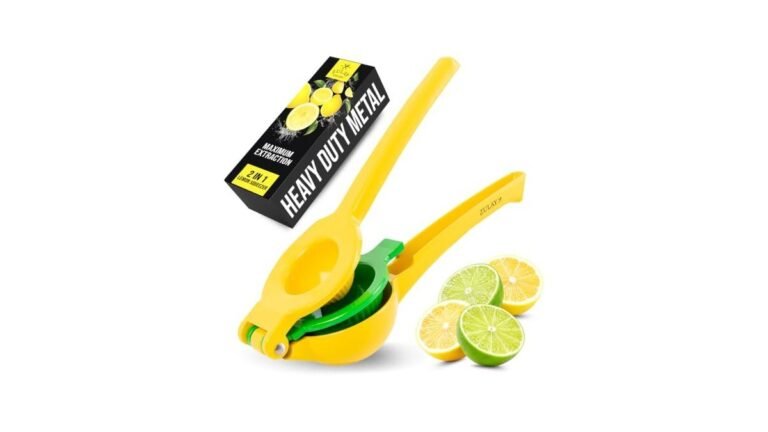
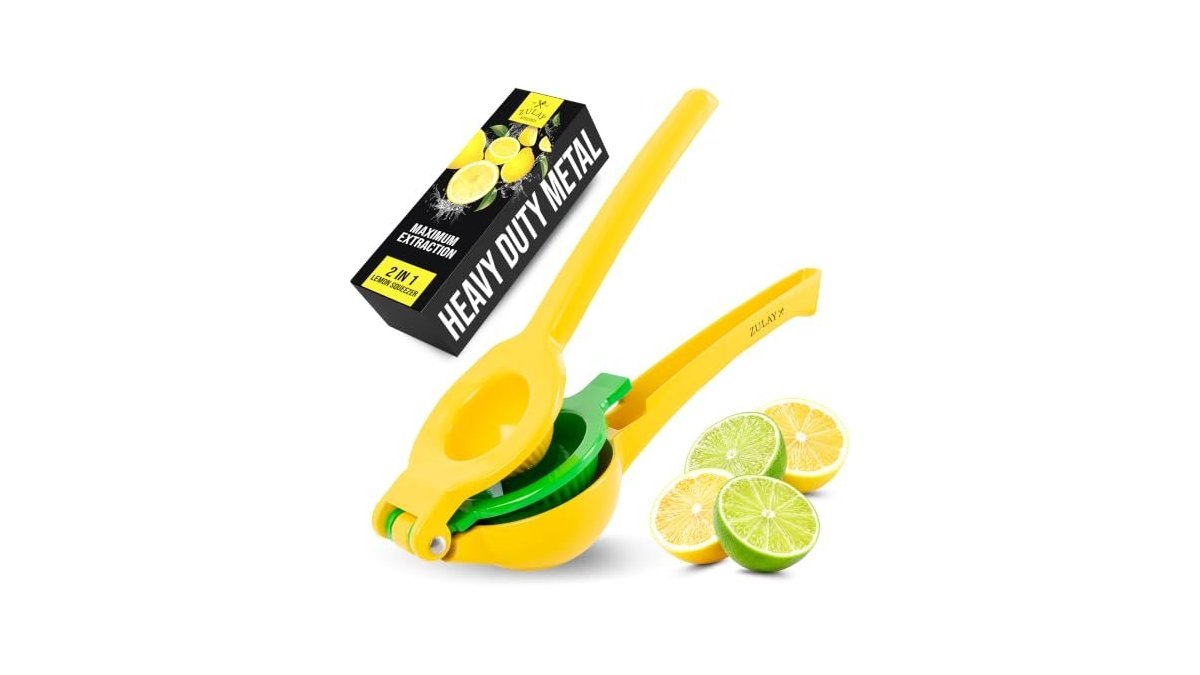
This listing promises a 2-in-1 squeezer that handles limes, lemons, and small oranges, with holes at the bottom of the bowl acting as a seed filter. The seller says the aluminum body carries a food-grade coating, and that the ergonomic handle is comfortable to grip. It’s dishwasher safe, and Zulay backs it with a lifetime guarantee.
On an ordinary day, that means you halve a lemon, drop it in the bowl, and squeeze — no electricity, no batteries, nothing crowding the counter. The seed filter is the detail that matters most in daily use, because seeds in a drink are the small annoyance that makes people stop reaching for a tool. A lifetime guarantee on a kitchen gadget is also unusual.
What works:
- Seed filter keeps pulp and pits out of the glass
- No power, no batteries, nothing to plug in
- Dishwasher safe, or rinse under the tap
- Lifetime guarantee from the seller
- Works on limes, lemons, and small oranges
Where it gives ground:
- Designed for limes, lemons, and small oranges only
- Coated aluminum body, not solid stainless steel
Skip it if: You mainly juice large oranges or grapefruit.
2. OXO Good Grips 2-in-1 Citrus Juicer
Right for: A household that juices both small and large citrus.
OXO’s listing describes a 2-in-1 design where you snap on a small reamer for lemons and limes, or a large reamer for oranges and grapefruit. The body holds up to 1 ½ cups or 350 mL, with measurement markings printed up the side and a drip-free pour spout. The reamers snap off for cleaning and nest inside each other for storage.
That measurement marking changes how you cook, not just how you juice. If a recipe calls for a set amount of juice, you squeeze straight into the bowl and read the level instead of juicing into a separate cup. The drip-free spout matters after that, because pouring from a wide bowl into a small glass is where most of the mess happens. The two reamers are the real reason to pick this one.
What works:
- Snap-on reamers in different sizes cover small and large fruit
- Measurement markings up to 1 ½ cups / 350 mL
- Drip-free pour spout for cleaner pouring
- Reamers snap off and nest for storage
- BPA-free body with a comfortable grip shape
Where it gives ground:
- A bowl-and-reamer design, not a one-hand press
- Storage needs both reamers kept together
Skip it if: You want a single tool you can squeeze with one hand.
3. Chef’n FreshForce Lemon Squeezer Citrus Juicer
Right for: Anyone whose hands tire during a long juicing session.
Chef’n’s listing centers on a patented dual-gear mechanism that the seller says delivers up to 20% more juice than standard citrus squeezers, with less hand strain. It’s built from durable nylon and stainless steel, with non-slip handles and a basket that catches pulp and pits. It’s designed specifically for lemons, key limes, and similar small fruit, and it’s top-rack dishwasher safe.
The gear mechanism is the whole point here, and it’s worth understanding why. That’s the difference between getting through two lemons and getting through a whole bag for lemonade without your grip giving out. The compact size also means it stores in a drawer rather than on the counter.
What works:
- Dual-gear mechanism reduces hand strain
- Seller states up to 20% more juice than standard squeezers
- Non-slip handles for a firm grip
- Basket catches pulp and pits
- Top-rack dishwasher safe and compact to store
Where it gives ground:
- Built for lemons and key limes, not large oranges
- Nylon and stainless steel construction, not all metal
Skip it if: You need a single tool that also handles larger citrus.
4. KitchenAid Citrus Juice Press Squeezer
Right for: Someone who hates cleaning up after juicing.
This listing describes a citrus press with a unique hopper that contains all the juice inside the tool, plus an integrated spout for pouring. It sits flat on the countertop for leverage, which the seller says lets you squeeze more juice out of a lemon or lime. Inside the hopper there’s a built-in strainer that catches pulp and seeds, and the whole thing is dishwasher safe. It’s made from aluminum and nylon, for lemons and limes, and comes with a one-year hassle-free replacement plus a lifetime limited warranty.
The hopper contains all the juice within the press with an integrated spout for pouring.
What works:
- Hopper contains juice with an integrated pour spout
- Sits flat on the counter for added leverage
- Built-in strainer catches pulp and seeds
- Dishwasher safe for fast cleanup
- One-year replacement plus lifetime limited warranty
Where it gives ground:
- Made for lemons and limes, not larger citrus
- Aluminum and nylon body, not stainless steel
Skip it if: You want to juice oranges and grapefruit with the same tool.
5. Zulay Kitchen Cast Iron Juicer
Right for: High-volume juicing, bars, and juice stands.
This listing describes a cast iron press with a 5-inch diameter bowl, built to handle everything from small limes to large grapefruits. The cast iron lever arm delivers mechanical advantage, so the seller says it powers through thick-skinned citrus with minimal effort. Rubberized feet keep it planted on the counter, and the seller positions it for both home and commercial use — bars, juice stands, restaurant kitchens. It’s available in 20+ colors.
A 5-inch diameter bowl designed to handle everything from small limes to large grapefruits. The rubberized feet keep the press firmly planted on your counter.
What works:
- 5-inch bowl takes limes up to large grapefruits
- Cast iron lever arm for serious mechanical advantage
- Rubberized feet stop slipping and tipping
- Built for continuous, high-pressure use
- Available in 20+ colors
Where it gives ground:
- Heavy cast iron, so it stays on the counter
- A press for citrus, not a small handheld tool
Skip it if: You want something light that lives in a drawer.
6. Rekix Lemon Squeezer
Right for: A straightforward metal squeezer for lemons and limes.
Rekix’s listing promises maximum extraction from limes, lemons, and small oranges, with a large 2.8-inch bowl and an ergonomic handle. The seller describes sturdy metal construction and a design meant to extract juice with minimal effort. It’s dishwasher safe or can be rinsed under the tap, and the listing says the handle suits all hands, young and old.
What works:
- Large 2.8-inch bowl for lemons and limes
- Sturdy metal construction
- Ergonomic handle sized for most hands
- Dishwasher safe or rinse under the tap
- Also handles small oranges
Where it gives ground:
- Suited to limes, lemons, and small oranges
- A handheld press, so it needs hand strength
Skip it if: You’re juicing grapefruit or working through large volumes.
7. ChefVille 4-in-1 Orange Juicer Manual
Right for: Campers, party hosts, and anyone who measures juice.
ChefVille’s listing describes a 4-in-1 tool with a 16.9 oz cup that the seller says is 40% larger than the 12 oz capacity of most similar products. The cup carries mL markings so you can measure juice directly, and the set includes two juicing heads — a 12-tooth head for lemons and limes, and a 3-claw head for oranges and larger fruit. It also grates, separates egg yolks, and folds flat for storage, all in food-grade BPA-free PP plastic with a silicone base.
One instruction in this listing is worth reading twice: the seller states clearly that you squeeze using the side grips only, and that the detachable handle is for carrying and pouring, not squeezing. That’s a design you have to learn, and using the handle to press would be the wrong move. Get it right, though, and the measuring cup removes a whole step from making marinades and cocktails.
What works:
- 16.9 oz cup with mL markings for measuring
- Interchangeable heads cover lemons, limes, and oranges
- Also grates and separates egg yolks
- Flip-top design folds flat for drawers
- BPA-free with a non-slip silicone base
Where it gives ground:
- Squeeze with side grips only, not the handle
- Food-grade PP plastic construction, not metal
Skip it if: You want an all-metal tool that lives on the counter.
8. RCMo Lemon Squeezer 304 Stainless Steel Large Metal Manual Citrus
Right for: A buyer who wants solid stainless steel and nothing else.
RCMo’s listing states this squeezer produces 20% more juice than other citrus juicers, and it’s made from 304 stainless steel — described as durable, corrosion-resistant, and non-reactive with fruit juice. The seller mentions an optimal bowl size, reinforced hinges, thick casting, and strong levers, with silicone-bonded handles. It’s for lemons, limes, and other small citrus, and it’s dishwasher safe or rinses under the faucet.
The reinforced hinges and thick casting are the seller’s answer to the part that usually breaks first on a squeezer. This is a tool bought once and kept.
What works:
- 304 stainless steel, resistant to citrus acid
- Reinforced hinges and thick casting
- Silicone-bonded handles for grip
- Seller states 20% more juice than other juicers
- Dishwasher safe or rinse under the faucet
Where it gives ground:
- Made for lemons, limes, and small citrus
- A handheld press, so it asks for hand strength
Skip it if: You need to juice oranges and grapefruit regularly.
9. Kensington London Lemon Squeezer
Right for: Anyone with a weak or painful grip.
Kensington London’s listing says this squeezer is easy to use whether you’re an arthritis sufferer or a weight lifter, and that it’s built from premium 304 stainless steel with reinforced joints. The seller claims half the effort produces over 50 percent more juice than a traditional press. The handles are extra long with silicone grips to prevent slipping, and it’s dishwasher safe. It carries a lifetime warranty.
The extra-long handles are the design choice that makes the rest work. A longer handle means more leverage for the same amount of hand force, which is the mechanical reason this listing can claim easier squeezing. For someone whose hands hurt, that difference isn’t a small comfort — it’s the difference between juicing and not bothering. The silicone grips matter too, because slipping is what makes you grip harder.
What works:
- Extra-long handles for more leverage
- Silicone grips prevent slipping
- 304 stainless steel with reinforced joints
- Seller states over 50% more juice than a traditional press
- Dishwasher safe with a lifetime warranty
Where it gives ground:
- Built for lemons, limes, oranges, and citrus generally
- A handheld press, so it still needs a squeeze
Skip it if: You’d rather push down on a countertop press than squeeze.
10. Etinslant Citrus Juicer
Right for: Someone who prefers a twist-and-press reamer.
Etinslant’s listing describes a manual juicer in 304 (18/8) stainless steel, described as food-grade, solid, and resistant to rust and citric acid corrosion. It uses an 11-tooth pointed cone reamer to extract juice, with a slitted sieve that filters seeds and pulp while letting juice drain fast into the base bowl. There are two pour spouts, two-sided handles, and a 10 oz bowl. The cone is about 2.75 inches tall and the sieve 5.43 inches across, and it’s dishwasher safe. Etinslant offers a 12-month warranty and a 60-day return window.
The slitted sieve is a small detail with a real effect. Round holes let pulp settle and block the flow; slits drain faster and jam less, which is why the seller calls it out. The two spouts let you pour from either side, and the compact dimensions make this one portable for travel and camping. It’s a reamer, so it works by twisting fruit over the cone rather than pressing it flat.
What works:
- 304 (18/8) stainless steel, resistant to citric acid
- 11-tooth cone reamer extracts thoroughly
- Slitted sieve filters seeds and drains fast
- Pour spouts on both sides for easy dosing
- 12-month warranty and 60-day returns
Where it gives ground:
- A reamer design, so it needs twisting motion
- Compact 10 oz bowl, suited to a glass at a time
Skip it if: You want a tool that presses fruit flat for high volume.
Also Worth Considering
Drizom Squeezer Built-in Measuring Cup — This one combines a manual hand squeezer with a built-in measuring cup and a grater, in a 12 oz size. It’s for a buyer who wants to measure juice as they squeeze without reaching for a separate cup, and the grater adds a second job to the same tool. Worth a look if measuring matters more to you than metal construction.
Zulay Kitchen Stainless Squeezer — A stainless steel squeezer with a heavy-duty solid metal bowl, sized large for manual citrus pressing. This suits someone who wants the squeezer style but prefers stainless steel to a coated body. It’s the metal counterpart to the same brand’s 2-in-1 squeezer.
Zulay Kitchen Manual Fruit Juicer — A heavy-duty juice press with a detachable lever and a removable strainer, described as a hand juicer for all fruits. The detachable lever is the interesting part, because it separates for storage and cleaning. Worth considering if you want one press that isn’t limited to citrus.
How to Think Before You Choose
Squeezer or Reamer: Which Motion Suits You
These two designs ask your hands to do completely different things. A squeezer works like pliers — you put a halved fruit in the bowl and close your hand. A reamer works like a pestle — you press a fruit half onto a cone and twist. Neither is better in the abstract, but one will suit you and the other won’t.
Most people should lean toward a squeezer if they juice lemons and limes often, because the motion is quick and the fruit goes straight in. Lean toward a reamer if you juice oranges and grapefruit, where the fruit is too big to fit in a handheld press and the cone does the work instead. Some people own one of each and use them for different fruit, which is a reasonable way to solve it.
Before you decide, check your own hands. Hold a lemon half and squeeze it hard for a few seconds, then imagine doing that twenty times. If your grip tires quickly, the geared squeezers and the extra-long-handled models exist for exactly that reason. If twisting hurts your wrist, go the other way. That quick test tells you more than any description.
What the Tool Is Made From and Why It Matters
Citrus juice is acidic, and acid is what eventually wears down kitchen tools that rely on a coating for protection. The listings here split into three groups: coated aluminum, 304 stainless steel, and food-grade plastic. Each behaves differently over years of use, and the difference shows up long after the first squeeze.
Stainless steel in the 304 or 18/8 grade is the material built for this job. It doesn’t react with fruit juice, it resists corrosion, and it doesn’t need a coating to protect it. Coated aluminum is lighter in the hand and the coating is food-grade, but the coating is the part doing the protecting. Food-grade PP plastic is the lightest option, and it’s BPA-free in the listings here.
Most people should lean toward stainless steel if they plan to use the tool for years, and toward plastic or coated aluminum if they want something light. Check your current kitchen tools for the answer: if a coated pan in your cupboard has scratches through the finish, that’s the same wear pattern to expect. Look at the hinge and the joints too, since that’s where a squeezer usually fails first.
Capacity, Bowl Size, and What Actually Fits
The single most common mistake is buying a juicer that won’t take the fruit you actually buy. Bowl size decides this, and it’s printed in the listings if you look for it. A 2.8-inch bowl takes a halved lemon comfortably. A 5-inch bowl takes a grapefruit half. A 10 oz or 16.9 oz cup decides how much juice you can collect before pouring.
Most people should match the bowl to their most common fruit, not their occasional one. If you juice lemons daily and grapefruit twice a year, buy for the lemon. If you’re making cocktails for a group, capacity matters more than bowl size, because emptying a small bowl every two lemons gets old fast.
Check this at home before ordering. Take the fruit you use most, cut it in half, and measure the cut face with a ruler. Then compare that number to the bowl or sieve diameter in the listing. Add a little room, because a fruit that exactly fills the bowl is awkward to seat. That one measurement prevents most returns.
Who Should Skip These Altogether
A hand juicer is a genuinely useful tool, but it isn’t the right answer for everyone — and knowing when to walk away saves you a drawer full of unused gadgets.
- If you squeeze one lemon a month, a fork or your hands will do the job, and a small manual squeezer is more to wash than it’s worth.
- If you already own a squeezer or reamer that works, replacing it buys you very little unless a specific problem — hand pain, wrong bowl size — is pushing you to switch.
- If you’re juicing for a family every morning, a hand tool will wear you out, and an electric juicer is built for that volume.
- If you want fresh juice for one recipe or one party, a hand tool may be more to wash and store than the occasion calls for.
Frequently Asked Questions
What do I need to have on hand before a hand juicer is useful?
You need ripe fruit and a knife, and that’s about it. Every tool here works on halved citrus, so you cut first and juice second. A cutting board and a glass or measuring cup to catch the juice complete the setup. None of these need electricity, batteries, or assembly. Firm, cold fruit gives up less juice than fruit at room temperature, so roll it on the counter first to soften the flesh.
What tends to go wrong first with a hand juicer?
The hinge and the joints are where a squeezer usually fails, because that’s where the force concentrates every time you press. That’s why several listings here talk about reinforced hinges, thick casting, and strong levers. On coated tools, watch the coating itself; once it wears through, the protection is gone. On reamer-style tools like the Etinslant Citrus Juicer, the cone and sieve are one solid piece of 304 stainless steel, so there’s no hinge to fail.
Is the simplest pick here actually enough?
For most households, yes. If you juice lemons and limes for drinks, dressings, and recipes, a basic squeezer does everything you need, and the extra features on the multi-part tools won’t earn their keep. The Zulay Kitchen 2-in-1 Squeezer is the clearest example — one piece, a seed filter, dishwasher safe, no parts to lose. Where the simple pick stops being enough is volume and fruit size.
What should I confirm before I order?
Confirm three things: the bowl or sieve size, the material, and the warranty. Bowl size decides which fruit fits, so compare it to the fruit you buy most — the Rekix Lemon Squeezer states a 2.8-inch bowl, the Etinslant Citrus Juicer a 5.43-inch sieve, and the Zulay Kitchen Cast Iron Juicer a 5-inch bowl. Material decides how it ages: 304 stainless steel resists citrus acid, coated aluminum relies on its coating, and food-grade PP plastic is BPA-free but lighter. Warranty varies — Zulay Kitchen and Kensington London both state a lifetime guarantee, KitchenAid offers a one-year replacement plus a lifetime limited warranty, and Etinslant offers 12 months with a 60-day return window.
Closing
For most buyers, the Zulay Kitchen 2-in-1 Squeezer covers the everyday job — lemons, limes, small oranges, a seed filter, and a lifetime guarantee behind it. If your hands tire easily or you juice in volume, the Chef’n FreshForce Squeezer and its dual-gear mechanism is the pick for the harder case, and the Zulay Kitchen Cast Iron Juicer is the one for grapefruit and bar-sized batches. Before you order, measure the cut face of the fruit you use most and check it against the bowl size in the listing. That single number settles more decisions than anything else on this page.