10 Best Electric Lemon Juicers for Fast, Easy Juice
1. BLACK+DECKER 32oz Electric Citrus Juicer

Best for: Everyday juicing with easy pulp control
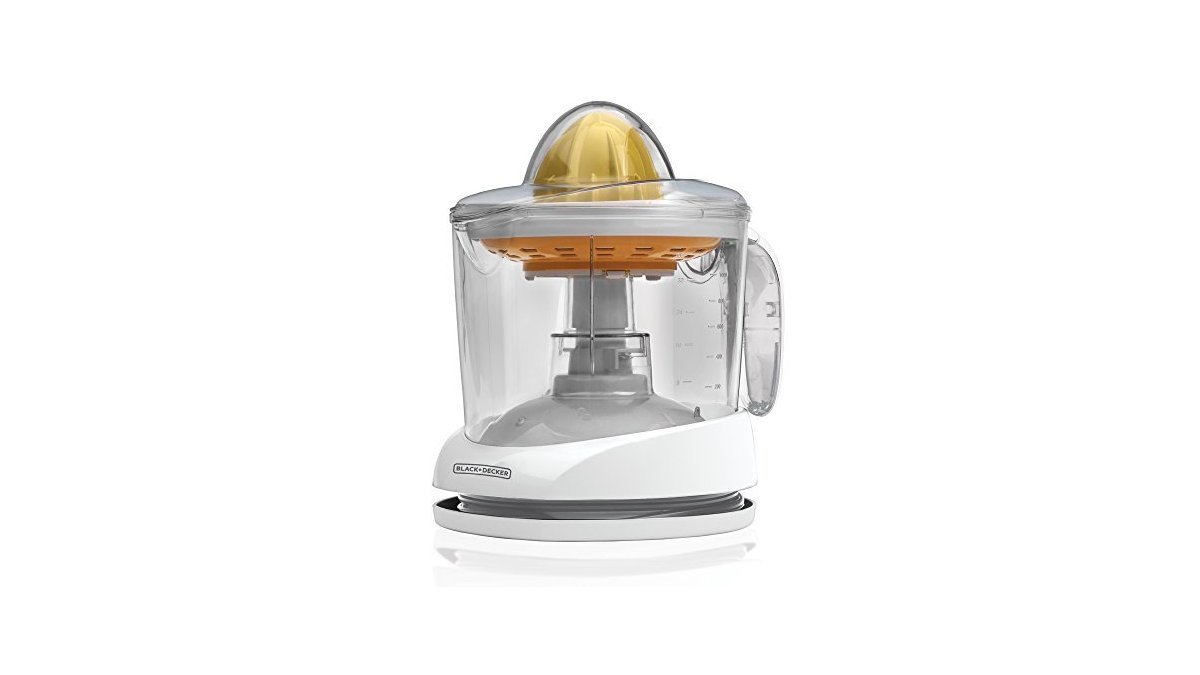
This electric citrus juicer has a 32-ounce container that doubles as a pitcher. You press the fruit half down on the cone and the motor starts. The auto-reversing cones spin both ways to pull more juice from each piece. The pulp basket is removable, so you can toss the pulp or save it for baking and sauces.
The clear container has measurement markings on the side, which matters more than it sounds. When a recipe calls for a quarter cup of lemon juice, you can watch the level rise instead of squeezing into a separate cup and guessing. The container has a handle and a drip-free spout, so you can carry it to the table and pour straight from it.
What you have to accept is that the pulp basket fills up as you work. On a big batch, you’ll stop to empty it.
| What this gives you | What you have to accept |
|---|---|
| Auto-reversing cones for more extraction | Pulp basket needs emptying during large batches |
| Measurement markings on the container | Container is plastic, not glass |
| Pitcher with handle and drip-free spout | No cordless option — needs an outlet |
2. Cuisinart Pulp Control Citrus Juicer

Best for: Buyers who care about pulp level and warranty
Cuisinart built this around three pulp settings — low, medium, and high — set by an adjustable reamer. That’s the feature that separates it from most juicers here. If you like pulp in your orange juice but not in your lemonade, you change one dial instead of swapping parts.
It handles the smallest lime up to the largest grapefruit, so one machine covers your whole citrus drawer. There’s a final-spin feature that pulls extra juice out of the pulp, and a snap-up spout that reaches over tall glasses and stops drips between pours. The parts are dishwasher safe.
The warranty is the other thing worth noting: a limited 3-year warranty from Cuisinart. It’s the only warranty period stated in this group of listings.
Who it fits: Anyone who juices several kinds of citrus and wants to control texture without changing parts.
Who should pass: If you only ever juice lemons and never think about pulp, the three-setting reamer is a feature you’d pay for and not use.
3. Eurolux Electric Citrus Juicer Stainless Steel

Best for: Quiet, powerful juicing in shared spaces
Eurolux lists a 300W motor running at 110 RPM. That’s the power figure the listing prints, and it’s aimed at high-efficiency extraction from oranges, lemons, and limes. The listing also calls out quiet operation, which matters if you juice before anyone else is awake or you share a wall with a neighbor.
The design is hands-free in a different way than a press. You cut the fruit, place it on the cone, close the lid, and press one button. The motor does the rest. There’s no holding and pushing each half down by hand.
The body is stainless steel with a footprint of 22 by 19 by 31.7 cm, so it takes real counter space but not a lot of it. Detachable food-contact parts are top-rack dishwasher safe, and the listing recommends rinsing soon after use to prevent residue buildup. Safety features include secure part locking and rest interval protection, plus BPA-free components and a stable base.
What goes smoothly:
- Operation takes a single press, so your hand does less work per fruit
- 300W motor at 110 RPM for steady extraction
- Stainless steel body wipes down easily
- Top-rack dishwasher safe parts
- Stable base and part locking for safety
What you have to accept:
- Needs an outlet, so it stays on the counter
- The listing advises washing parts soon after use for long-term care
4. Vinci Automatic Citrus Press

Best for: Hands-free juicing with no splashing
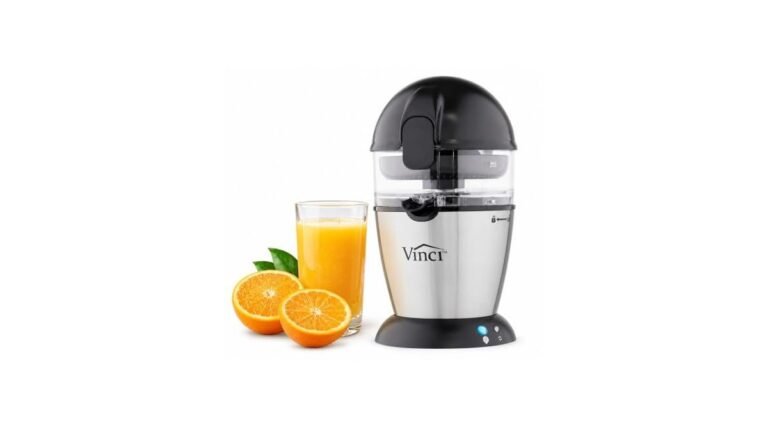
The Vinci is a fully enclosed press. You cut the fruit, place it on the reamer, close the lid, and press the Auto Juice button. The machine presses the fruit inside the chamber in about 10 seconds. No squeezing, no holding, and no splashing on the counter.
The extraction is pressure-sensitive. The listing says the patented technology adjusts pressure based on rind thickness, which helps prevent scraping too deep into the rind — the thing that turns fresh juice bitter. That’s the detail the listing highlights about how this press extracts.
It fits key limes up to grapefruit 4.5 inches in diameter. The Tritan bowl holds 12 ounces and has a locking spout: keep it closed to collect juice, lower it to pour into a glass. Fine and coarse pulp filters are both included, and the lid, bowl, reamer, and filters are top-rack dishwasher safe.
Two things to accept. The 12-ounce bowl means you empty it between batches if you’re juicing for a crowd. And the lid has to be closed and locked for the machine to work, so you can’t watch the juice level rise mid-press.
Snapshot:
- Fully enclosed chamber keeps juice in and splashes out
- About 10 seconds per press cycle
- Pressure adjusts to rind thickness
- Two pulp filters included
- 12 oz bowl with locking spout
- Top-rack dishwasher safe parts
5. KitchenAid Go Cordless Citrus Juicer

Best for: Kitchens with no free outlet nearby
This is the cordless pick. It runs on a rechargeable 12V MAX removable battery that’s included, and it charges by USB cable. No cord means you can juice on the counter, at the table, or anywhere the fruit is.
The reamer auto-reverses for better extraction, and it handles grapefruits, lemons, limes, and oranges. The pour spout is designed to pour straight into a glass with minimal drips. The reservoir bowl, reamer, removable knob, and stainless steel sieve are all dishwasher safe.
In the box you get the juicer, a 16-ounce reservoir bowl, the reamer, the sieve, the battery, and the USB charging cable. That’s a complete setup with nothing extra to buy.
What you accept is battery management. A cordless juicer runs until the charge is gone, and then it needs time on the charger. If you’re juicing a big bag of lemons in one sitting, a corded machine won’t stop halfway.
Who it fits: Small kitchens, RVs, and anyone who wants to juice away from an outlet.
Who should pass: Big-batch juicers who’d rather not think about charge level mid-project.
6. Proctor Silex Alex’s Lemonade Stand 34 oz. Electric Citrus Juicer

Best for: Making lemonade for a crowd
The headline here is the pitcher. It holds more than any other model on this list, it has easy-to-read measurement markings, and it detaches so you can carry it to the table and serve. For lemonade, that’s the whole job in one container.
It comes with two nesting reamers, so it fits tiny Key limes up to grapefruit. The reamer auto-reverses when needed for maximum extraction, and a sliding dial on the side controls pulp — left or right, no parts to swap. Pulp collects in the strainer and you discard it.
The pitcher isn’t only for citrus. The same machine handles salad dressings and marinades, so it earns counter space beyond breakfast drinks.
The listing notes the item is available while supplies last.
The trade-off is size. A full-size pitcher takes up counter and cabinet space, and it’s the bulkiest shape in this group. If you juice one lemon for a recipe, you’re using a machine built for a pitcher of lemonade.
7. Elite Gourmet ETS623 Electric Citrus Juicer

Best for: Small kitchens and dorms
Elite Gourmet lists a 40W motor and compares it to typical 25W citrus juicers, saying the extra power gives faster juice yield. The reamer auto-reverses for better extraction, and activation is push-down, so there’s no button to find with a wet hand.
Capacity is 24 ounces, or 3 cups, which the listing frames as good for 2 to 3 servings. There’s a built-in pour spout and an integrated pulp and seed filter, so seeds stay out of the glass. Removable parts are top-rack dishwasher safe, though the listing recommends hand washing for the longest product life.
The compact body is the point. It fits apartments, dorms, RVs, and small kitchens. It’s BPA-free and ETL listed for safety compliance.
What you accept: 3 cups is a home batch, not a party batch. If you’re making lemonade for a group, you’ll refill and repeat.
What goes smoothly:
- 40W motor with auto-reversing reamer
- 24 oz capacity for 2–3 servings
- Push-down activation, no buttons
- Integrated pulp and seed filter
- Compact footprint for small spaces
What you have to accept:
- 3-cup batches mean refilling for groups
- Hand washing recommended for longest life
8. Martha Stewart Electric Citrus Juicer & Juice Extractor

Best for: Buyers who want two reamer sizes included
This juicer ships with two reamer sizes. One fits limes and lemons, the other fits oranges and grapefruits. You swap the reamer instead of forcing a small fruit onto a big cone, which is the difference between clean extraction and fruit spinning off the cone.
Extraction is press-and-juice: push the fruit onto the reamer and it runs. The removable pulp control filter lets you choose smooth juice or full pulp. The anti-drip spout holds juice until you pour, which helps when you’re measuring for a recipe and don’t want a drip running down the outside of the container.
All removable parts are dishwasher safe, with hand washing recommended. The compact footprint keeps it on the counter within reach, and there’s a non-slip base so it stays put while you press. The finish is linen.
What you accept is that pulp control is a filter you remove, not a dial you turn. That’s one more part to wash and store.
9. SUSTEAS Electric Citrus Juicer

Best for: Fast juicing of both halves of a fruit at once
The dual-head design is the whole idea. Two heads press two fruit halves at the same time, or you can press two different fruits together — lemon in one side, orange in the other. The listing pairs that with a 280W motor at 160 RPM for faster, higher-yield juicing on busy mornings.
There’s also a built-in cutter. You press fruit down and it cuts in half, so you don’t need a knife or a cutting board. The dual cones fit limes, lemons, oranges, and grapefruits up to 3.5 inches in diameter. A built-in strainer catches seeds and thick pulp for less waste.
The spout is a flip-top with a silicone seal: open to pour, close to stop drips. Removable parts are top-rack dishwasher safe, base excluded, and the materials are BPA-free and food grade. The compact body stores easily, and the listing suggests small kitchens, RVs, camping, and narrow counters.
Two limits to accept. The 3.5-inch cone limit means the largest grapefruits won’t fit. And the built-in cutter is one more blade surface to clean by hand, since the base isn’t dishwasher safe.
Snapshot:
- Dual heads press both halves of a fruit at once
- 280W motor at 160 RPM
- Built-in cutter, no knife needed
- Fits citrus up to 3.5 inches
- Flip-top anti-drip spout
- Top-rack dishwasher safe, base excluded
10. Healnitor 150W Electric Citrus Juicer Squeezer with 2 Cones

Best for: Quiet juicing with a stainless steel look
Healnitor lists a 150W motor and a decibel level not higher than 60. That’s the number the listing prints, and it’s the reason this one earns a spot: if noise is your main concern, this is the listing that actually states a figure.
The body is stainless steel wrapped, with a compact shape that fits easily on a counter. It comes with two sizes of juicing head and an upgraded aluminum die-casting handle with new pressing technology, which the listing says handles all types of citrus and improves yield. The anti-drip spout and stainless steel slag tray keep the pour clean.
All removable parts are dishwasher safe, and four non-slip rubber feet hold it steady while you press.
The listing doesn’t mention a juice container capacity, so check that against your batch size before buying.
Also Worth Considering
Homeleader Electric Citrus Juicer — a straightforward orange juicer and lemon squeezer. The title tells you what it does and who it’s for, and nothing more. If you want a basic electric squeezer without extra features, it belongs on your shortlist.
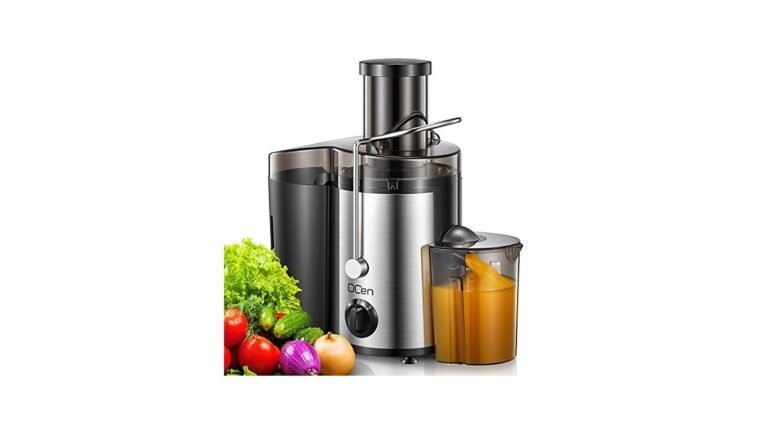
QCen Electric Citrus Juicer — this one lists a rubber handle, two size cones, an anti-drip spout, and BPA-free construction in a black stainless finish. The two cones cover small and large fruit, and the rubber handle is a comfort detail for repeated pressing.
Reemix Electric Citrus Juicer — two interchangeable cones for orange, lemon, and grapefruit, in brushed stainless steel. It’s built for easy cleaning and easy use, and the interchangeable cones cover the same fruit range as the picks above.
The Decision Filter
Start with one question: how much juice do you need in one go? That single answer cuts this list in half. If you’re juicing one or two lemons for a recipe, a compact machine with a small bowl is all you need, and a 34-ounce pitcher just takes up space. If you’re making lemonade or juice for a family, capacity and a pour spout matter more than anything else. If you juice several kinds of citrus, pulp control and reamer sizes decide it. And if your counter has no free outlet, the cordless option solves your actual problem.
Most people miss this: the fruit size range. A juicer that only fits up to a certain diameter will spin a large grapefruit off the cone, and one with a single reamer will fight a Key lime. Check the listed fruit range before anything else.
Then look at what happens after the fruit is cut. A pressure-activated machine starts when you push the fruit down and stops when you lift, so you control the pace by hand. A one-touch or hands-free model closes a lid and runs on its own, which is the difference between standing at the counter and walking away.
Pulp is the third question, and it splits two ways. Some juicers give you settings, low, medium or high, or a fine and coarse filter you swap. Others give you a single basket that collects what you don’t want so you can toss it or cook with it. If you like pulp, settings let you keep it. If you don’t, a basket does the work for you.
Two more details decide daily use. An auto-reversing reamer changes direction to pull more juice from each half, and a drip-free or locking spout keeps the counter clean between pours. Both are worth more than they sound.
Cleanup is where a juicer earns its counter space. Removable parts that are top-rack dishwasher safe get used on a Tuesday. Hand-wash-only parts get left in the cabinet.
The Thirty-Second Checklist
- Will you juice often enough to keep this on the counter?
- Does anyone else in the house need to use it without instruction?
- Will your largest fruit actually fit the listed cone size?
- Do you have a free outlet where you plan to juice?
- Can you wash the removable parts by hand if needed?
- If it’s the wrong one, can you return it easily?
Two of those questions decide more than the rest. If someone else in the house will use it, look for one-touch operation or a press-and-hold lever, because a machine that needs explaining gets left in the cupboard. If your fruit runs from key limes to grapefruit, check that the cones or reamers cover both ends of that range.
On the outlet: one model here runs on a removable 12v battery you charge by USB, so it can move around the kitchen. Everything else needs a cord within reach of where you plan to stand.
On cleanup, some brands recommend hand washing for the longest product life even when the parts are top-rack dishwasher safe. If you know you won’t hand wash, that recommendation matters more than the dishwasher-safe claim.
Three Regrets Worth Avoiding
Regret #1: Buying for batch size you don’t have. A large pitcher is the right call for family lemonade and the wrong call for one lemon in a salad dressing. It takes counter space and cabinet space every day for a job you do twice a month. The fix: count how much juice you actually make in a typical week before you choose capacity.
Regret #2: Ignoring the fruit size range. Listings print the diameter a machine handles, and buyers skim past it. Then a grapefruit doesn’t fit or a lime spins off the cone, and the machine feels broken when it’s working as designed. The fix: measure your most common fruit against the listed range, and check whether two reamers are included.
Regret #3: Not checking the stated warranty. Some listings here print a limited 3-year warranty, and others state no coverage period at all. That gap matters if the motor quits in year two. The fix: read the warranty line before you buy, and treat a stated multi-year warranty as part of what you’re getting.
If You Want This, Look for That
Here’s how to match a feature to the job you actually have.
| If you want… | Look for | Avoid |
|---|---|---|
| Juice for a crowd | 30 oz or larger pitcher | Small bowls you refill constantly |
| Smooth juice, no pulp | Adjustable pulp dial or filter | Fixed pulp with no control |
| No splashing on the counter | Enclosed press chamber | Open cone with no lid |
| Juice away from an outlet | Rechargeable battery included | Corded models only |
| Quiet early-morning juicing | A stated decibel level | No noise information listed |
| One machine for all citrus | Two reamers or a wide fruit range | Single cone with a narrow range |
Two rows deserve a second look, because the listing rarely says what you need in plain words.
On pulp, the mechanism matters more than the label. A dial or a set of filters lets you choose low, medium or high, or swap fine for coarse. A strainer that only catches seeds and thick pulp gives you one result every time. If you like your juice a certain way, buy the control, not the promise.
On fruit size, the range is the tell. A machine that names key limes at one end and grapefruit up to 4.5 inches at the other has already told you it will fit everything between. A single cone with no stated range is a guess you make at home, with fruit already cut.
Capacity is the third number worth checking. Pitchers run from 12 ounces to 34, and a 24-ounce bowl is built for two to three servings. Match that to how many glasses you pour before you stop, not to how many you might pour at a party.
Closing
When two picks still look equal, use this tie-break: pick the one whose stated fruit range covers your largest and smallest citrus. Everything else — pulp control, capacity, cordless freedom — only helps if the fruit actually fits the cone. A machine that handles your whole citrus drawer beats one with a better feature list that can’t take a grapefruit.
Your next step is simple. Cut the list to two using the Decision Filter, then check the fruit range and the stated warranty on each. Those two lines settle most of the doubt.
On fruit range, read the wording closely, because it’s where the listings differ most. One machine names key limes through grapefruit up to 4.5 inches in diameter. Another pairs two nesting reamers, one for small fruit and one for large. A third ships two interchangeable cones, the big one for oranges and grapefruit and the small one for limes and lemons. A fourth covers limes to grapefruits up to 3.5 inches.
If your fruit is bigger than the stated ceiling, no feature on that machine rescues the purchase. If it fits, the rest of the list is yours to weigh.
After that, the buy button takes you to the current listing, where you can confirm the details for yourself before you commit.
Frequently Asked Questions
Will an electric lemon juicer work on limes and grapefruit too?
It depends on the reamer and the listed fruit range, not the motor. Most models here handle limes through grapefruit, but the range is printed for a reason. Some fit fruit up to 3.5 inches, others up to 4.5 inches, and some ship with two nesting reamers. Check the diameter your largest fruit needs.
How much juice does one lemon or orange actually give?
That varies by fruit, not by machine. Auto-reversing cones and final-spin features are the listed ways these models get more of what’s there. A clear container with measurement markings lets you see the yield as you go, so a recipe that needs a quarter cup doesn’t turn into guesswork.
Do I need to peel or cut the fruit first?
You cut the fruit in half, then press the cut side onto the reamer. You don’t peel it — the rind is what you hold and press. One model here has a built-in cutter, so you press the whole fruit down and it halves itself. With the rest, you’ll want a knife and a board within reach.
Are the parts really dishwasher safe?
The listings here say removable parts are top-rack dishwasher safe, and several add that hand washing is recommended for the longest product life. That’s the honest reading: the dishwasher won’t ruin them, but hand washing is gentler. The base and motor housing are never dishwasher safe on any model here. One listing specifically excludes the base. Rinse food-contact parts soon after use to prevent residue buildup, especially around the strainer and spout.
How do I stop juice from dripping down the machine?
Look for a spout that closes or locks. Several models here use an anti-drip or locking spout that holds juice until you pour, and one uses a flip-top with a silicone seal. That’s the feature that keeps counters and hands clean between pours. If clean counters matter to you, treat the spout design as a deciding feature.
What should I check before I buy?
Three things. First, the fruit range, so your largest and smallest citrus fit. Second, the warranty line, since some listings state a limited multi-year warranty and others state no coverage period. Third, the capacity, measured against how much juice you make in one session. Pulp control, cordless operation, and quiet running are real features, but they only matter after those three basics line up with how you actually juice.