Best Commercial Juice Extractor: 10 Picks for High-Volume Juice Bars
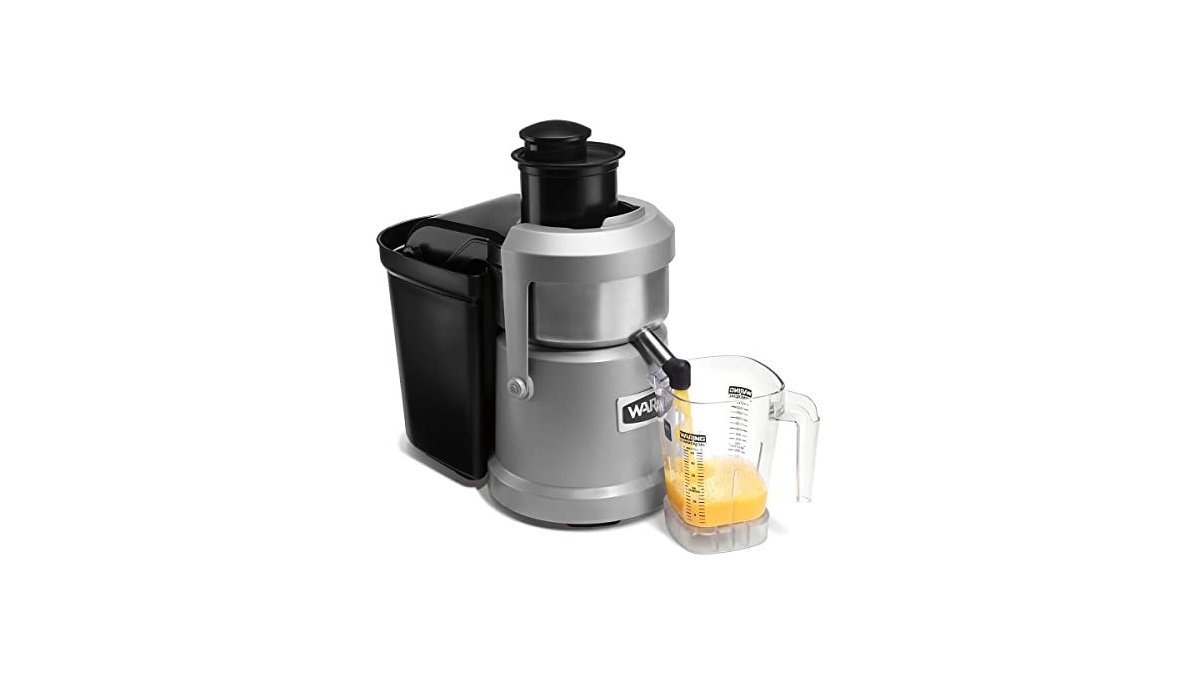
1. Waring Commercial Waring Products WJX80 120V 1.2HP HD Pulp Eject

Right for: High-volume cafes and bars running juice all day.
The Waring WJX80 is a heavy-duty centrifugal extractor built around one job: pushing juice out the door from open to close. It’s aimed squarely at high-volume smoothie shops, cafes, bars, restaurants, hotels, and healthcare establishments — places where juice is a menu item, not a weekend hobby.
What works:
- Continuous pulp ejection keeps production moving without pauses
- 1.2 HP motor built for all-day commercial use
- Stainless steel basket and shredder disc for strong yield
- Dishwasher-safe parts plus an included cleaning brush
- Aimed at high-volume settings like cafes, bars, and hotels
Where it gives ground:
Skip it if: You juice a few glasses a day at home and want something smaller.
2. VEVOR Commercial Orange Juicer Machine
Right for: Shops that sell fresh orange juice by the cup, all day.
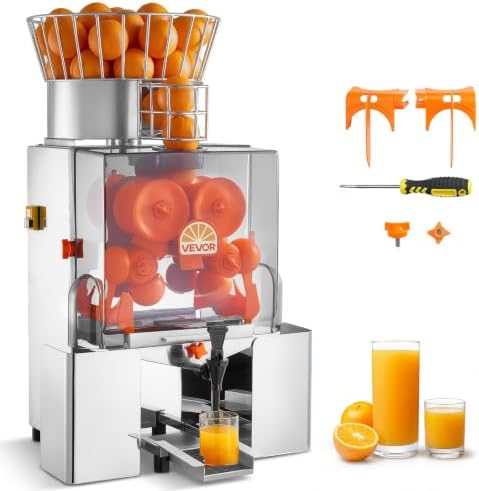
This VEVOR unit does three jobs in one pass: it peels, juices, and filters automatically. A 120W motor drives an upgraded textured juicing wheel, and the listing says it can process up to 20 oranges per minute. The fruit basket up top is large, the feed chute is wide, and it takes soft, juicy fruits between 55 and 80 mm (2.2 to 3.2 inches) across.
Picture a grocery store or juice bar at lunch rush. You dump oranges in the basket, the machine peels and presses them, and a display screen counts how many fruits have gone through — handy for tracking yield per case. The faucet lets you control how the juice flows into a cup, and the pull-out filter box keeps the flavor clean. A pressure sensor stops the machine the moment the transparent cover opens, and the power switch has a water-resistant cover.
What works:
- Automatic peeling, juicing, and filtering in one unit
- Handles up to 20 oranges per minute
- Display screen tracks how many fruits were processed
- Pull-out filter box and detachable parts for easier cleaning
- 304 stainless steel and PC materials on food-contact areas
Where it gives ground:
- Feed chute suits fruits of 55–80 mm
- The listing describes it as suitable for soft, juicy fruits
Skip it if: You need to juice carrots, apples, or leafy greens too.
3. Sunkist Growers J-1 Commercial Juicer

Right for: Citrus-only operations that want a proven, simple press.
The Sunkist J-1 is a citrus press with a chrome finish, and it comes with three interchangeable extracting bulbs. That means you can swap the bulb to match the fruit — oranges, lemons, limes, grapefruits — instead of forcing a single bulb to handle every kind of produce.
What works:
- Three interchangeable extracting bulbs for different citrus sizes
- Listed 20 gallon per hour ability
- Chrome finish suited to front-of-house placement
- 31-pound build that stays put during service
- Citrus press design focused on oranges, lemons, limes, and grapefruit
Where it gives ground:
Skip it if: You need one machine that juices both citrus and vegetables.
4. CMICE Commercial Juicer Machine E2x

Right for: Busy juice bars that need the highest orange throughput.
The CMICE E2x is built around speed. The listing says it can squeeze 22 to 30 oranges per minute, which is the highest figure in this group. A 120W motor is described as more durable for longer continuous working time, and the housing is food-grade stainless steel with an acrylic cover. The concave and convex pressing ball is upgraded to raise the juice rate by 5 percent.
Think about a fruit store on a Saturday. The storage basket sits on top of the machine for fast refilling, the pull-out filter cartridge collects juice and lifts out for cleaning, and two rind collection buckets plus a travel tray are removable. The acrylic cover won’t let the machine start while it’s open, the ON/OFF switch has a cover against water, and a ventilation port helps dissipate heat. It takes oranges from 1.57 to 3.15 inches.
What works:
- Squeezes up to 22–30 oranges per minute
- Upgraded pressing ball raises juice rate by 5 percent
- Top-mounted storage basket for fast feeding
- Acrylic cover stops the machine from starting while open
- Removable rind buckets, travel tray, and pull-out filter cartridge
Where it gives ground:
- Fruit size range of 1.57–3.15 inches
Skip it if: Your volume is modest and you don’t need 30 oranges a minute.
5. Express KitchQuip Commercial Juice Extractor

Right for: Kitchens juicing a wide mix of fruits and vegetables nonstop.
This Express KitchQuip extractor pairs a 3/4 HP motor with automatic pulp ejection, and the listing frames that combination as nonstop operation without constant interruption. It runs on 110V and juices apples, carrots, celery, citrus, leafy greens, and more — a broader produce list than the citrus-only machines here. The body is stainless steel with cast aluminum, and the juice spout can be set in multiple positions.
For a kitchen doing green juice in the morning and apple-carrot in the afternoon, the pulp ejection is the feature that earns its place. You’re not stopping mid-service to clear a basket. The adjustable spout orientation matters more than it sounds: you can aim juice toward whatever container or station fits your counter, rather than rebuilding your setup around the machine.
What works:
- 3/4 HP motor for heavy-duty commercial juicing
- Automatic pulp ejection for continuous operation
- Handles apples, carrots, celery, citrus, and leafy greens
- Stainless steel and cast aluminum construction
- Multiple juice spout positions for flexible setup
Where it gives ground:
- The listing states no fruit-size range or feed chute width
Skip it if: You only press oranges and want a dedicated citrus machine.
6. VEVOR Commercial Orange Juicer Machine

Right for: Shops that want high yield and a slower, physical press.
This VEVOR is a slow masticating machine, and the numbers in the listing are the story. Four rotating shaft assemblies work together to press fruit, and the listing says the physical pressing method can process 132 to 176 lbs (60 to 80 kg) of citrus per hour with a juice yield over 80 percent. A fruit basket on top holds kumquats, lemons, oranges, and more, so you can refill during operation instead of stopping.
The adjustable fitting knob takes different fruit sizes, and the listing notes fruit should be washed, peeled, pitted, and cut to size — lemons are firmer, so it recommends halving them lengthwise. A built-in filter plate separates juice from pulp, with a peel outlet that pairs with a collection bin. The cover is detachable with a feed baffle on top.
What works:
- Listed yield over 80 percent from physical pressing
- Processes 132–176 lbs (60–80 kg) of citrus per hour
- Four rotating shaft assemblies for pressing
- Large top basket allows refilling during operation
- Adjustable knob fits different fruit sizes
Where it gives ground:
- Fruit needs washing, peeling, pitting, and cutting before juicing
- The listing calls it semi-automatic, so feeding still involves hands
Skip it if: You want to drop whole fruit in and walk away.
7. HIFMGHE Commercial Juice Extractor Machine

Right for: Smaller cafes and home kitchens that want commercial-style build.
The HIFMGHE is a centrifugal juicer with a 370W motor running up to 2800 RPM. The listing says juice yield can reach about 75 percent, depending on ingredient type, freshness, moisture content, and preparation. It separates juice from pulp automatically, which cuts the coarse residue in the finished drink, and the polished aluminum housing gives it a solid commercial-style structure with stainless steel in the food-contact areas.
On a normal day, that automatic separation means you’re not straining every batch by hand — a real difference if you’re making several pitchers. The deep feeding port takes larger pieces, and the included push rod guides them down. The extended downward juice outlet aims juice into a cup and reduces splashing around the work area. The blade, filter, and container all detach for cleaning. One thing to plan around: the listing says to allow about 20 minutes of cooling after 20 minutes of continuous operation.
What works:
- Automatic juice and pulp separation reduces manual straining
- 370W motor at up to 2800 RPM
- Listed yield around 75 percent, depending on the produce
- Deep feeding port plus included push rod
- Detachable blade, filter, and container for cleaning
Where it gives ground:
- Needs about 20 minutes of cooling after 20 minutes of running
- Aluminum housing rather than full stainless steel
Skip it if: You need a machine that runs continuously through a full shift.
8. Hamilton Beach Commercial 932 Manual Citrus Juicer

Right for: Bars and cafes that want a manual press with real force.
The Hamilton Beach 932 is a manual citrus juicer, and the listing puts a number on the arm: up to 2000 lbs (907 kg) of force, which it says gives maximum juice output with minimum skin oil and pulp residue. It has an acid-resistant enamel finish over metal components, sure grip feet to stop tipping, and a stainless steel strainer cone with an ABS plastic funnel that both come off for cleaning and sanitizing. It’s NSF certified.
In a bar, that certification and the acid-resistant finish are the practical details. The sure grip feet matter when you’re leaning on a lever with real force — a press that slides mid-squeeze is a hazard as much as an annoyance. And because it’s manual, there’s no motor to cool down or burn out during a rush.
What works:
- Extractor arm exerts up to 2000 lbs (907 kg) of force
- Acid-resistant enamel finish and metal components
- Sure grip feet help prevent tipping during use
- Removable stainless steel strainer cone and ABS funnel
- NSF certified for food service equipment
Where it gives ground:
- Manual operation means every press takes your own effort
Skip it if: You need hands-free volume and can’t spare an operator.
9. Moongiantgo Commercial Manual Juicer
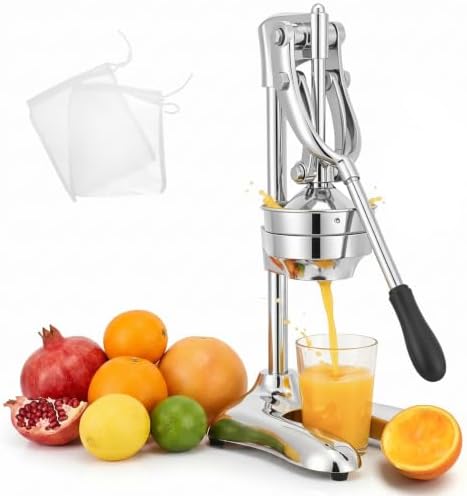
Right for: Small shops that want cold-press juice without electricity.
The Moongiantgo is a heavy-duty hand press built for cold pressing, which the listing says retains the original taste and nutrition. It’s meant for soft fruits — grape, lemon, lime, orange, pomegranate, watermelon, and grapefruit — and comes with two reusable fruit bags for packing small pieces like pomegranate and lime so they don’t move during pressing. The press cover, filter, and funnel are 304 stainless steel; the main body is zinc alloy and doesn’t touch the fruit.
The listing is refreshingly direct about what it won’t do. Don’t squeeze hard fruits like apples or sugar cane, low-water fruits like carrot, or fruits that don’t give juice easily like bananas and mangoes. For a small drink shop, that honesty is useful: this machine is built for citrus and soft fruit, and you plan your menu around that. The thickened base is heavy and stable, and with citrus it’s a one-handed operation.
What works:
- Cold press retains original taste and nutrition
- 304 stainless steel on press cover, filter, and funnel
- Two reusable fruit bags included for small fruit pieces
- Thickened base for stability during pressing
- One-handed operation with citrus
Where it gives ground:
- Not for apples, sugar cane, carrot, bananas, or mangoes
- Main body is zinc alloy, not stainless steel
Skip it if: You want to press hard vegetables or high-volume citrus fast.
10. CO-Z Cast Iron Citrus Juicer

Right for: Home bars and small cafes with limited counter space.
The CO-Z is a compact manual press in reinforced cast iron, and the listing says it withstands over 2300 psi for daily use. All fruit-contact parts are 304 food-grade stainless steel. The extra-long lever handle has a rubber grip for pressing tough pomegranates, a nonslip suction base holds it steady, and the 5-inch funnel takes fruits of all sizes. Detachable parts make cleaning easy, and the stainless steel strainer keeps seeds and pulp out of the glass.
For a home kitchen or a small bar counter, the compact footprint is the point. It presses oranges, lemons, limes, pomegranates, and grapefruit without taking up the space a motorized machine needs. The suction base is the detail that makes a lever press usable — you’re pulling hard on that handle, and a base that holds means you can put your weight into it safely.
What works:
- Reinforced cast iron rated to withstand over 2300 psi
- 304 food-grade stainless steel on fruit-contact parts
- Extra-long lever handle with rubber grip
- Nonslip suction base keeps it steady
- 5-inch funnel fits fruits of all sizes
Where it gives ground:
- Manual pressing means output depends on your own effort
Skip it if: You’re juicing for a crowd and need motorized speed.
Also Worth Considering
The Eapmic 80-100kg/hr Juice Extractor Machine is a 370W centrifugal juicer with a listed 80–100 kg per hour capacity. Its title points to heavy-duty stainless steel construction, separation of slag and juice, a safety guard, 2800 RPM speed, eight juice outlets, and a detachable net. Worth a look if you want a centrifugal machine with a stated hourly figure and multiple outlets.
The LIYUANJUN Commercial Juice Extractor Machine is a 110V, 60Hz, 370W centrifugal juicer built for fruits and vegetables. The title describes heavy-duty stainless steel construction and a centrifugal juice-making design aimed at kitchenware use. A straightforward option if you want a stainless centrifugal machine and can confirm the details with the seller.
The Josbuynls Commercial is a 370W, 110V electric stainless steel juicer for fruit and vegetable, described as a heavy-duty centrifugal machine with juice and residue separated and low noise. If noise during service is a concern for your space, that last point in the title is the one to check first.
How to Think Before You Choose
Continuous Running Versus Cooling Breaks
This is the trade-off that decides whether a machine fits your day. Some listings here describe continuous operation with automatic pulp ejection, and others state a cooling period — one lists about 20 minutes of cooling after 20 minutes of running. If your service runs in bursts with natural gaps, a machine that needs to rest between batches can work fine. If juice flows from open to close with no real pause, a cooling break means either a second machine or a gap in production you have to explain to customers.
Most buyers should lean toward matching the machine’s duty cycle to their busiest hour, not their average hour. The average is comfortable; the rush is where a machine fails. Check your own operation before deciding: count how many minutes in your busiest hour you’d actually be juicing, and whether there’s a natural pause in it. If there isn’t, continuous operation isn’t a nice extra — it’s the requirement that narrows your list to a few machines.
Citrus Press Versus All-Purpose Extractor
A citrus press and a centrifugal extractor do different jobs, and the listings here split cleanly along that line. Citrus machines peel, press, and filter oranges, lemons, and grapefruit, and some list throughput in oranges per minute or gallons per hour. Centrifugal machines take apples, carrots, celery, and leafy greens, with pulp ejection to keep them running.
The right lean depends on your menu. If fresh orange juice is the product, a citrus specialist gives you the throughput and the clean flavor you want, and an all-purpose machine adds capability you’ll never use. If your menu mixes green juice, carrot, and citrus, you need the extractor, and a citrus press won’t cover it. Before you choose, write out every juice you plan to sell going forward. If the list is all citrus, buy citrus. If it isn’t, buy the extractor and accept that it won’t peel an orange for you.
Manual Force Versus Motor Power
Manual presses and motorized machines split on who supplies the effort. The manual presses here list force figures — up to 2000 lbs and over 2300 psi — and they need an operator for every press. Motorized machines list wattage, horsepower, and RPM, and they run on their own once loaded.
Most people running a real juice business should lean motorized, because a manual press only keeps up with low volume. A manual press is the better fit when volume is low, when you want cold-press taste without electricity, or when counter space is tight. Check this at home before deciding: press a few oranges by hand and time it. If a single glass takes you more than a couple of minutes, multiply that by the cups you’d sell in a day. That number tells you whether a motor earns its place on your counter.
Who Should Skip These Altogether
These machines are built for volume, and not every reader needs that. Here’s who should buy something else — or nothing at all.
- If you make just a glass of juice now and then, a simple countertop juicer or a hand squeezer covers it, and a commercial machine just takes up space.
- If you already own a working juicer that handles your menu, keep it — a second machine adds cleaning and storage, not capability.
- If your space has no room for a machine that needs cleaning between batches and a spot for pulp and peel bins, no pick here fixes a layout problem.
- If you’d only use it for a single event or a short season, rent or borrow instead, because storage and upkeep outlast the occasion.
Frequently Asked Questions
What power supply do these machines need?
Most machines in this group run on 110V, which is standard US wall power. The Waring WJX80 is listed at 120V, and the Express KitchQuip and LIYUANJUN are listed at 110V. Check the outlet you plan to use and whether that circuit can carry the machine alongside whatever else runs on it.
How much cleaning does a commercial juicer need each day?
More than most buyers expect. Pulp builds up in filter baskets, strainers, and spouts, and citrus acid sits on surfaces if it’s left. The Waring WJX80 lists dishwasher-safe parts and an included cleaning brush, and the CMICE E2x lists a pull-out filter cartridge with removable rind buckets and a travel tray. Plan on a real cleanup at the end of every shift, not a rinse.
What tends to go wrong first?
The parts that touch fruit and the parts that move. Filter baskets and strainers clog and wear, and motors are the other weak point — the HIFMGHE listing says to allow about 20 minutes of cooling after 20 minutes of continuous operation. Keep fruit-contact parts clean and don’t run a motor past its stated duty cycle.
Is the simplest pick here enough for my shop?
Sometimes, yes. If you sell fresh orange juice and nothing else, a citrus press does the job, and the Sunkist J-1 lists three interchangeable extracting bulbs and a 20 gallon per hour ability. The simplest pick stops being enough when your menu widens or your volume climbs past what a single operator can press.
What should I confirm before ordering?
Confirm four things: the fruit sizes the machine accepts, the power supply and circuit, the duty cycle, and what’s included. The VEVOR orange juicer takes fruits of 55–80 mm, and the CMICE E2x takes oranges from 1.57 to 3.15 inches. If a listing doesn’t state a figure you need, ask the seller before you buy.
The Bottom Line
For most buyers running a real juice operation, the Waring WJX80 is the pick — continuous pulp ejection, a 1.2 HP motor, and dishwasher-safe parts make it the machine that keeps up with a full day. Before you order, write down your busiest hour, your full juice menu, and the fruit sizes you’ll actually buy, then check each against the listing.