The 10 Best Slow Juicers for Fresh, Quiet Juice
Best Slow Juicer
A slow juicer isn’t a blender. It crushes and presses produce at low speed instead of shredding it at high speed. That difference matters, because heat and air are what dull fresh juice. Go slow, and the juice keeps more of what was in the fruit. Go fast, and you get foam, separation, and a drink that tastes tired within the hour.
So what are you really trying to get right with the best slow juicer? It comes down to three things: how much prep the machine saves you, how much juice it actually gets out of the produce, and how willing you’ll be to clean it tomorrow morning. That last one decides everything. A juicer that takes ten minutes to take apart and scrub is a juicer that ends up in a cabinet by week three. The people who juice every day aren’t more disciplined than everyone else. They just own a machine that’s easy to live with.
The one thing that separates a good buy from a bad one here is the feed chute. A narrow chute means you’re standing there with a knife, cutting apples into wedges before they’ll fit. A wide chute takes whole fruit, and that changes how often you’ll actually use the thing. Look at the chute width first, then the strainer setup, then the motor.
You’ll also want to think about what else the machine can do. Some of these press nut milk and frozen sorbet as well as juice, which spreads the value across more of your week. Others are built for juice alone, and do it with fewer parts to wash.
Warranty is the last piece, and it’s the one buyers skip past. Slow juicers have moving parts that wear. A long warranty tells you the maker expects the machine to last. A short one tells you something too.
None of this has anything to do with what the machine costs on any given day. What doesn’t move is what the listing tells you it’s built from, what it does, what it leaves out, and how long it’s covered for. Judge it on that.
1. Anybear 350W Cold Press Juicer 4.9″ inch Feed Juice Sorbet

Best for: Families who want juice, nut milk and sorbet from one machine
This is the 350W model in the Anybear line, and the headline number is the 4.9-inch feed chute. That’s wide enough for whole apples and celery sticks, so you’re not standing at the counter with a knife before you’ve even started. The dual-stage auger runs at low temperature to keep vitamins and enzymes intact, and the motor puts out 230nm of torque, which is what lets it get through ginger and leafy greens without stalling.
The 3-in-1 claim is worth taking seriously. Juice, nut milk and sorbet come from the same setup, with no filter swaps or extra attachments to buy. If you’ve been considering a juicer and a separate nut milk maker, this replaces both with a single machine on the counter. The BPA-free Tritan parts are the same material family used in baby bottles, and the listing says there’s no plastic aftertaste.
| What it gives you | What you accept |
|---|---|
| 5-year warranty and 8-hour support replies | You’ll still disassemble and rinse after every session |
Who it fits: Anyone who wants a single machine handling juice, nut milk and sorbet, and who’ll use the nut milk or sorbet often enough to justify the counter space.
Who should pass: If you only ever make green juice and want the simplest possible clean-up, the extra functions here are parts you’ll wash and never use.
2. Hurom H330 Cold Press Juicer Machine

Best for: Batch juicers who want to load up and walk away
The H330’s selling point is the 2-liter mega hopper. You load whole apples, carrots, celery and leafy greens, press start, and leave it. No pre-cutting, no standing there feeding it one piece at a time. That’s the difference between juicing being a chore and juicing being something you do while you make breakfast. The listing says you can batch a full recipe in one load.
At 50 RPM the auger presses rather than shreds, and Hurom claims up to 65% more vitamins with juice staying fresh up to 72 hours in the fridge. A safety shut-off stops the motor the instant the hopper lid opens, and it restarts when you close it. The detachable power cord is a small thing that makes countertop storage easier.
- What goes smoothly: Self-feeding means no babysitting; quiet enough for a 6 AM start; fine and coarse strainers let you set pulp level; quick disassembly for cleaning; safety shut-off on the lid.
- What you have to accept: The ice cream strainer is sold separately, so sorbet isn’t included out of the box; the 2-liter hopper is a big object on the counter.
The 15-year warranty is the longest here, and it’s backed by a company that’s been building slow juicers since 1974.
3. Anybear 200W Cold Press Juicer

Best for: First-time juicers who want simple and easy to clean
This is the smaller Anybear, at 200W and 180nm of torque, running up to 65 RPM. The listing claims juice yield up to 98.9%. The feed chute is 4.3 inches, which still takes larger fruits and bigger quantities of produce without cutting. For someone moving up from a blender, this is the gentler entry point.
The design here is deliberately simple. A one-piece stainless steel filter, three steps to disassemble, and a single rinse under water with the brush that comes in the box. Fewer parts means fewer places for pulp to hide, and that’s the whole game when it comes to whether you keep juicing. The feed chute component is made from imported USA Tritan, described as baby food-grade.
Snapshot:
- 4.3″ chute handles larger fruits without pre-cutting
- 65 RPM low-speed extraction to limit oxidation
- One-piece stainless filter rinses clean with the included brush
- Three-step disassembly for daily cleaning
- 5-year extended warranty with free replacement available
- Recipe collection included to get you started
The trade-off is scope. This one only makes juice. It doesn’t claim nut milk or sorbet, so if you want those, you’re looking at a different machine. For plain fruit and vegetable juice, though, the simpler build is the point.
4. HEYNEMO Slow Masticating Juicer Machine

Best for: Big households that go through a lot of produce
The 5.9-inch feed chute is a standout width, and that’s not a small detail. Whole apples, carrots and cucumbers go straight in. The listing says this saves prep time while keeping more natural flavor and nutrients in the glass. At 55 RPM the motor runs slow enough to limit heat buildup, and the listing describes the result as smooth, pulp-free juice.
The dual-layer strainer separates pulp in two stages, which is what cuts down on foam and residue. The anti-clogging reverse function is there for the moment something fibrous jams the auger — flip the switch and it clears. The listing also describes a large capacity design that makes enough for the whole family in one batch, and detachable parts that come apart for cleaning.
Who it fits: Families making juice for four or more people at once, and anyone who resents chopping before juicing.
Who should pass: If you juice a single glass for yourself most mornings, the family-size capacity is more machine than the job needs.
The listing positions this for family breakfasts, fitness juicing, offices, dorms and parties.
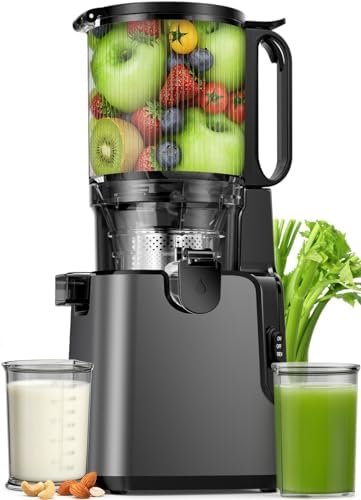
5. YPONE Juicer Machines 2-in-1 Cold Press Juicer Easy to Clean
Best for: Buyers who want nut milk and soy milk alongside juice
The label covers juice, vegetable juice, nut milk and soy milk. That last one is unusual — most machines in this group stop at nut milk. The 5.8-inch feed chute takes whole oranges, apples and celery without pre-cutting, and a smart safety lock stops the machine the moment the lid opens.
At 55 RPM the masticating action avoids heat and oxidation, and the listing describes foam-free juice as the result. The dual-layer 0.3mm mesh strainers are built to reduce clogging and leave no residue, with the listing claiming up to 99% juice yield. Assembly is three main parts with one-button operation, and a cleaning brush comes in the box.
What goes smoothly: 5.8″ chute takes whole fruit; nut milk and soy milk as well as juice; safety lock cuts power when the lid opens; three-part assembly and one-button operation; cleaning brush included.
What you have to accept: The titanium grey finish shows smudges more than a matte body would; the large capacity means it’s sized for households, not single servings.
The listing calls out holiday feasts and a week’s worth of juice as the use case.
6. Hurom H320 Cold Press Juicer Machine

Best for: Committed juicers who want control over pulp level
The H320 gives you a control lever and both fine and coarse strainers, so you set the pulp level to your own taste instead of accepting whatever the machine decides. The listing describes the auger squeezing produce like a hand-squeezer, leaving bone-dry pulp. That’s the detail that matters — dry pulp means the juice is in your glass, not in the waste bin.
The self-feeding hopper fits whole produce, and the inlet is wide enough to add more ingredients while the machine is still running. Juice stays fresh up to 72 hours. The AC motor is described as near-silent, and the listing notes easy assembly for beginners and veterans alike.
| What it gives you | What you accept |
|---|---|
| Add ingredients while it’s running | You’ll still clean the strainer after each session |
Hurom has over 50 years in this category, and the listing frames the H320 as the same juicing performance as the H330 and J2 at a more accessible position in the range. If pulp control is what you care about most, this is the one built around it.
7. Omega J8006 Nutrition Center Quiet Dual-Stage Slow Speed Masticating Juicer

Best for: Buyers who want a long-established dual-stage design
The Omega J8006 is a dual-stage slow speed masticating juicer running at 80 revolutions per minute, with a 150-watt motor. The listing describes it as creating continuous fresh fruit and vegetable juice with high juice yield, and it’s finished in silver.
That’s the listing. It’s a title-only entry in this comparison, so there’s no feature detail beyond the name, the speed, the wattage and the yield claim. What that means for you is straightforward: you’re judging this one on its dual-stage design, its 80 RPM speed and its reputation as a long-running model in the category, not on a list of features the seller has laid out.
Who it fits: Someone who wants a proven dual-stage slow juicer and doesn’t need nut milk, sorbet or a wide-chute feeding system to go with it.
Who should pass: If a wide feed chute matters to you, or you want the machine to do more than juice, the other picks here cover that ground more directly.
8. EanOruus Juicer Machines

Best for: Meal preppers juicing several days ahead at once
The 100-ounce hopper is a standout capacity here, and the listing is explicit about who it’s for: families and serious meal preppers. You load ingredients for multiple days of juice in one go, which means fewer refills and less time standing at the machine. The 6.5-inch feed chute takes whole apples and oranges without cutting.
Interchangeable strainers cover juice and sorbet, and the listing adds nut milk to the list. The AC brushless motor is described as high-torque and whisper-quiet, engineered for heavy daily use. All detachable parts come off for cleaning, including a detachable pulp outlet that the listing says makes cleanup as quick as the juicing.
Snapshot:
- 6.5″ mega-wide chute for whole fruit, no pre-cutting
- 100oz hopper holds multiple days of produce
- Two strainers: juice and sorbet
- AC brushless motor built for daily heavy use
- Detachable pulp outlet for faster cleanup
- Premium gray finish
The honest trade-off is size. A 100-ounce hopper is a serious appliance, and it needs the counter space to match. If you juice one glass at a time, this is more capacity than you’ll fill.
9. LINKChef Cold Press Juicer Machine

Best for: Small kitchens where counter space is tight
The LINKChef runs at 45 RPM, and the listing claims that locks in 100% of the vitamins and enzymes. The self-feeding design pairs with a 4.53-inch chute, so you load whole apples, pears or carrots and walk away while the 200W motor cuts, feeds and extracts.
The vertical footprint is the feature that separates this one. The listing describes a compact, space-saving design that fits under a kitchen cabinet, with fewer individual components so most parts clean with a quick rinse. The 200Nm high-torque motor is claimed to extract up to 30% more juice with bone-dry pulp. A one-touch reverse function handles clogs, and an automatic shut-off safety lid stops the machine if it’s opened.
Who it fits: Anyone in a small kitchen who wants slow juicing without giving up the counter, and who’ll use the nut milk and sorbet functions too.
Who should pass: If you’re juicing for a large family in one session, the compact build is working against you rather than for you.
The kit includes a juice container, pulp cup and recipe book, so you’re not buying accessories separately to get started.
10. SUSTEAS Juicer Machines

Best for: Households that want juice and frozen dessert from one unit
The SUSTEAS covers fresh juice and creamy ice cream, with an upgraded motor the listing says handles fiber-rich leafy greens as well as fruit. The 5.3-inch feed chute takes whole apples, oranges and celery directly, which the listing frames as simple enough for children and seniors to use.
The filtration is the standout detail: a 2mm coarse strainer to prevent jamming, plus 0.8mm and 0.5mm fine filters for smooth juice, with the listing claiming up to 99% yield. Running at 40 to 60 RPM, it crushes produce gently without heat. The 64-ounce hopper holds enough for multiple servings or a large gathering, and cleanup takes seconds with the included brush.
What goes smoothly: Three-stage filtration for smooth juice with less clogging; 5.3″ chute takes whole fruit; 64oz hopper reduces refills; juice and frozen dessert from one machine; brush included for quick cleanup.
What you have to accept: The sorbet function needs frozen fruit prepared ahead; the premium black finish is a fingerprint magnet in a busy kitchen.
The listing pitches this as a gift for weddings, birthdays and housewarmings, which tells you it’s designed to look the part on a counter as well as work there.
The Decision Filter
Answer one question first: will anyone else in the house use this, or is it just you? That single answer cuts this list fast.
If it’s just you, and you drink one glass a day, the compact and mid-size machines are the right shape. A 100-ounce hopper and a 6.5-inch chute are wasted on a single serving.
If a partner or kids will use it too, capacity and a wide chute move to the top of your list. Nobody wants to chop apples at 7 AM before they’ve had coffee.
Most people miss this: the strainer is what you’ll actually spend your time on. A wide chute saves you thirty seconds of chopping. A strainer with three layers and a pulp outlet saves you minutes of scrubbing, every single day.
So ask yourself how many parts you’re willing to wash. That answer rules out more machines than any spec on the box.
If you’ll wash anything, chase yield and capacity. If you won’t, chase fewer parts.
Now the part buyers get wrong. A wide chute and a self-feeding hopper aren’t the same promise. A 4.9-inch or 5.3-inch chute takes whole apples and celery sticks, so you chop less. A self-feeding hopper takes whole produce and lets you walk away while it works. If you juice standing at the counter, the chute is enough. If you want to leave the kitchen, you need the hopper.
Then count the strainers before you buy, because how many come in the box decides what the machine can make. One strainer means juice. Two interchangeable strainers, juice and sorbet, add frozen fruit sorbet. Add a third and you get nut milk as well. If nut milk is the reason you’re shopping, a single-strainer machine won’t do it.
Last, check the warranty against how you’ll use it. Five years covers a light daily habit. Fifteen years is built for a household that runs it every morning.
The Thirty-Second Checklist
- Will you really juice most mornings, or is this a weekend thing? Be honest here. A juicer bought for a habit you don’t have becomes a shelf.
- Does anyone else in the house need to operate it without help? If yes, weight and assembly steps matter more than motor size.
- Will whole fruit actually fit your usual shopping, or will you still chop? A wide chute only saves you time if the produce you buy fits through it.
- Do you want nut milk and sorbet, or just juice? Some machines do all three with no extra attachments. Others need a strainer sold separately.
- Can you spare the counter space for the size you’re considering? A large hopper holds more, but it also takes up more room.
- If it turns out wrong, can you live with the return process? Check the warranty length and how fast support answers before you buy, not after.
Three Regrets Worth Avoiding
Regret #1: Buying a narrow chute and then realizing you’re chopping every single morning. A feed chute under five inches means apples get cut, celery gets trimmed, and the prep takes longer than the juicing. The fix is simple: check the chute width before anything else, and go wide if whole fruit matters to you.
Regret #2: Choosing a machine with too many parts to wash. Slow juicers with multiple strainers, separate pulp cups and detachable outlets clean beautifully in the listing and slowly in real life. The fix is to count the parts you’ll rinse daily, and pick the machine with the fewest you can live with.
Regret #3: Assuming a warranty is a formality. Some of these carry five years, one carries fifteen, and the difference shows up in year three when a part wears. The fix is to read the warranty length as a statement of how long the maker expects the machine to run, and weigh it accordingly.
If You Want This, Look for That
Here’s the short version of what to check before you commit to any of these.
| If you want… | Look for | Avoid |
|---|---|---|
| No morning chopping | Chute over 5 inches | Chutes under 4 inches |
| Juice for a family | Hopper over 60oz | Single-serving capacity |
| Nut milk and sorbet | Two or three strainers | Juice-only designs |
| Fast daily cleanup | Few parts, one-piece filter | Many small detachable pieces |
| Quiet early starts | Low RPM, AC motor | High-speed motors |
| Long-term cover | Multi-year warranty | Short or unclear terms |
The chute number is where most people guess wrong. A 4.3-inch chute takes larger fruits and vegetables, but you still cut the big ones down. At 4.9 inches and up, whole apples and celery sticks go in as they are.
If your counter is tight, remember the chute is only one dimension. A wide chute on a tall vertical body still fits under a cabinet; a wide chute on a wide body may not.
On strainers, check how many come in the box before you buy. One strainer means juice only. Two gets you juice plus sorbet or nut milk. Three, or a fine and coarse pair, lets you dial pulp up or down.
Warranty is the quiet one. Five years is common here. Fifteen years exists, and it tells you who expects the machine to last.
Frequently Asked Questions
Will a slow juicer fit under my kitchen cabinets?
It depends on the model, and the listings give you the shape to judge from. The LINKChef is described as a compact vertical design that takes up minimal countertop space, built for tight kitchens. Larger-capacity machines with big hoppers are taller and wider, and need clearance above them to load produce. Measure your counter-to-cabinet gap before you buy.
Can I put whole fruit in without cutting it?
Only if the feed chute is wide enough, and the widths here range from 4.3 inches to 6.5 inches. The EanOruus at 6.5 inches and the HEYNEMO at 5.9 inches take whole apples and oranges with room to spare. The smaller chutes take larger fruits and bigger quantities, but a big apple may still need halving. Check the chute size against the produce you buy most often.
Do these machines really make nut milk and sorbet?
Several do, and the listings are specific about which. The Anybear 350W, YPONE, EanOruus, LINKChef and SUSTEAS all list nut milk or sorbet functions. The Hurom H330 offers juice and nut milk with an ice cream strainer sold separately. The Omega J8006 is listed as a juicer. If nut milk matters to you, confirm it’s named in the listing before you buy.
How long does the juice stay fresh?
The Hurom models claim up to 72 hours in the fridge, which comes from the low-speed pressing that limits oxidation. Other listings in this group don’t state a storage time, so treat those as juice-to-drink-fresh. A sealed container and a cold fridge will always help, but the 72-hour figure is specific to the Hurom slow squeeze technology.
What happens if something jams mid-juice?
Most of these have a reverse function for exactly that. The Anybear 350W has a “REV” mode to clear jams, the HEYNEMO and LINKChef both list one-touch reverse, and the SUSTEAS uses a 2mm coarse strainer to prevent jamming in the first place. Flip to reverse, let it clear, then carry on. Fibrous greens and ginger are the usual culprits.
Is cleanup really as quick as the listings say?
The listings describe three-step disassembly, one-piece filters and quick rinses, and the part that varies is how many pieces you’re rinsing. The Anybear 200W uses a one-piece stainless filter with a single rinse. The SUSTEAS has three filter layers. The EanOruus adds a detachable pulp outlet. Fewer parts means faster cleanup, so count them before you decide.
Are the materials safe for daily family use?
The listings name BPA-free Tritan, stainless steel and GE-Ultem across several models, and Hurom notes these are the same materials used in baby bottles and aerospace. The Anybear models describe USA-imported Tritan as baby food-grade. If material safety is your priority, look for BPA-free Tritan named in the listing.
Closing
When two picks still look equal, use this rule: choose the one with fewer parts to wash. Everything else — chute width, capacity, motor power — shows up once in a while.
The strainer shows up every single day, and it’s the thing that decides whether the machine stays on your counter or moves to a cabinet.
If the finalists are tied on parts, then take the longer warranty and stop second-guessing.
Your next step is to check the current listing for the model you’ve settled on, confirm the chute width and strainer count match what you need, and read the warranty terms in full before you commit.
One more thing worth doing before you buy: picture the ingredient you actually juice most. If it’s leafy greens or anything fibrous, the reverse function earns its place — it clears a jam mid-batch instead of making you take the machine apart. If you mostly run apples and carrots, that feature will sit unused.
And if the machine is for a household where someone else will be cleaning it, weigh the strainer count for them, not for you.