The 10 Best Lemon Juicers for Easy, Pain-Free Squeezing
You’re halfway through a recipe and it calls for the juice of three lemons. So you cut one open, start squeezing, and feel that dull ache in your hand before you’re even done with the first half. That’s usually the moment people stop and start searching for the best lemon juicer.
The hard part is that these machines split into two very different groups. Some are electric and do the pressing for you, and some are manual tools you work by hand. Within each group, the real differences come down to how much fruit fits at once, how much pulp control you get, and how many parts end up in the sink afterward. This page walks through ten options and what each one actually asks of you.
| # | Product | Best for | |
|---|---|---|---|
| 1 | VINCI Electric Juicer | Top pick | Check Price |
| 2 | Cuisinart Pulp Control Citrus Juicer | Recommended | Check Price |
| 3 | Breville 800CPXL Pro Juicer Machine | Recommended | Check Price |
| 4 | BLACK+DECKER Electric Citrus Juicer | Recommended | Check Price |
| 5 | Healnitor Electric Citrus Juicer | Recommended | Check Price |
| 6 | Elite Gourmet ETS740 Citrus Juicer | Recommended | Check Price |
| 7 | Chef'n Citrus Orange Squeezer Juicer | Recommended | Check Price |
| 8 | Dreamfarm Fluicer Fold-Flat Citrus Juicer | Recommended | Check Price |
| 9 | ASTRALSHIP Machine Electric Orange Lemon | Recommended | Check Price |
| 10 | LEBENLANG Orange Juicer | Recommended | Check Price |
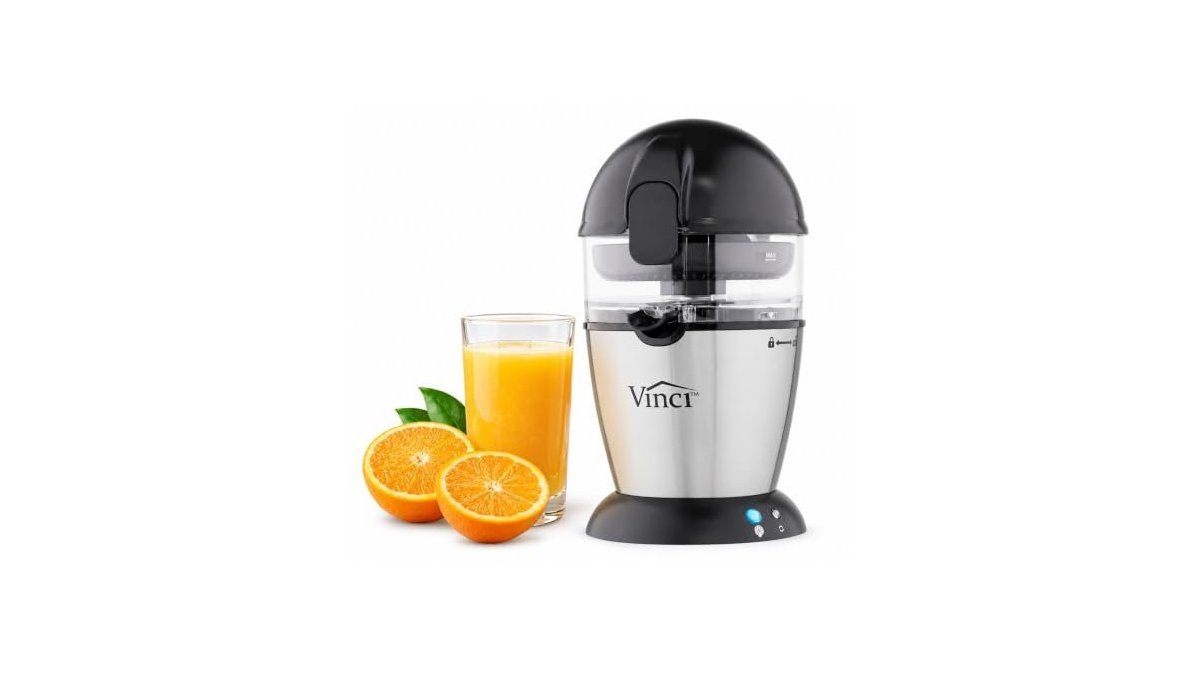
1. VINCI Electric Juicer

Right for: someone who wants juice made without holding anything.
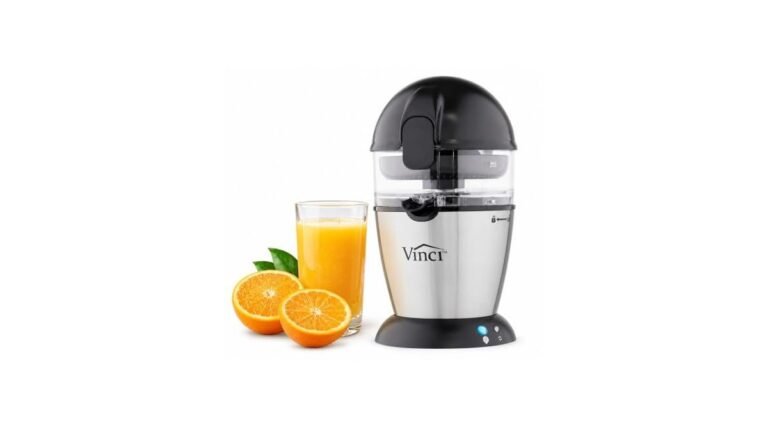
The VINCI works differently from most electric juicers. You cut the fruit, place a half on the reamer, close the lid, and press Auto Juice. The machine presses inside a fully enclosed chamber in about 10 seconds, so there’s no splashing and no hand pressure. The listing says the pressure adjusts to the thickness of the rind, which is meant to stop the reamer from scraping too deep and pulling bitter oils into the juice. It takes fruit from key limes up to grapefruit 4.5 inches across, and the 12 oz Tritan bowl has a locking spout you can lower to dispense straight into a glass.
On a normal morning, that means you can start it and step away for those ten seconds instead of standing there leaning on a cone. The Fine and Coarse pulp filters give you two outcomes rather than a dial, so you pick your texture before you start rather than adjusting as you go. The lid, bowl, reamer and filters are top-rack dishwasher safe. It’s a countertop appliance, so it suits someone who juices most days rather than twice a year.
What works:
- Fully enclosed juicing keeps splashing off your counter
- Pressure adjusts to rind thickness automatically
- Handles key limes through 4.5-inch grapefruit
- 12 oz bowl with a locking, lowerable spout
- Two pulp filters and top-rack dishwasher-safe parts
Where it gives ground:
- Two pulp settings, not a full range of levels
- Needs counter space and a power outlet
Skip it if: you juice one lemon at a time and want nothing plugged in.
2. Cuisinart Pulp Control Citrus Juicer

Right for: the buyer who wants one machine for every citrus size.
Cuisinart’s entry covers the full range from the smallest lime to the largest grapefruit, and it does it with an auto-reversing universal cone. That reversing action is the core of the design: the cone changes direction so it works the fruit from more than one angle rather than spinning one way. You get three pulp settings – low, medium and high – on an adjustable reamer, which is a real step up from a setup that only lets you swap filters. A final-spin feature is listed as extracting more juice from the pulp, and the extra-long snap-up spout is built to clear taller glasses and cut down on drips.
For someone who makes orange juice on Sunday and lemon juice on Wednesday, the three settings are the part that matters day to day. You can go low for a clear glass or high when you want body in a dressing. The parts are dishwasher safe, and the unit carries a limited 3-year warranty. It’s a straightforward countertop machine with no learning curve.
What works:
- Three pulp settings: low, medium, high
- Auto-reversing cone for more efficient juicing
- Final-spin feature pulls more juice from pulp
- Extra-long snap-up spout fits taller glasses
- Limited 3-year warranty
Where it gives ground:
- Spout and cone need a rinse if you juice daily
- Takes up counter room between uses
Skip it if: you want a tool that lives in a drawer, not on the counter.
3. Breville 800CPXL Citrus Press Pro Juicer Machine

Right for: the heavy user who wants a lever doing the pressing.
Breville builds this one around a die-cast lever arm rather than a push-down cone. You lower the arm and the machine takes over, with a triple-hinged design that keeps downward pressure through the whole press. The Quadra-Fin cone is finned and undulated to work fruit of different sizes, and both the cone and the body are die-cast and acid resistant. A dual safety switch means the cone won’t spin until the arm is down and enough pressure is on top of it.
The drip-stop spout holds juice back instead of letting it run onto the counter, and the cone, collector, filter and fruit dome all go in the dishwasher. The listed power is 110 watts at 110 to 120 volts, and it’s covered by a 1-year limited warranty.
What works:
- Die-cast lever arm does the pressing for you
- Quadra-Fin cone works across fruit sizes
- Acid-resistant die-cast cone and body
- Dual safety switch prevents spinning until locked down
- Drip-stop spout and dishwasher-safe parts
Where it gives ground:
- 1-year limited warranty is shorter than some here
- Lever arm needs clearance above the unit
Skip it if: your counter sits under a low cabinet and you need vertical room.
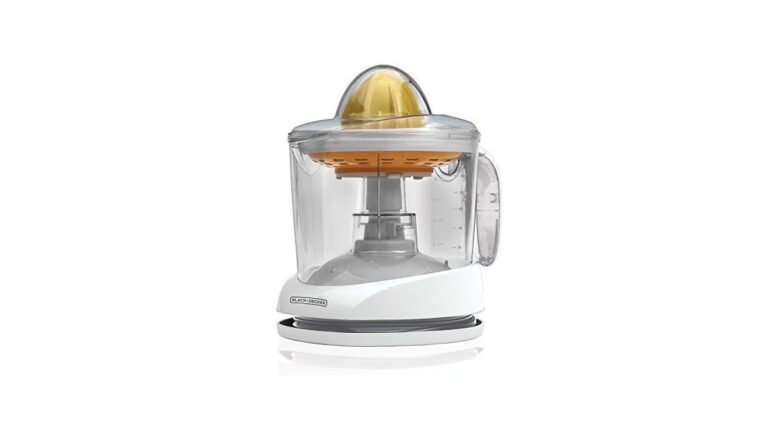
4. BLACK+DECKER 32oz Electric Citrus Juicer

Right for: someone juicing straight into a pitcher for a full recipe.
BLACK+DECKER’s approach is the pitcher. The 32 oz clear container doubles as a jug with a handle and a drip-free pour spout, and it has measurement markings on the side, so you can juice to a line instead of guessing. Auto-reversing cones handle extraction, and the pulp control works through a removable basket – pulp collects in it, and you can either toss it or fold it into another recipe. The clear container means you watch the yield rise with each piece of fruit.
The measurement markings are the practical win here. If a recipe wants half a cup of lemon juice, you squeeze until the line, and you’re done. That beats squeezing into a small bowl and then measuring separately. The pulp basket gives you a third option beyond fine and coarse: keep the pulp and use it. It’s a simple machine with no settings to learn, and the container comes off for pouring and cleaning.
What works:
- 32 oz container doubles as a measuring pitcher
- Pulp basket lets you discard or reuse pulp
- Auto-reversing cones for extraction
- Drip-free pour spout and handle
- Clear container shows yield as you go
Where it gives ground: The clear container is plastic, so it’s the part to handle gently when emptying and washing
- Pitcher design takes more shelf or counter room
Skip it if: you only ever need a tablespoon of juice at a time.
5. Healnitor 150W Electric Citrus Juicer Squeezer with 2 Cones

Right for: the buyer who wants quiet operation and a steel look.
Healnitor lists a decibel level no higher than 60, which is roughly the sound of a normal conversation. That’s the headline here, because most electric juicers make themselves known. The body is stainless steel, and it comes with two juicing heads in different sizes plus an upgraded aluminum die-casting handle and what the listing calls new pressing technology. A 150W motor drives it. The anti-drip spout and stainless steel slag tray are there to keep the pour clean and the pulp contained, and all the removable parts are dishwasher safe.
If you juice early, before the rest of the house is up, the noise figure is the thing you’ll notice most. The interchangeable heads mean you swap them rather than adjust a setting, which is simple but does mean a small part to store. Four non-slip rubber feet keep it steady while it runs, and the compact body is meant to fit easily into a kitchen. It’s a machine for someone who wants the job done without announcing it.
What works:
- Listed at no higher than 60 decibels
- Two juicing heads for different fruit sizes
- Stainless steel shell and slag tray
- Anti-drip spout keeps the pour clean
- Removable parts are dishwasher safe
Where it gives ground:
- Swapping cones means storing the spare head
- No pulp-level dial, just the two heads
Skip it if: you want a single cone that adjusts itself to any fruit.
6. Elite Gourmet ETS740 Citrus Juicer

Right for: a small kitchen or dorm where space is the first concern.
Elite Gourmet builds this for tight rooms. The listing calls it slim and travel-friendly, suited to tiny kitchens, dorms, campers and starter homes, and it keeps countertop use to a minimum. The 1.2L container holds about 5 cups, which the listing puts at 4-5 servings, and it has a pouring spout and handle built in, plus a strainer that collects pulp and seeds. An auto-reversing 40-watt reamer runs the juicing: push down to juice, release to stop. Interchangeable cones cover different fruit sizes, and all detachable parts are dishwasher safe. The listing describes it as BPA-free.
The push-to-run control is about as simple as it gets – there’s no button to find, no setting to pick. For a dorm room or a camper, that’s exactly right. The 1.2L capacity is the other half of the story: it’s built for making a batch for several people at once rather than one glass.
What works:
- 1.2L container holds about 4-5 servings
- Push-down reamer with auto-reversing action
- Built-in strainer collects pulp and seeds
- Slim build suits small kitchens and dorms
- BPA-free, per the listing
Where it gives ground:
- Large container takes up room even when slim
Skip it if: you want a fast motor for juicing in bulk every day.
7. Chef’n Citrus Orange Squeezer and Juicer

Right for: someone who mostly squeezes oranges and large citrus.
Chef’n’s tool is manual and built around size. The listing says it’s designed for larger citrus, with extra bowl depth for high-capacity juicing, so it’s aimed at oranges rather than key limes. A patented dual-gear mechanism is meant to give maximum juice output with minimal force, cutting down on the hand fatigue you get from a plain squeezer. It’s made from reinforced nylon and stainless steel to stand up to frequent use, and the listing promises no seeds and no splatter. It’s top-rack dishwasher safe.
The gear mechanism is the part that changes the experience. The listing says the dual-gear system gives maximum juice output with minimal force. For anyone who makes orange juice a few times a week, that’s the difference between a chore and a habit. At 15 inches it’s a long tool, so it’s built for reach and leverage rather than drawer compactness. It’s manual, so there’s nothing to plug in.
What works:
- Dual-gear mechanism cuts hand fatigue
- Extra bowl depth for larger citrus
- Reinforced nylon and stainless steel build
- Listed as no seeds and no splatter
- Top-rack dishwasher safe
Where it gives ground:
- 15-inch length needs drawer or hook space
- Manual action means you still do the work
Skip it if: you want the machine to do all the pressing for you.
8. Dreamfarm Fluicer Fold-Flat Citrus Juicer

Right for: the cook who wants a juicer that disappears into a drawer.
The Fluicer folds completely flat. That’s the whole idea: the listing calls out its slimline design and says it stores without bulky humps or bumps in your drawers. It’s been featured as one of Time Magazine’s Top Inventions of 2023 and Food & Wine’s 2026 Kitchen Favorites, per the listing. The mechanism is hinged and presses the fruit from the sides, the way your hand would, rather than squashing it flat like a traditional press – which the listing says takes less force. A built-in pip catcher strains the juice and doubles as a funnel to direct the flow into a glass or small bowl. It’s recommended for lemons and limes, and it’s 10 inches.
The side-pressing action is worth understanding before you buy. Because it works the fruit the way a hand does, the force needed drops, and that matters if you’re juicing several lemons in a row. The pip catcher as funnel is a small design choice that saves you dirtying a second vessel. It’s manual and made for lemons and limes specifically, so it’s the tool for a cook who wants fresh juice in small amounts without hauling out an appliance.
What works:
- Folds flat for drawer storage
- Hinged side-press needs less force
- Built-in pip catcher doubles as a funnel
- Recommended for lemons and limes
- Compact 10-inch size
Where it gives ground:
- Made for lemons and limes, not large citrus
- Manual, so one fruit goes in at a time
Skip it if: you need to juice grapefruit or make a full pitcher.
9. Astralship Citrus Juicer Machine Electric Orange & Lemon Squeezer

Right for: the family that wants a full pitcher every morning.
ASTRALSHIP lists an 80W high-torque motor and says a glass takes about 30 seconds, with pressure activation – press the fruit onto the cone to start, release to stop. Interchangeable nesting cones cover the range: the small cone alone for limes and lemons, the large cone snapped on top for oranges and grapefruit. The 24 oz pitcher has measurement markings, an ergonomic handle and an integrated pulp strainer that blocks seeds and thick pulp as you go. A right twist detaches the pitcher for drip-free pouring. The stainless steel casing sits on a weighted motor base for stability, and the dust cover, juicing attachments, pulp filter and container are all top-rack dishwasher safe.
The nesting cones are the detail to note at unboxing – the small cone ships inside the large one, so you pull them apart before first use. Day to day, the 24 oz pitcher is the point: it’s sized for several glasses, so one session covers the whole family. The weighted base matters more than it sounds, because a light juicer that slides while you press is a genuine annoyance. The dust cover keeps it hygienic between uses.
What works:
- 80W motor, listed at about 30 seconds per glass
- Two nesting cones for limes through grapefruit
- 24 oz pitcher with measurement markings
- Integrated pulp and seed strainer
- Weighted stainless steel base for stability
Where it gives ground:
- Cones ship nested and must be separated first
- Pitcher locks with a twist, so assembly matters
Skip it if: you want a compact unit and don’t need 24 oz at a time.
10. LEBENLANG Orange Juicer Electric

Right for: a single person or couple who wants a small, stable machine.
LEBENLANG lists two directions of rotation for maximum yield, so you press lightly and the machine does the rest. Two pressing cones in different sizes cover oranges, lemons, limes and grapefruits. The 24 oz container is removable, transparent and has a measuring scale, and the listing says it’s 100% BPA-free and food-safe. An anti-pulp system pushes most of the pulp out at the sieve, so you get clear juice with minimal residue. Non-slip rubber feet keep it stable while squeezing, and it’s compact and lightweight. The dishwasher-safe parts come apart for cleaning.
The two-direction rotation is the feature that separates it from a basic single-direction reamer, because working the fruit both ways tends to leave less behind in the shell. The anti-pulp system suits anyone who wants a clean glass rather than a cloudy one. It’s described as compact, light and ready in a few simple steps, which fits a small kitchen or a single-person household where a big appliance would be overkill. The rubber feet mean it stays put on a smooth counter.
What works:
- Two rotation directions for higher yield
- Two cones cover oranges through grapefruit
- 24 oz removable container with measuring scale
- Anti-pulp system for clearer juice
- Non-slip feet and dishwasher-safe parts
Where it gives ground:
- Lightweight build, so press evenly
- Compact size suits smaller batches
Skip it if: you want a heavier, fixed machine for daily bulk juicing.
How to Think Before You Choose
Electric Versus Hand Power
This is the first fork in the road, and it decides everything after it. An electric juicer does the pressing, so your hand and wrist stay out of it. That matters most when you’re juicing several fruits in a row, or when grip strength is an issue. A manual tool asks you to supply the force, and in return it stores in a drawer, needs no outlet, and has no motor to fail. Most people should lean electric if they juice more than a couple of times a week, or if they’re making juice for more than one person. Lean manual if you squeeze a lemon into a recipe now and then, or if counter space is genuinely tight. One thing you can check at home: count how many times last week you needed fresh citrus juice. If it’s under three, a manual tool will do everything you need. If it’s most days, the pressing is the part you’ll want off your hands. There’s no wrong answer here, only a mismatch between the tool and the habit.
How Much Fruit Fits at Once
Capacity is the quiet decider. A juicer with a small bowl or a single-fruit press means stopping to empty and reload, and that pause adds up over a batch. A larger container lets you keep going and measure as you pour. Think about your actual unit of juice: one lemon for a dressing, or a full pitcher for breakfast. The listings here range from a 10-inch manual tool for lemons and limes up to containers holding 24 oz, 32 oz and 1.2L. Before you decide, find your largest measuring jug and note the line you usually fill to for juice. That number tells you which containers are big enough and which will have you emptying mid-job. If you cook for one, a small capacity is fine and keeps the unit compact. If you make juice for a family, a bigger container saves you a second round.
Cleaning and Where It Lives
The part nobody thinks about until the third use is cleanup. Citrus pulp dries hard and sticks, so the number of removable parts and whether they’re dishwasher safe decides how often you’ll actually reach for the machine. Every electric model here lists dishwasher-safe removable parts, but the counts differ – some have a cone, bowl and filter, others add pulp baskets and dust covers. Manual tools are usually one or two pieces and rinse in seconds. Then there’s storage. A machine with a 24 oz or 32 oz pitcher and a weighted base needs counter or cupboard room, while a fold-flat manual tool slips into a drawer. Check the height of the space where it will live, including any lever arm that needs clearance above it. A juicer that’s awkward to clean or store is a juicer that stays in the cupboard.
Who Should Skip These Altogether
The listing recommends this for lemons and limes.
- If you need a squeeze of lemon once a month, a plain hand reamer or bottled juice serves you better than any machine here.
- If you already own a blender or a stand mixer with a citrus attachment, that setup likely covers what you need without another appliance.
- If your kitchen has no free outlet or counter space, a manual squeezer fits where an electric juicer simply can’t go. If you’re buying for one holiday recipe and nothing after, borrow one or choose a manual tool rather than an appliance.
Frequently Asked Questions
What do I actually need to run an electric citrus juicer?
An electric juicer needs a free outlet and enough counter space for the base plus the container. The Breville 800CPXL lists 110 to 120 volts, for example. A unit with a 24 oz pitcher and a weighted base takes real room, so measure your counter or cupboard first.
How much work is it after the juice is made?
Cleanup is the honest cost of any electric juicer. Every electric model in this list has removable, dishwasher-safe parts, so the routine is: take it apart, rinse the pulp off, and load the top rack. The one thing to watch is the pulp basket on models like the BLACK+DECKER CJ625 – empty it before it dries.
What tends to go wrong first with these machines?
The parts that touch citrus most often are the ones to watch, because citric acid is corrosive over time. The Breville 800CPXL specifically lists an acid-resistant die-cast cone and body. Rinsing parts promptly and not forcing fruit onto a cone at an angle will get you the longest life.
Is the simplest option here enough?
Often, yes. The Elite Gourmet ETS740 uses a push-down reamer with no settings at all – push to juice, release to stop. The trade-off is control: no pulp dial means you take the texture the strainer gives you.
What should I confirm before ordering?
Check three things. First, the fruit size range – most models here take limes through grapefruit, but the Dreamfarm Fluicer is recommended only for lemons and limes. Second, the container size against your usual batch. Third, the warranty: the Cuisinart CCJ-500P1 carries a limited 3-year warranty, while the Breville 800CPXL lists a 1-year limited warranty.
Conclusion
Pick the one that matches how often you actually cook, then try it on a single lemon before committing to a whole batch. If it feels awkward, you’ll know within a minute. A tool you don’t dread reaching for is the one you’ll keep using.