Best Electric Orange Juicers: 5 Picks for Fresh Juice
Best Electric Orange Juicer
Fresh orange juice is one of those small daily pleasures that’s easy to get wrong. You buy a bag of oranges, you squeeze two by hand, your wrist aches, and the rest of the fruit sits in the bowl going soft. That’s usually the moment people start looking for an electric juicer. The goal isn’t complicated: you want juice in the glass, not on the counter, and you want it fast enough that you’ll actually do it again tomorrow.
The tricky part is that “electric orange juicer” covers a few different machines. Some are press-style juicers with an arm you pull down. Others are hands-free models with a lid and a button. They all squeeze citrus, but they ask different things of you while they do it. That’s the real dividing line, and it’s the thing worth getting right before you buy.
Here’s what separates a good buy from a bad one. It isn’t the motor size on the box. It’s whether the machine matches how you’ll actually use it. If you juice two oranges at breakfast, a compact press that lives on the counter is fine. If you make a pitcher every weekend, you need a bigger bowl and a spout that pours without dripping. If you hate the sound of a motor and the feel of holding fruit, a hands-free model changes the whole experience.
Then there’s cleanup, which is where most juicers quietly fail. A juicer with parts that go in the dishwasher gets used. One with fiddly bits you have to scrub by hand gets pushed to the back of a cabinet. So check what comes apart, and check what the maker covers it with. A one-year warranty and a three-year warranty tell you different things about how confident the brand is.
This guide walks through the best electric orange juicers, sorted by what they’re genuinely good at. No hype, no invented claims — just what each listing says, and who each machine suits.

- Motorized juicer makes fresh juice from lime to grapefruit
- One-handed operation of the juicer press
- Finned juicing cone and fruit dome grip the fruit
- Safety switch stops the cone until the arm is lowered
- 300W industrial strength motor
- One-hand juice pressing arm
- Die-cast construction with a fully stainless steel body
- Suction cups and a no-drip spout lock

- Cut citrus in half, close the lid, press Auto Juice
- Juicer presses the fruit in about 10 seconds
- Automatic juicing adjusts pressure to the rind thickness
- Juices citrus up to 4.5 inches in diameter

- Handles the smallest lime to the largest grapefruit
- 3 pulp control settings: low, medium, high
- Auto-reversing universal juicer cone
- Final-spin feature extracts more juice from pulp

- Auto-reversing juicing cones for maximum juice extraction
- Adjustable Pulp Control with a removable pulp basket
- Markings on the clear juice container
- Drip-free pour spout with handle
1. Breville BCP600SIL Citrus Press Motorized Orange Juicer
Best for: One-handed daily juicing for one or two people
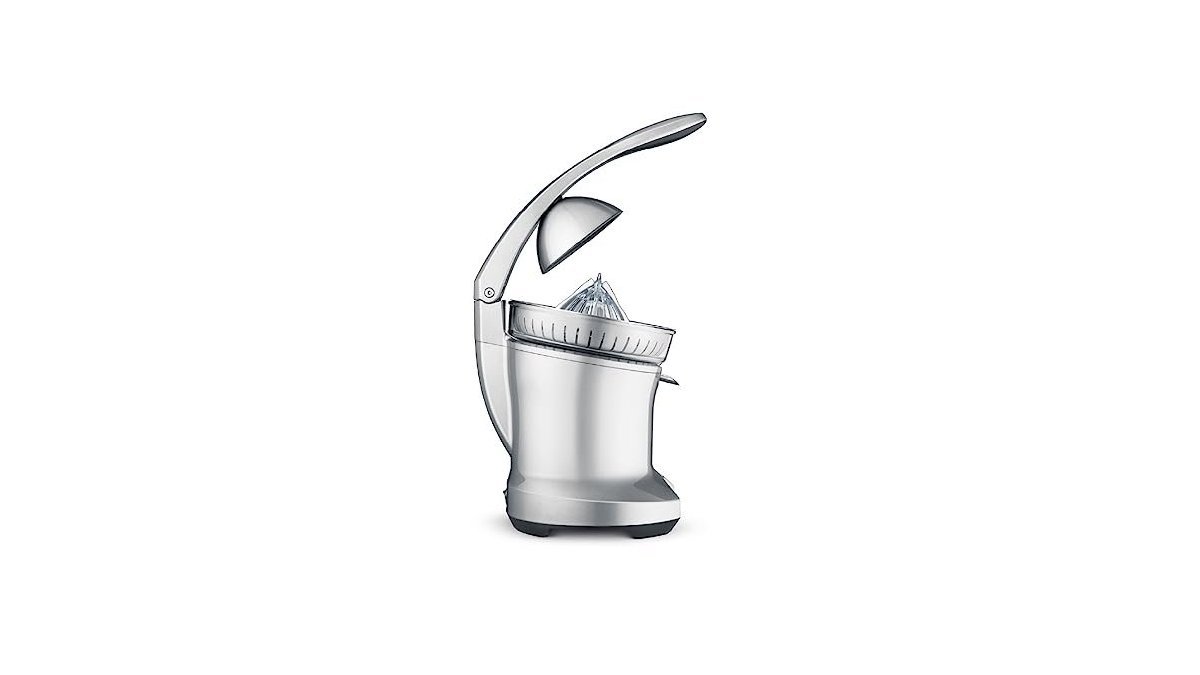
The Breville BCP600SIL is a motorized press with a finned juicing cone and a fruit dome that grips the fruit while the arm presses down. The feature that would change a buyer’s mind is the dual switch safety system: the cone won’t spin until the arm is lowered and enough pressure is on top of the fruit. That’s a real safety detail, and it also means the machine only runs when you’re actually pressing. A one-size-fits-all cone handles everything from the smallest lime to the largest grapefruit, and the drip stop spout holds juice back so it doesn’t run onto your counter.
In daily use, this is a machine you operate with one free arm. You cut the fruit, place it on the cone, lower the handle, and the assisted arm does the pressing. The juicing cone, juice collector, juice filter, and fruit dome are all dishwasher safe, so cleanup is mostly a matter of lifting parts off and loading them. It’s a countertop appliance, not a cabinet one, and it’s covered against defects for a full year of normal use.
| What it gives you | What you accept |
|---|---|
| Assisted arm presses the fruit for you | One-year limited warranty |
| Dual switch safety — no spin until pressed | 110-watt motor |
| Drip stop spout keeps the counter clean | — |
| Cone, collector, filter and dome are dishwasher safe | — |
2. Eurolux Die Cast Stainless Steel Electric Citrus Juicer Squeezer
Best for: Buyers who want a sturdy stainless steel body
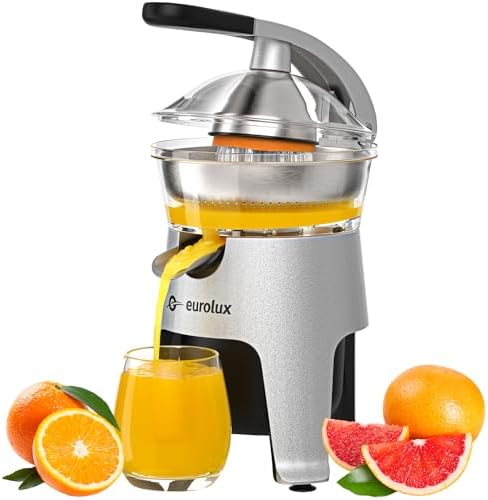
The Eurolux Die Cast Juicer leads with a 300-watt industrial strength motor. The body is die-cast with a fully stainless steel finish, so it’s built to sit out on the counter and look like it belongs there. Suction cups hold the base steady while you press, and a no-drip spout lock keeps juice from escaping between pours.
Owning this one is about the pressing arm. It’s a one-hand operation, so you hold the fruit steady and let the arm do the work rather than leaning your whole body into it. The listing also includes two stainless steel filter sizes so you can choose how much pulp ends up in the glass. Eurolux leans on its 30-plus years in the category as the reason to trust the build.
What goes smoothly:
- 300-watt industrial strength motor
- Suction cups keep the base locked to the counter
- No-drip spout lock stops messes between pours
- Interchangeable stainless steel filters give you pulp control
- One-hand pressing arm means less strain
What you have to accept:
3. Vinci Hands Free Juicer
Best for: Anyone who wants zero hands-on squeezing
The Vinci Hands Free Juicer is the odd one out here, and that’s the point. You cut the citrus in half, place it on the reamer, close the lid, and press the Auto Juice button. The machine presses the fruit inside a fully enclosed chamber in about 10 seconds. Nothing splashes, and you never hold the fruit while it’s being squeezed. The pressure-sensitive extraction adjusts to the thickness of the rind, which the listing says helps prevent scraping the pith too hard and pulling bitter flavor into the juice.
The capacity detail is worth noting: the Tritan bowl holds up to 12 ounces, and the spout locks so you can collect juice in the bowl or lower it to pour straight into a glass. It handles key limes up to grapefruit at 4.5 inches in diameter. You get both fine and coarse pulp filters, and the lid, bowl, reamer, and filters are top-rack dishwasher safe. This is the pick for someone who wants juice without the ritual of pressing.
Snapshot:
- Fully enclosed juicing — no splashing on the counter
- Auto Juice button does the pressing in about 10 seconds
- 12 oz BPA-free Tritan bowl with a locking spout
- Fine and coarse pulp filters included
- Fits key limes up to 4.5-inch grapefruits
- Removable parts are top-rack dishwasher safe
4. Cuisinart Pulp Control Citrus Juicer
Best for: Buyers who care most about pulp settings
The Cuisinart CCJ-500P1 gives you three pulp control settings — low, medium, and high — on an adjustable reamer, plus an auto-reversing universal cone that changes direction to work the fruit more evenly. For anyone who likes a little pulp in the glass but not too much, that dial is the reason to pick this one. It takes the smallest lime to the largest grapefruit, and a final-spin feature extracts more juice from the pulp left behind. There’s also an extra-long snap-up spout that fits taller glasses and helps prevent drips.
The thing that stands out beyond the juicing itself is the coverage. This juicer carries a limited 3-year warranty. Dishwasher-safe parts keep cleanup simple. The trade-off is that it’s a press-style machine, so you’re still holding the fruit and applying pressure — the auto-reversing cone helps, but your arm is part of the process.
| What it gives you | What you accept |
|---|---|
| Three pulp settings: low, medium, high | You still press the fruit by hand |
| Auto-reversing cone for even extraction | Final-spin adds a step to each batch |
| Limited 3-year warranty | — |
| Dishwasher-safe parts | — |
5. BLACK+DECKER 32oz Electric Citrus Juicer
Best for: Making larger batches for recipes and pitchers
The BLACK+DECKER CJ625 is built around a clear 32-ounce juice container, and that changes how you use it. Markings on the side let you juice straight into a recipe measurement instead of pouring from a glass, and the container doubles as a pitcher with a handle and a drip-free pour spout. That’s the feature that would move a buyer: you’re not juicing one glass at a time, you’re juicing a batch and pouring it where it needs to go.
The juicing itself is pressure activated with auto-reversing cones for maximum extraction, and the pulp collects in a removable basket. You can throw the pulp out or save it for baking and other recipes. The clear container lets you see the yield from each piece of citrus, which is handy when you’re working through a bag of oranges.
Who it fits: Anyone juicing for a family, a pitcher of cocktails, or a recipe that calls for measured juice. The 32-ounce container and pitcher handle make batch work simple.
Who should pass: Buyers who want a hands-free machine. This one is about volume and easy pouring.
Also Worth Considering
The Proctor Silex Electric Citrus Juicer has a 34 oz. container, pressure-activated juicing, a pair of reamers sized for big and small fruit, and pulp control, so it covers both limes and grapefruits with a single machine. Its pitcher detaches and goes to the table with a pour spout and measurement markings, and the pitcher, reamers, lid, and pulp strainer are all dishwasher safe. A cord wrap and nested storage keep it neat in the cabinet.
The Elite Gourmet ETS623 Citrus Juicer brings a 24 oz. capacity, a BPA-free 40-watt motor, large-volume pulp control, and an easy-pour spout in a compact black and stainless design. The reamer reverses direction to pull more juice from each half. It’s built for small kitchens, dorms, and RVs.
The Elite Gourmet ETS-411 Citrus Juicer is the smallest of the three, with a 30-watt motor, a 16 oz. capacity, a BPA-free build, large-volume pulp control, and an easy-pour spout for oranges, lemons, limes, and grapefruits. The 16 oz. capacity is about enough for a couple of glasses. Push down to juice and release to stop.
The Decision Filter
Answer one question first: do you want to hold the fruit while it’s squeezed, or not? That single answer splits this list in half. If you want your hands out of it, the hands-free style fits, and everything else drops away. If you don’t mind pressing, you get a wider choice of body materials and pulp settings.
Then ask how much juice you make at one time. A small bowl suits a glass or two. A large container suits a pitcher.
Most people miss this: the spout. A locking or drip-stop spout is the difference between a clean counter and a sticky one, and it’s the detail buyers read past when they’re comparing motor watts.
Pulp is the third question, and it’s the one that decides whether you keep using the machine. Some models give you settings to choose from. Others collect the pulp in a basket or strainer you empty afterward. If you drink your juice clear, buy the first kind. If you bake or cook with the pulp, the basket is the better buy.
Two more things decide it. Check the reamers: a nesting pair covers small limes and large grapefruits, while a single cone is a compromise. Check the parts list for the dishwasher, because the cone, bowl, filter and dome are the pieces that get sticky every single time.
The Thirty-Second Checklist
- Will you really juice several times a week, or only now and then? A press that takes a minute of your own arm is fine for a weekend. If it’s a daily habit, the arm and the cleanup are what you quit on.
- Does anyone else in the house need to use it without a struggle? One free arm is all the Breville and Eurolux presses ask. The Vinci asks for none at all.
- Will it fit under your cabinets or in the spot you have free? The Elite Gourmet ETS623 is built to save space, and the ETS-411 is the more compact of the two.
- Do you want your hands on the fruit, or completely off it? Hands-off means cutting the fruit, closing the lid and pressing a button. The Vinci then works in about ten seconds.
- How much juice do you need in one go — a glass or a pitcher? Bowls and pitchers run from 12 ounces to 34, so match the size to the glass or the crowd you actually pour for.
- If it’s the wrong one, can you live with what it can’t do? The Breville is backed for a single year, the Cuisinart for three.
Three Regrets Worth Avoiding
Regret #1: Buying for motor power when the real problem was cleanup. A machine with parts that don’t go in the dishwasher gets used twice and then sits. The fix is simple: check the listing for dishwasher-safe parts before anything else, because that’s what decides whether the juicer earns counter space.
Regret #2: Getting a small bowl when the household drinks juice by the pitcher. You end up juicing in rounds, emptying between each one, and the job takes longer than doing it by hand. The fix is to match the container size to your actual batch, not to your best-case morning.
Regret #3: Assuming every machine handles every fruit. Some are built around a specific range. The fix is to check the stated fruit range and the wattage together, so the machine you pick covers the fruit you actually buy.
Closing
When two picks still look equal, use this tie-break: pick the one whose parts go in the dishwasher and whose spout locks. Those two details decide whether you keep using the machine after the first week. Everything else — motor size, body material, pulp dials — matters less than whether cleanup is easy and the counter stays clean.
Check the fruit range against what you actually buy. A machine that handles the smallest lime to the largest grapefruit covers nearly every kitchen, so the real question is whether yours stops short of the fruit you juice most.
Then check the container size against how much you drink at once. A 12-ounce bowl suits a single glass; a 32- or 34-ounce pitcher is built for a crowd.
If you juice for one, the smaller bowl is enough and takes less counter space. If you juice for a family or batch for recipes, the pitcher saves you a second round.
Your next step is to check the fruit range and the container size against what you actually buy and drink. If those line up, the machine will fit your routine instead of fighting it. Then head to the product page and confirm the details for yourself before you decide.
Related guides
Frequently Asked Questions
Will an electric juicer work with lemons and limes, or only oranges?
Most electric citrus juicers handle the full range, but the cone design matters. Models with a one-size-fits-all cone or a universal reamer grip small limes and large grapefruits with the same part. Some machines ship with a reamer for big fruit and a separate one for small, which gives a better fit at both ends.
How do I keep the juice from tasting bitter?
Bitterness usually comes from pressing too hard into the white pith under the rind. Some machines address this directly. The Vinci, for example, uses pressure-sensitive extraction that adjusts to rind thickness to help prevent excessive scraping. With a press-style juicer, the fix is in your hand: press firmly but stop before the cone grinds into the pith. Pulp filters also help, since fine pulp carries more of the bitter oils.
Can I put the parts in the dishwasher?
It depends on the model. The Breville BCP600SIL lists its juicing cone, juice collector, juice filter, and fruit dome as dishwasher safe. The Vinci lists the lid, juice bowl, reamer, and filters as top-rack dishwasher safe. Cuisinart lists dishwasher-safe parts as well. Always check which specific parts are covered, because motors and bases never go in, and some brands limit certain pieces to the top rack.
How much juice does one orange actually give?
That varies by fruit, not by machine, so no listing can promise a number. What the listings do give you is container size, which tells you how much you can collect before emptying. The BLACK+DECKER CJ625 holds 32 ounces and has measurement markings, and the Vinci bowl holds 12 ounces. If you know roughly how much you drink, container size is the practical number to compare.
Do these juicers take up a lot of counter space?
Press-style machines with a die-cast or stainless body are the heaviest and stay put once placed, which is fine if you have a dedicated spot. Compact models with a smaller footprint suit tight kitchens. If space is tight, look at the container size and body material together, since a smaller bowl usually means a smaller machine. Measure your free counter space before you commit.
What kind of warranty should I expect?
Coverage varies a lot in this category, so it’s worth checking. Breville lists a 1-year limited product warranty on the BCP600SIL. Cuisinart lists a limited 3-year warranty on the CCJ-500P1. That difference matters if you juice often, because the warranty is the brand’s own statement about how long the machine should hold up.
Is a hands-free juicer worth it over a press-style one?
It comes down to whether you mind holding the fruit. A hands-free model like the Vinci cuts the citrus, closes the lid, and presses a button, so there’s no squeezing and no splashing. A press-style machine asks you to hold the fruit and lower an arm, which some people find more controlled.