Best Juicer For Oranges: 10 Picks That Make Fresh OJ Easy
You wanted one glass of fresh orange juice. Maybe it’s Sunday morning, maybe the kids are finally asleep, and you reach for the juicer in the back of the cabinet. Then you remember why it’s back there. The squeezing, the seeds, the sticky counter, the pulp you didn’t ask for. So you started searching for the best juicer for oranges, and now you’re staring at a wall of machines that all look the same.
That’s the real problem with this category. Two things pull against each other. Electric models do the work for you, but they take up counter space and ask for a wipe-down after every use. Manual presses are simple and quiet, but your arm does the pressing. Then there’s pulp. Some people want it, some people can’t stand it, and only some machines let you choose.
This page sorts that out. It compares what each listing actually promises, who each one suits, and where each one gives ground.
1. Cuisinart Pulp Control Citrus Juicer

Right for: The household that juices oranges and grapefruit all week.
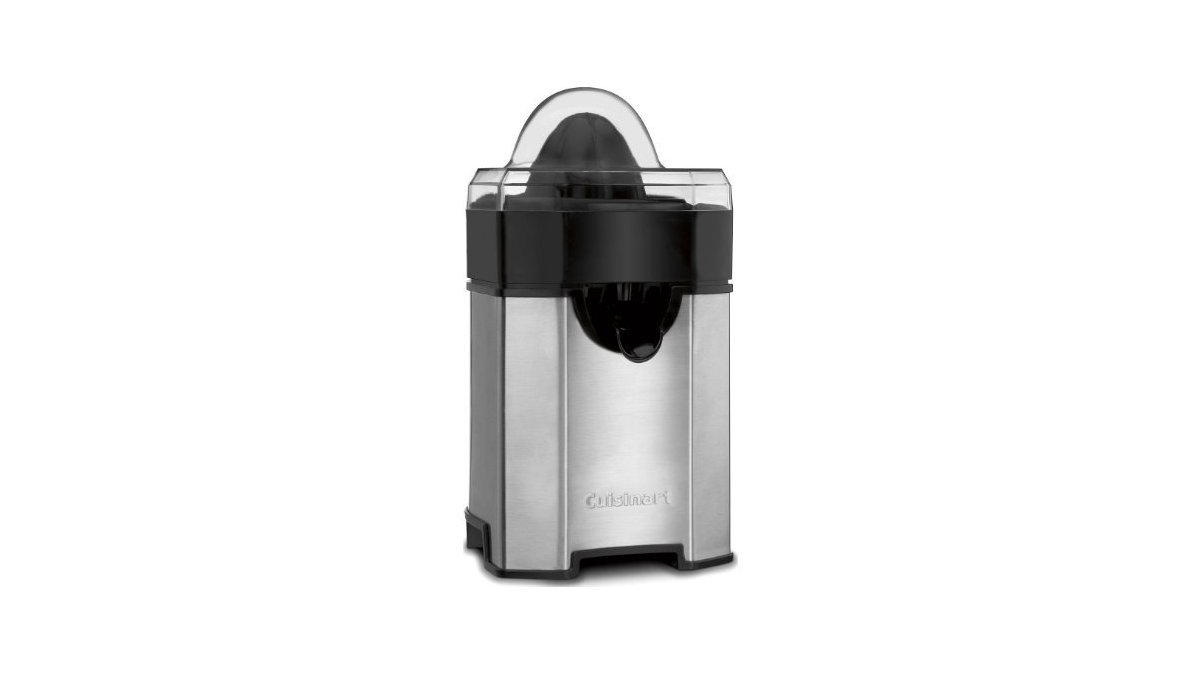
This is the most flexible machine on the list. The listing says it handles everything from the smallest lime to the largest grapefruit, so you don’t need to swap cones or buy anything extra. The reamer has three pulp settings – low, medium, and high – and it reverses automatically while it works. That matters more than it sounds. A reamer that only spins one way leaves juice in the fruit, and you end up pressing harder to make up for it.
There’s a final-spin feature that the listing says pulls extra juice out of the pulp. The spout snaps up and extends, which the listing says fits more glasses and stops drips. If you’ve ever cleaned dried orange juice off a counter, you know why that’s the detail people care about.
The parts are dishwasher safe, and it carries a limited 3-year warranty. It’s the only warranty term stated among the juicers compared here.
What works:
- Fits limes up to large grapefruit in one machine
- Three pulp settings, so you pick your texture
- Auto-reversing cone for better extraction
- Final-spin feature pulls more juice from pulp
- Limited 3-year warranty
Where it gives ground:
- Needs counter space for a full-size base
Skip it if: You want to juice without wiping down a machine afterward.
2. BLACK+DECKER 32oz Electric Citrus Juicer

Right for: Someone who wants to press fruit down and be done.
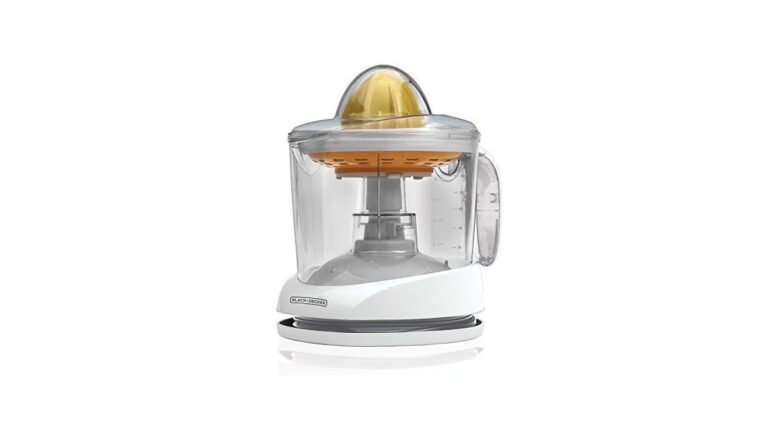
This is the simplest machine here, and the listing doesn’t pretend otherwise. You press the fruit onto the cone, it spins, and the juice runs into the container. The cones reverse automatically to pull more juice out. There’s no button to find and no setting to think about.
The pulp basket is the part worth explaining. Pulp collects in a removable basket, and the listing says you can throw it out or use it in other recipes. That’s a genuinely useful option if you bake, because orange pulp goes into muffins and cakes without any extra work. The container is clear, so you can watch the level rise, and it has measurement markings for recipes. It doubles as a pitcher with a handle and a drip-free spout, so you can carry it to the table instead of pouring glass by glass.
Cleanup is the trade-off, since the basket, cone, and container all need rinsing between batches if you’re doing a lot of fruit.
What works:
- Pressure-activated, so there’s nothing to adjust
- Pulp basket is removable and reusable in recipes
- Clear container with measurement markings
- Container doubles as a pitcher with a pour spout
- 32 oz capacity
Where it gives ground:
- Pulp control is a basket, not a dial with levels
Skip it if: You need precise control over how much pulp ends up in the glass.
3. Proctor Silex 34 oz. Electric Citrus Juicer
Right for: The host making juice for a full table of people.
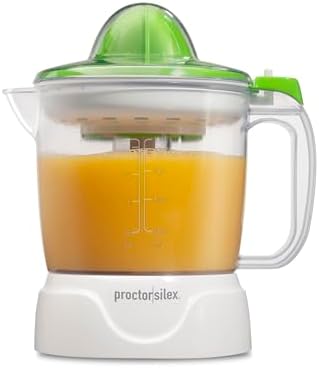
Capacity is the whole story here. The listing gives a 34 oz detachable pitcher. If you’re making juice for a family breakfast or a brunch, that changes the job from a chore into a single uninterrupted session.
It comes with two nesting reamers. One handles small fruit like Key limes, the other takes large grapefruit, and the machine reverses automatically for extraction. You slide a pulp dial from left to right to set how much pulp comes through, and the pulp collects in a strainer you can lift out and dump. The pitcher has a pour spout and measurement markings, so you can measure straight into a recipe instead of guessing.
The pitcher, reamers, lid, and pulp strainer are all dishwasher safe. The cord wraps for storage, and the reamers nest inside each other so the whole thing takes less cabinet room than its capacity suggests.
What works:
- 34 oz pitcher
- Two reamers cover Key limes up to grapefruit
- Sliding pulp dial adjusts texture
- Dishwasher-safe pitcher, reamers, lid, and strainer
- Cord wrap and nested storage
Where it gives ground:
- A big pitcher means a bigger footprint on the counter
Skip it if: You only ever juice a single piece of fruit at a time.
4. KitchenAid Go Cordless Citrus Juicer

Right for: The cook who moves around the kitchen while working.
No cord. That’s the point of this one, and it changes where you can use it. The listing says it runs on a rechargeable 12v MAX removable battery that’s included, and it comes with a USB charging cable. You can juice at the counter, at the table, or outside, without hunting for an outlet.
The reamer reverses automatically for extraction, and the listing says it handles grapefruit, lemons, limes, and oranges. The reservoir bowl holds 16 ounces. The pour spout is designed to go straight into a glass with minimal drips, which is the kind of detail that only matters after you’ve cleaned up a spill.
The reservoir bowl, reamer, removable knob, and stainless steel sieve are all dishwasher safe. The trade-off with any cordless appliance is the battery. You charge it, you use it, and eventually you charge it again. For a glass or two a day, that’s fine. For a big batch, you’ll want to plan around the charge.
What works:
- Cordless, powered by an included 12v MAX battery
- Auto-reversing reamer for extraction
- 16 oz reservoir bowl
- Precision pour spout for minimal drips
- Dishwasher-safe bowl, reamer, knob, and sieve
Where it gives ground:
- Battery needs recharging between uses
- 16 oz bowl is smaller than the pitchers on several other models here
Skip it if: You juice several pounds of fruit in one sitting.
5. Vinci Electric Juicer

Right for: Anyone who hates the mess and the hand-holding.
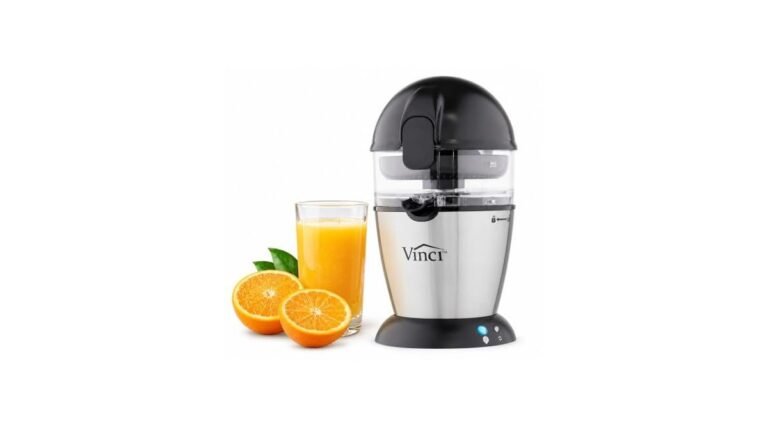
This one does the work differently. You cut the fruit in half, put it on the reamer, close the lid, and press the Auto Juice button. The listing says the machine presses the fruit inside a fully enclosed chamber in about 10 seconds. Nothing splashes, because nothing is open. You aren’t holding anything down.
The pressure is the interesting part. The listing describes patented technology that adjusts pressure based on how thick the rind is, which the seller says helps prevent scraping too deep and pulling bitter flavor into the juice.
It fits fruit up to 4.5 inches across, so Key limes through large grapefruit all work. The Tritan bowl holds 12 ounces and has a locking spout, so you can collect juice or dispense straight into a glass. Two pulp filters – fine and coarse – set your texture. The lid, bowl, reamer, and filters are top-rack dishwasher safe.
What works:
- Fully enclosed juicing, so there’s no splashing
- Hands-free operation, about 10 seconds per fruit
- Pressure adjusts to rind thickness
- Fits citrus up to 4.5 inches
- Fine and coarse pulp filters included
Where it gives ground:
Skip it if: You want to see the juice flowing as you press.
6. Eurolux Premium Electric Orange Juicer

Right for: The buyer who wants the motor to do all the work.
The listing gives this one a 160W high-torque motor, and the seller describes it as commercial-grade power for home use. In practice, a stronger motor means you press the fruit down and it keeps spinning instead of slowing when you lean in.
The body is stainless steel, which the listing frames as both durable and a match for kitchen style. There’s a soft grip rubber handle for one-touch operation – a gentle press starts it, and the listing says there’s an auto shutoff. A single cone fits all fruit, so you don’t swap anything when you move from oranges to limes.
Eurolux is described as a brand with over 30 years in home appliances. The listing doesn’t mention a warranty length. The parts are dishwasher safe.
What works:
- 160W high-torque motor
- Stainless steel construction
- Soft grip handle with one-touch operation
- Auto shutoff
- A universal cone for all citrus
Where it gives ground:
Skip it if: You want a machine you can pick up and store in a drawer.
7. Elite Gourmet ETS623 Electric Citrus Juicer

Right for: Small kitchens, dorms, and RV owners.
Space is what this one solves. The listing calls the design compact and space-saving, and names apartments, dorms, RVs, and small kitchens as the fit. If your counter is already full, that matters more than any other feature here.
The motor is 40 watts, and the listing compares it directly to typical 25W citrus juicers, saying it delivers faster juice yield. The reamer reverses automatically, and you activate it by pushing the fruit down. Capacity is 24 ounces, or about 3 cups, which the listing frames as 2 to 3 servings.
There’s a built-in pour spout and an integrated pulp and seed filter, so seeds stay out of the glass without a separate step. Removable parts are top-rack dishwasher safe, though the listing recommends hand washing for the longest product life. It’s BPA-free and ETL listed for safety.
What works:
- Compact design for small kitchens, dorms, and RVs
- 40W motor, compared in the listing to typical 25W models
- 24 oz capacity, about 3 cups
- Auto-reversing reamer with push-down activation
- Integrated pulp and seed filter
Where it gives ground:
- Hand washing recommended for longest product life
- 3-cup capacity suits small batches, not crowds
Skip it if: You need to serve juice to a big group at once.
8. CO-Z Cast Iron Juicer

Right for: The home bartender who wants bar-quality citrus.
No electricity, no cord, no motor to wear out. This is a lever press. The listing says the reinforced cast iron withstands over 2300 psi, and every part that touches fruit is 304 food-grade stainless steel. You pull the handle down and the fruit gives up its juice.
The lever is extra long with a rubber grip, which the listing says makes even tough pomegranates easy to press. The base uses nonslip suction to stay put while you work. The funnel is 5 inches, so it takes fruit of all sizes. A stainless steel strainer keeps seeds and pulp out of the glass, and the detachable parts rinse or go in the dishwasher.
This is the pick if you make cocktails, because a press gives you control an electric machine doesn’t. It’s also the pick if you don’t want another appliance plugged in. The trade-off is your arm. You do the pressing, every single time.
What works:
- Reinforced cast iron rated over 2300 psi
- 304 food-grade stainless steel on fruit-contact parts
- Extra-long lever with rubber grip
- Nonslip suction base stays steady
- 5-inch funnel fits fruit of all sizes
Where it gives ground:
- Every glass takes manual effort
Skip it if: You want juice without pulling a lever for each fruit.
9. OXO Good Grips 2-in-1 Citrus Juicer

Right for: The cook who squeezes a lemon here and an orange there.
Two reamers, one tool. You snap on the small one for lemons and limes, or the large one for oranges and grapefruit. The listing gives measurement markings up to 1.5 cups, or 350 mL. There’s a drip-free pour spout, and the body is BPA-free with a shape built for a comfortable grip.
This is a manual juicer, so you do the twisting. What it offers in return is control and almost no cleanup. The reamers snap off for washing and nest together for storage, which keeps the whole thing small in a drawer.
It’s the right answer for someone who cooks with citrus more than they drink it. Dressings, marinades, sauces, and a squeeze over fish – that’s the pattern here, and a manual tool handles it without a cord or a counter footprint. It’s the wrong answer if you’re making a pitcher of orange juice every morning.
What works:
- Two reamers cover small and large fruit
- Measurement markings up to 1.5 cups / 350 mL
- Drip-free pour spout
- BPA-free body with a comfortable grip
- Reamers snap off and nest for storage
Where it gives ground:
- Manual twisting, so your hand does the work
- 1.5 cup capacity suits small amounts
Skip it if: You want a machine to make juice for the whole family.
10. Dreamfarm Fluicer Fold-Flat Citrus Juicer

Right for: The small-kitchen cook who has no drawer space to spare.
This one folds completely flat. The listing calls the design slimline and says it folds with no bulky humps, so it slides into a drawer instead of taking counter space. If your kitchen is short on room, that’s the feature that decides it.
The mechanism is different from a traditional press. It hinges and presses the fruit from the sides, the way your hands would, and the listing says that takes less force than squashing fruit flat. There’s a built-in pip catcher that strains juice and doubles as a funnel to direct the flow into a glass or small bowl. The listing recommends the orange version for lemons, limes, and oranges.
It was featured in Time Magazine’s Top Inventions of 2023 and Food & Wine’s 2026 Game Changers, per the listing. It’s manual, so you still do the squeezing, and it’s built for smaller fruit rather than grapefruit.
What works:
- Folds completely flat for drawer storage
- Hinged mechanism presses from the sides
- Built-in pip catcher strains and funnels
- Recommended for lemons, limes, and oranges
- 11-inch size
Where it gives ground:
- Manual operation, so you supply the force
- The listing recommends it for small and medium citrus, not grapefruit
Skip it if: Grapefruit is your main fruit.
Also Worth Considering
LUUKMONDE Electric Citrus Juicer — The listing gives this one a 1.2L large volume container, plus a powerful motor and an LED working lamp. It handles orange, lemon, lime, and grapefruit. If volume is your priority and you want an electric machine, this is worth a look before you decide.
Healnitor Electric Citrus Juicer — A 150W motor with two cones and a stainless steel body, described in the listing as quiet. It’s built for lime, grapefruit, and lemon, and the design is detachable for cleaning. The two-cone setup means you switch cones for different fruit sizes rather than using one universal cone.
ASTRALSHIP Juicer Machine Electric Orange — A stainless steel base with a 24oz pitcher, pressure-activated operation, two cones, and a pulp filter. It covers orange, lemon, and grapefruit. The pressure-activated design means no buttons, and the pitcher takes the juice straight to the table.
How to Think Before You Choose
Electric Power or Your Own Arm
This is the first real decision, and it’s not about which is better. It’s about which you’ll actually use. An electric machine spins the reamer for you, so a glass of juice takes seconds and almost no effort. A manual press or juicer asks for your arm every time. On day one, both feel fine. On day forty, the manual one is still sitting in the drawer and the electric one is still on the counter, or the reverse, depending on you.
Most people should lean electric if they drink citrus juice most mornings. The effort is the thing that stops a habit. Lean manual if you cook with citrus rather than drink it – a squeeze of lemon into a dressing, a lime into a marinade. Those jobs take one fruit and ten seconds, and a manual tool handles them without a cord or a counter footprint.
Here’s what to check at home before you decide. Count how many times last week you wanted citrus juice and didn’t make it. If the number is high, the friction is the problem, and electric removes it. If it’s low, you don’t need a motor.
Pulp, Seeds, and What Ends Up in the Glass
Pulp is the most personal thing about juice, and the listings here handle it in three different ways. Some have a dial with settings. Some have a removable basket that collects pulp so you can toss it or bake with it. Some give you two filters, fine and coarse. A few have no adjustment at all.
Most people should lean toward a machine with at least two options, because your preference changes with the fruit. Orange juice with pulp is good. Lemon juice with pulp in a dressing is not. A single fixed setting locks you into one texture for everything.
The thing to check is your own glass. Next time you buy orange juice, look at whether you reach for pulp or no pulp. That’s your answer, and it’s more reliable than any description. Also think about seeds. Some machines have a strainer that catches them, some rely on the pulp basket, and some let them through. If you juice pomegranates, that detail matters a lot.
Capacity, Footprint, and Where It Lives
A juicer has to live somewhere, and that somewhere decides how often you use it. A large pitcher means fewer trips to empty it, but it also means a bigger base that stays on the counter. A compact machine fits in a small kitchen but fills up fast. A folding manual tool disappears into a drawer entirely.
Most people should lean toward the smallest machine that covers their usual batch. If you make just a serving or two at a time, a large pitcher is dead space you’re storing. If you make juice for four people, a small bowl means stopping halfway through, and that’s its own kind of friction.
Measure your cabinet or counter before you order. Take a tape measure to the spot where the juicer will live, and check the height too, because some machines are tall. Then count your usual servings. A couple of servings is a small machine. Four or more is a pitcher. If you’re between sizes, go bigger, because a half-full pitcher still works and a full bowl doesn’t.
Who Should Skip These Altogether
None of these are bad buys, but a few readers should keep their money and their counter space.
- If you drink juice once a month, buy a single orange and squeeze it by hand – a fork works, and nothing needs storing.
- If you already own a blender, it’ll break down citrus for a marinade or a smoothie without another appliance on the counter.
- If you want juice for a crowd every single day, a home juicer is the wrong scale – that job belongs to a dedicated juice bar or a much larger machine.
- If you’d use it once for a party and then forget it, borrow one or skip the juice and buy it fresh that week.
The Closing Word
For most people, the Cuisinart Pulp Control Juicer is the pick. It covers limes to grapefruit, gives you three pulp settings, and carries a limited 3-year warranty. For the harder case, where you want juice without holding anything down or cleaning up a splash, the Vinci Electric Juicer does the pressing inside a closed chamber in about 10 seconds.
Before you order, do one thing. Measure the spot where the juicer will live, and count how many glasses you actually make in a week. Those two numbers settle more than any feature list. Then check the listing for today’s details and confirm what’s in the box.
Frequently Asked Questions
What do I need to have ready before the juicer arrives?
You need fruit at room temperature, a knife and cutting board, and a glass or pitcher. Room-temperature citrus gives up more juice than cold fruit, so take it out of the fridge an hour ahead if you can. For electric models, you also need a free outlet nearby, unless you pick the KitchenAid Go KCJR161BM, which runs on an included 12v MAX battery.
How much cleanup does a citrus juicer really need?
More than the listing photos suggest, but less than you fear. Every electric model here has removable parts that are dishwasher safe, though the Elite Gourmet ETS623 listing recommends hand washing for the longest product life. The real work is the rinse between batches if you’re juicing a lot of fruit.
What tends to go wrong first with these machines?
Pulp buildup and worn reamers, in that order. Pulp collects in baskets, strainers, and spouts, and if you don’t clear it, extraction drops and the juice tastes bitter. On electric models, the reamer is the part that takes the wear, since it’s spinning against rind every time.
Is the simplest pick here enough for most people?
Often, yes. The BLACK+DECKER CJ625 is pressure-activated, so there’s no button and no setting to learn, and the 32 oz container doubles as a pitcher. The question is whether you need pulp control. If you do, the Cuisinart Pulp Control Juicer gives you three settings, and the Vinci Electric Juicer gives you two filters.
What should I confirm before I order?
Confirm the capacity against how many glasses you make, and confirm the footprint against where it will live. Check what’s in the box, since the KitchenAid Go KCJR161BM includes the battery and a USB charging cable, and not every cordless tool does. Finally, check the warranty, since the Cuisinart Pulp Control Juicer states a limited 3-year term and several listings here don’t state one at all.
Conclusion
Pick the one that matches how you actually drink juice, not the fanciest box on the shelf. If you’re still unsure, start with a simple manual press and see how often you reach for it. You’ll learn pretty fast what you really need.