Best Breville Juicer: 5 Picks for Every Kitchen
Best Breville Juicer
Juicing at home sounds simple until you start shopping for a breville juicer. Then you meet a wall of numbers — chute sizes, wattage, jug capacity, pulp bins — and every listing promises the same thing. So here’s the honest question to ask yourself first: how much produce will you actually push through this thing in one go, and who else in the house has to clean it afterward?
That second part matters more than most buyers expect. A juicer only earns its counter space if the gap between “I want juice” and “the juice is in a glass” stays short. That gap is decided by three things: how wide the feed chute is, how much juice the jug holds before you have to stop and empty something, and how many parts need washing when you’re done. Get those three right for your kitchen and you’ll use it weekly. Get them wrong and it becomes a cupboard resident.
Breville’s Juice Fountain family is built around that idea. Almost every model here skips pre-cutting with a wide chute, uses a stainless steel filter basket, and includes a froth separator in the jug. The differences sit in capacity, footprint, and how the pulp is handled. That’s where your decision really lives.
This guide compares the listings side by side, so you can match the machine to your counter, your family size, and your patience for cleanup. Nothing here is a lab test — it’s what each seller states about their own product, read carefully. That’s enough to sort a good fit from a bad one, because the specs that matter here are the ones the listings actually print.
The one thing that separates a good buy from a bad one in this category: buy for the batch size you’ll make on your busiest day, not your average day. A small jug that’s fine on a quiet Tuesday will frustrate you on a Sunday when three people want a glass. Oversize the jug, then check it still fits under your cabinets.

- 3.5 in feed chute, 70 fl oz of juice
- Cold Spin Technology and Noise Reduction Technology
- Cold Spin Technology with Italian-made precision mesh filter
- Juice whole fruits without pre-cutting

- Centrifugal juicer with 3 inch extra wide chute
- Dual speeds and simple clean up
- Titanium reinforced disc and Italian-made micro mesh filter basket
- 3 inch chute juices whole fruits without pre-cutting

- 3 inch wide chute juices whole fruits and vegetables
- Pulp collects within the unit's footprint
- Titanium-reinforced disc and Italian-made micro mesh filter basket
- 3 inch chute juices whole fruits without pre-cutting

- Cold extraction system gives 70 fl oz of juice
- 850 watt motor processes tough fruits and vegetables in seconds
- Cold Spin Technology with Italian-made precision mesh filter
- 3 inch chute juices whole fruits without pre-cutting

- Space-saving design with 70 fl oz of juice
- Dual speeds for optimal performance
- Cold Spin Technology with Italian-made precision mesh filter
- 3.5 inch chute juices whole fruits without pre-cutting
1. Breville BJE830BSS Juice Fountain Cold XL
Best for: Big families juicing large batches at once
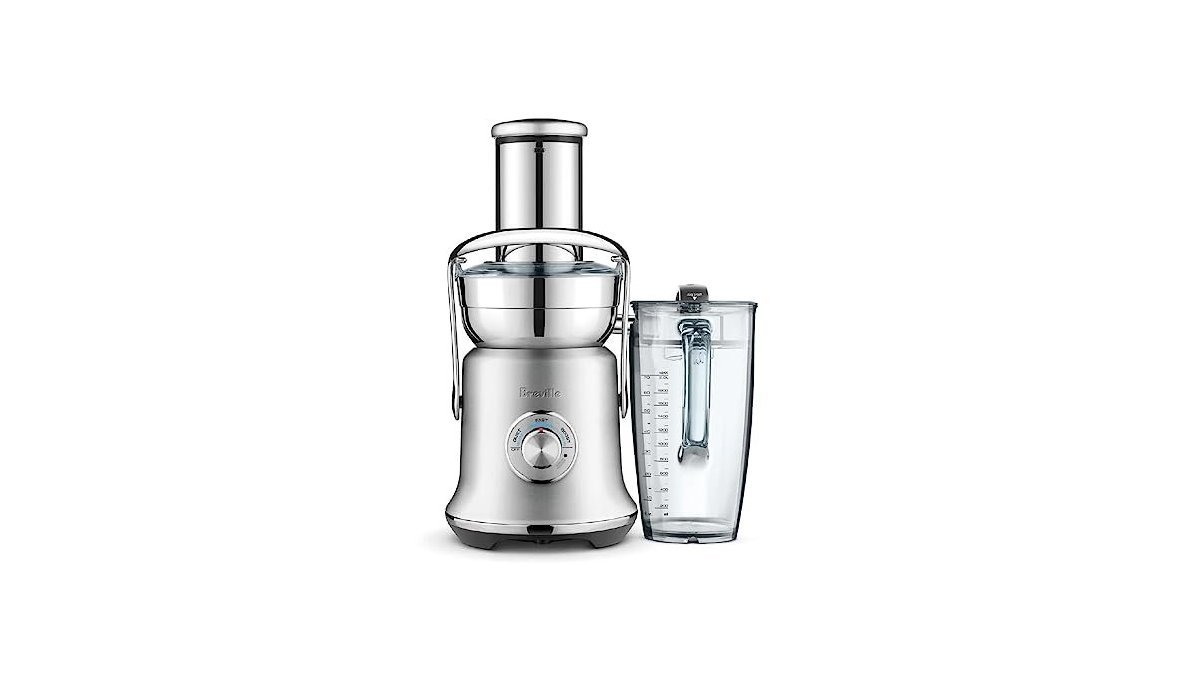
The Juice Fountain Cold XL is the largest-capacity machine in this lineup, built around a 70 fl oz seal-and-store jug and a 3.5 in extra-wide chute. That chute is the headline feature — it takes whole carrots, apples, and oranges without pre-cutting, which removes the knife-and-board step that stops most people from juicing on a weekday. Breville pairs it with Cold Spin Technology and an Italian-made precision mesh filter, and states the machine can extract 70 fl oz up to five times faster than a cold press machine.
The trade-off that chute forces is size. A wider feed tube and a bigger jug mean a bigger body on the counter, and the listing’s answer is a pulp bin positioned behind the base rather than beside it. That keeps the footprint tighter than the capacity suggests, but it’s still a full-size appliance, not a tuck-away one. The Quiet setting is listed as reducing mechanical noise by 40%, which matters if you juice early and the rest of the house is asleep.
In daily use, the seal-and-store jug is what changes the routine. You can run a whole bag of carrots in one session, seal the jug, and refrigerate for up to three days instead of juicing every morning. The inverted nozzle stops drips when you pour into a glass, and a cleaning brush comes in the box. This is a lot of machine if you only ever make one glass at a time.
| What this one gives you | What you have to accept |
|---|---|
| 3.5 in chute — no pre-cutting | A full-size body on the counter |
| 70 fl oz seal-and-store jug, up to three days in the fridge | More juice than a single drinker needs |
| Pulp bin behind the base to save space | Emptying a large pulp bin after a big batch |
| Quiet setting, listed at 40% less mechanical noise | Still a running motor in an open kitchen |
2. Breville Juice Fountain Plus
Best for: First-time juicers learning what they like
The Juice Fountain Plus is the entry point into the range, and the listing frames it that way — a centrifugal juicer with an 850W motor, dual speeds, and a 3 in extra-wide chute. The two speeds are the useful part for a beginner: low for softer fruits and leafy vegetables, high for denser fruits and harder vegetables.
The extraction system pairs a titanium-reinforced disc with an Italian-made micro mesh filter basket, both stainless steel. The 35.2 fl oz juice jug has a built-in froth separator, so you pour more juice and less foam into the glass. The 2.6 qt pulp container detaches, and the power cord wraps around the feet underneath for storage.
Where this one asks something of you: the 35.2 fl oz jug is roughly half the capacity of the XL models, so a family batch means emptying and restarting. The 3 in chute is narrower than the 3.5 in version too. For one or two people, neither is a real problem.
What goes smoothly:
- Dual speeds handle soft and hard produce without guesswork
- 3 in chute takes whole carrots, apples, and oranges
- Froth separator in the jug means less foam in the glass
- Cord wraps under the base and the pulp container detaches for storage
- Cleaning brush included
What you have to accept:
- 35.2 fl oz jug means refilling for a family-sized batch
- 3 in chute is narrower than the 3.5 in models here
3. Breville BJE200XL Juice Fountain Compact Centrifugal Juicer
Best for: Small kitchens with limited counter space
The Juice Fountain Compact is the space-saver of the group, and the listing is direct about it: a small juicer that still takes whole fruits and vegetables through a 3 in chute. Pulp collects within the unit’s footprint rather than in a bin hanging off the side, which is the design choice that keeps it narrow. If your counter is already crowded, that’s the spec that decides it.
It runs the same extraction approach as the larger models — a titanium-reinforced disc and an Italian-made micro mesh filter basket, both stainless steel — and the same 3 in chute that skips pre-cutting on carrots, apples, and oranges. The juice jug is 25 fl oz with an integrated froth separator, and the pulp container is 1.6 qt. A safety locking arm means the juicer won’t run unless the cover is in place and the arm is vertical, which is a sensible feature in a house with kids.
The catch is capacity, and it’s a big one for some buyers. A 25 fl oz jug is about two glasses. If you’re juicing for one person most mornings, that’s exactly right. If you’re making a jug for the week, you’ll be stopping and emptying constantly — and the smaller pulp container fills faster too.
Snapshot:
- 3 in chute takes whole produce without pre-cutting
- Pulp collects inside the footprint, so it stays narrow
- 25 fl oz jug with froth separator — about two glasses
- 1.6 qt pulp container empties more often than the XL models
- Safety locking arm stops operation without the cover in place
- Cord wraps under the base for storage
4. Breville BJE430SIL Juice Fountain Cold Fruit and Vegetable Juicer
Best for: Mid-size households that want cold extraction
The Juice Fountain Cold sits in the middle of the range and borrows the best feature from the top model: Cold Spin Technology with an Italian-made precision mesh filter, designed to avoid damaging vitamins and minerals through heat and processing. It also carries the same 70 fl oz seal-and-store jug as the XL, good for up to three days in the refrigerator. What it doesn’t carry is the 3.5 in chute — this one uses a 3 in feed.
The 850W motor is listed as processing even the toughest fruits and vegetables in seconds, and there’s a detail here the other models don’t mention: an LED light that illuminates if the motor has stopped due to overloading. That’s a preventative feature aimed at motor longevity, and it’s genuinely useful — it tells you to slow down instead of leaving you guessing why the machine quit.
The speed is set by an electronic control. High speed is for denser fruits and harder vegetables, low speed for leafy vegetables and soft fruit. Getting that wrong is the most common way people end up disappointed with a centrifugal juicer.
Run a handful of kale through on high and you get a wet pulp container and very little in the glass. The machine hasn’t failed; it was asked to do the wrong job.
Owning it looks like this: a 3.6 qt pulp container, an inverted nozzle that stops drips, and a detachable spout for juicing straight into a glass. The gap between this and the XL comes down to the chute width and the quiet setting. If neither matters to you, this covers the same ground.
Who it fits: Buyers who want the cold extraction system and the large seal-and-store jug, and who are happy to cut the occasional oversized apple.
Who should pass: Anyone who juices mostly leafy greens and wants the widest possible chute, or who needs the noise reduction of the Quiet setting.
5. Breville Juice Fountain Cold Plus
Best for: Tight counters that still need big batches
The Juice Fountain Cold Plus reads as the space-saving version of the XL, and the listing says so plainly: a no-nonsense juicer with a unique space-saving design, a 70 fl oz jug, and dual speeds. It keeps the 3.5 in extra-wide chute, so whole carrots, apples, and oranges go in without pre-cutting, and it keeps Cold Spin Technology with the Italian-made precision mesh filter.
The dual speeds are the piece worth noting. Breville lists them as handling leafy greens, berries, carrots, and apples — a wider stated range than the single-speed models can claim. Combined with the 70 fl oz seal-and-store jug and the up-to-three-days refrigeration, that makes this a machine for someone who wants variety in what they juice, not just volume.
What you accept: the pulp bin sits behind the base to save counter space, which is the trick that keeps it compact, and the body is still built around a large jug. There’s no Quiet setting listed here, unlike the XL. So if noise is your deciding factor, that’s the one spec that separates the two.
What goes smoothly:
- 3.5 in chute handles whole produce, no knife needed
- Dual speeds cover leafy greens, berries, carrots, and apples
- Large jug seals and stores for days
- Pulp bin behind the base keeps the footprint tighter
- Inverted nozzle and detachable spout cut down on drips
What you have to accept:
- No Quiet setting listed, unlike the XL
- Large jug and pulp bin still need emptying after a big batch
Also Worth Considering
Two more listings turned up in the same family, both remanufactured rather than new. The Breville Fountain Cold Centrifugal Juicer is a certified remanufactured version of the Juice Fountain Cold, carrying the same model number, RM-BJE430SIL. The Breville RM-BJE830BSS1BUS1 Breville is a renewed Juice Fountain Cold XL in brushed stainless steel.
The two aren’t covered the same way, and that’s the part worth slowing down for. The remanufactured Fountain Cold is a Breville Certified Remanufactured Product, which the listing says shows limited or no wear, includes all original accessories, and carries a six-month Breville Limited Warranty from the date of purchase.
The renewed Cold XL listing states the same terms: limited or no wear, all original accessories, six months from purchase. So in both cases the coverage is half the one-year limited warranty the new machines carry.
If you buy either, keep the purchase date somewhere you’ll find it. Six months runs out quietly, and a claim after that point is yours to absorb.
The Decision Filter
Answer one question before you look at anything else: how many glasses do you need in a single session? That single answer does most of the sorting here. If it’s one or two, the compact and mid-size machines cover you, and a large jug just means more to wash. If it’s four or more, or you want juice for several days, the 70 fl oz models are the only ones that won’t have you stopping mid-batch.
Then ask who cleans it. A machine with fewer parts and a smaller pulp bin gets used more, because the cleanup is shorter.
Most people miss this: the chute width, not the motor, is what decides whether you juice on a busy morning. A 3.5 in chute takes a whole apple. A 3 in chute does too, and that saved cut is the step that keeps the habit alive.
Where the pulp goes is the next thing to check, because it decides how much counter you give up. On the compact and the two XL models the pulp bin sits behind the base, inside the machine’s own footprint. On the Plus it hangs off as a detachable container, so the machine needs more room around it.
The speed settings split along the same lines. The Plus, the Cold and the Cold Plus give you two speeds: low for soft fruit and leafy greens, high for dense fruit and hard vegetables. The XL gives you variable speed instead, and the Compact gives you neither.
One more fork: a factory-refurbished unit carries a six-month Breville warranty, against a year on a new one. If the shorter coverage matters to you, take the year.
The Quick Checklist
- Will you really juice more than twice a week, or is this a January thing?
- Does anyone else in the house need to use it without help?
- Will it fit under your cabinets with the jug in place?
- Can you reach a power outlet without moving the machine?
- Do you have space for the pulp bin and the jug at the same time?
- If it’s the wrong size, can you live with it sitting unused?
Answer the capacity question with a number, not a feeling. The jugs run 25, 35.2 and 70 fl oz, and the pulp containers run 1.6, 2.6, 3.6 and 3.9 qt. A full batch is enough for the whole family and keeps in the refrigerator for days. If you’re juicing for one, that’s a lot of juice to get through.
The chute decides how much chopping you do. Three inches takes whole carrots, apples and oranges. Three and a half inches does the same with more room, so it’s the one to pick if you juice whole produce and hate pre-cutting.
The speed settings cover everything either way: low for softer fruits and leafy vegetables, high for denser fruits and harder vegetables.
Three Regrets Worth Avoiding
Regret #1: Buying for average use instead of busiest use. A 25 fl oz jug is fine on a quiet morning and a problem on a Sunday.
Regret #2: Ignoring the footprint until it’s on the counter. A wide chute and a large jug make a large body, and the space-saving models solve that by moving the pulp bin behind the base.
Regret #3: Assuming every machine sounds the same. Breville lists a Quiet setting on the Cold XL that reduces mechanical noise by 40%, and no equivalent setting on the Cold Plus. If you juice early or late, that’s the spec to check.
If You Want This, Look for That
Here’s the short version of what to check on any listing in this category.
| If you want… | Look for | Avoid |
|---|---|---|
| Juice for the whole week | 70 fl oz seal-and-store jug | Small jugs you refill mid-batch |
| No knife work in the morning | 3.5 in extra-wide chute | Narrow chutes that need pre-cutting |
| A machine that fits a small counter | Pulp bin behind the base | Side-mounted bins that add width |
| Quiet early-morning juicing | A stated noise reduction setting | Assuming all juicers sound alike |
| Leafy greens and berries too | Dual speed settings | Single-speed machines only |
| Easy cleanup after use | Detachable pulp container, cleaning brush | Fixed parts you can’t rinse separately |
Two of those rows deserve a second look before you buy.
The 70 fl oz jug is one of the biggest differences in this lineup. The compact model holds 25 fl oz and the Plus holds 35.2 fl oz, so if you’re juicing for a family, those two mean a second batch. The machines with a seal-and-store jug are listed as keeping juice in the refrigerator for days. If you juice for one and drink it fresh, the small jug is fine and takes less counter space.
On chute width, the difference is 3 in versus 3.5 in. Both are described as letting you juice whole carrots, apples and oranges without pre-cutting, so the 3.5 in chute isn’t the line between chopping and not chopping.
Speed settings matter more than they look. Low speed is for softer fruits and leafy vegetables, high for denser fruits and harder vegetables.
Related guides
Frequently Asked Questions
Will a Breville juicer fit under my kitchen cabinets?
It depends on the model, and the listing gives you the shape but not the height. The space-saving designs put the pulp bin behind the base rather than beside it, which keeps the width down, but a 70 fl oz jug still sits on top. Measure your clearance from counter to cabinet before you buy.
What’s the difference between Cold Spin Technology and a cold press juicer?
They’re different methods. A cold press machine crushes produce slowly, while Breville’s Cold Spin Technology uses a centrifugal system with an Italian-made precision mesh filter, designed to avoid damaging vitamins and minerals through heat and processing. Breville states the Cold XL can extract 70 fl oz up to five times faster than a cold press machine.
Can I juice leafy greens in these machines?
Yes, and the dual-speed models are the ones built for it. Breville lists the low speed for softer fruits and leafy vegetables, and the high speed for denser fruits and harder vegetables. The Cold Plus listing specifically names leafy greens and berries among what its speed settings handle.
How long can I store the juice?
The largest models come with a seal-and-store jug that Breville states keeps juice in the refrigerator for days. The smaller models use a standard juice jug with a froth separator. If batch juicing for the week is your plan, that seal-and-store jug is the feature to look for, because it’s the part designed for it.
Do I need to cut fruit before juicing?
Mostly no. Breville lists a 3 in or 3.5 in extra-wide chute across these models, and states that whole fruits and vegetables — including carrots, apples, and oranges — go in without pre-cutting. The 3.5 in chute is the wider of the two, so it gives you more room for whole produce. Check the chute size against what you usually juice.
What happens if I overload the juicer?
On the Juice Fountain Cold, Breville lists an LED light that illuminates if the motor has stopped due to overloading. It’s described as a preventative feature to protect motor longevity. The practical response is to feed produce more slowly and let the motor recover.
Are the parts dishwasher safe?
The listings don’t state dishwasher suitability for any of these models, so treat that as unknown rather than assumed. What they do list is a cleaning brush included with every model, plus detachable pulp containers and removable jugs and filters. Check the seller’s care instructions on the listing you’re buying before you rely on a dishwasher cycle.
Conclusion
Before you buy, picture your busiest morning and decide if you’d still reach for it then. If yes, pick the one that fits that moment, not the spec sheet. You’ll know it’s right when cleanup stops feeling like a chore.