The 8 Best Juice Strainers for Clear, Seed-Free Juice
A juice strainer sounds like a simple thing. You pour, you press, you wait, and clear liquid comes out the other side. That’s the idea, anyway. What most people get wrong isn’t the straining itself — it’s buying a tool that fights them every time they use it.
The one thing that separates a good buy from a bad one here is fit. Fit with your pot, fit with your jar, fit with the fruit or nut or grain you’re working with. A strainer that sits steady and lets you press hard without wobbling will get used weekly for years. One that slips, clogs, or needs two hands and a helper will end up at the back of a cabinet.
So before you pick anything, answer three questions about your own kitchen. What are you straining most — citrus, nut milk, berries, stock, yogurt, flour? How much of it at a time — a glass, a quart, a big pot? And who else has to use it without instructions?
The answers point to different tools. A conical chinois handles volume and pulp. A fine mesh basket handles quick jobs and rinsing. A cloth or nylon bag handles nut milk and cold brew, where you need to squeeze. A press handles citrus without electricity. A funnel with a filter handles bottling, where the mess happens at the neck of the jar, not in the bowl. None of them does all of it well.
This guide covers the best juice strainer options in several of those shapes. Every pick below comes from what the seller’s listing actually states — the material, the sizes, the mesh count, the parts included, the care instructions. Where a listing names a limit, that limit is here. Where it says nothing, nothing gets invented. What you won’t find is a printed price, because those move constantly and a number written today is wrong tomorrow. Use the buttons to check today’s figure on Amazon.
The rest is about matching the tool to the job you actually do, not the one you imagine doing.
All 8 products side by side — scroll sideways to see every column.
| Top Pick | Runner-Up | Best for Nut Milk | Best for Yogurt Making | Best Small Strainer | Best for Baking | Best Funnel Strainer | Best for Citrus | |
| Preview |  |  |  |  |  |  |  |  |
|---|---|---|---|---|---|---|---|---|
| Product | Norpro 642 Chinois | YLYL Mesh Strainer Set | PRINKROOMY Strainer Bag | Marsrut Food Strainer | Homestia Fine Mesh Strainer | Ocapind Colander Set | Kalave Steel Funnel | NutriChef Cast Iron Juicer |
| Brand | Norpro | YLYL | PRINKROOMY | Marsrut | Homestia | Ocapind | Kalave | NutriChef |
| Best for | Best Overall | Runner-Up | Best for Nut Milk | Best for Yogurt Making | Best Small Strainer | Best for Baking | Best Funnel Strainer | Best for Citrus |
| The listing says | Conical fine sieve removes seeds, skins and pulp Solid wood pestle presses cooked fruits and vegetables | Set of three strainers: 3.15 inch, 5.5 inch, 7.87 inch Food-grade 304 stainless steel wire with fine twill mesh | Available in 100, 200 and 300 mesh sizes Double-stitched edges and adjustable drawstring closure | Five pieces: filter, pitcher, handle, press and brush Pitcher holds 1.5L, converts up to 1.6 quarts of yogurt | Stainless steel strainer keeps pulp and herbs out of drinks Rod handle and front rest loop fit over glass or shaker | Set of four plastic mesh strainers in different sizes Fine mesh lets only the finest flour particles through | Metal funnel made of food grade stainless steel Detachable 200 mesh strainer with PP frame and nylon mesh | Cast iron frame and long lever with non-slip rubber feet Juices oranges, lemons, pomegranates and grapefruit |
| More information | Check Latest Price on Amazon | Check Latest Price on Amazon | Check Latest Price on Amazon | Check Latest Price on Amazon | Check Latest Price on Amazon | Check Latest Price on Amazon | Check Latest Price on Amazon | Check Latest Price on Amazon |
1. Norpro 642 Stainless Steel Chinois with Stand and Pestle Set
Best for: High-volume purees, stocks, jellies, and baby food
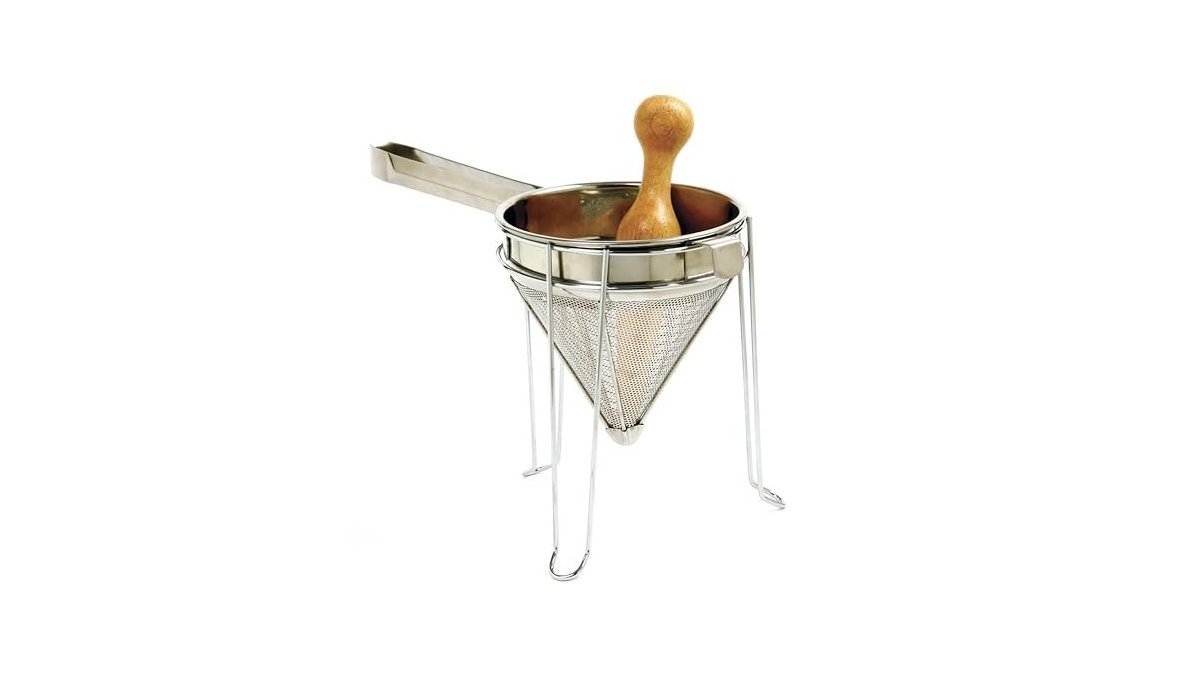
This is a conical sieve with a stand and a wooden pestle, and the shape is the point. A cone gives you more surface area than a flat basket, so liquid drains and pulp has somewhere to sit while you work it. The listing says the perforations are fine enough to catch small seeds, skins, and fibrous pulp. That’s the difference between a strained stock and a cloudy one.
The stand is what makes it usable. It’s a heavy-gauge chromed steel tripod that holds the chinois over pots and bowls from 4 to 10 quarts, so you’re not holding anything while you press. That frees both hands for the pestle, which the listing describes as contoured solid wood shaped to match the bowl. The whole set measures 17 by 9.5 by 7.5 inches assembled and comes apart for flat storage.
Owning it means a bit of counter commitment while it’s set up, and hand washing is recommended rather than the dishwasher. It also rewards a certain amount of patience — you press in batches, you scrape the cone, you press again. For someone making jelly or tomato sauce in quantity, that’s a normal rhythm.
| What it gives you | What you accept |
|---|---|
| Conical fine-perforated sieve for seeds, skins, and pulp | Hand washing recommended, not dishwasher |
| Wooden pestle contoured to the bowl | Assembled set takes up 17″ x 9.5″ x 7.5″ of space |
| Tripod stand fits pots and bowls from 4 to 10 quarts | Stand is a separate part to store and reassemble |
| Stainless steel that won’t react with acidic foods | Pressing dense pulp takes time and batches |
Who it fits: Anyone straining in volume who wants both hands free to press.
Who should pass: If you want a tool you can rinse and drop in the dishwasher, this isn’t that.
2. YLYL Mesh Strainer Set
Best for: Covering several jobs with one nesting set
Three strainers, three sizes, one purchase. The listing gives the measurements plainly: a 3.15 inch mini, a 5.5 inch small, and a 7.87 inch large with a deep bowl. That spread matters more than it sounds, because the right strainer for a single cocktail isn’t the right one for a pot of pasta water.
The mesh is described as 304 stainless steel wire in twill weave, sealed at the rim without burrs. The listing splits the jobs by size — the small one for flour, eggs, and smoothies, the medium for pasta, rice, quinoa, and juice, the large for soup, sauce, gravy, broth, and grease. Each has a long wire grip that the listing says stays cool over hot pots, and each ends in a hanging loop.
Daily life with a set like this is mostly about grabbing the right one without thinking. They nest or hang, so storage stays simple, and the listing says they rinse under running water or go in the dishwasher. The trade-off is that a basket strainer needs a hand on the handle while you pour, unless it’s resting on a rim.
What goes smoothly:
- Three sizes cover small, medium, and large jobs without swapping tools
- Twill mesh in 304 stainless steel with a sealed, burr-free rim
- Handles stay cool over hot pots and rest on rims
- Dishwasher safe, and the whole set nests or hangs for storage
- Wet and dry uses, from sifting flour to draining pasta
What you have to accept:
- A full set takes more storage room than a single strainer
3. PRINKROOMY Strainer Bag
Best for: Nut milk, cold brew, and fine filtration
This is a nylon bag, not a basket, and that changes what it can do. A bag lets you gather the material and squeeze it, which is how you get the last of the milk out of almond pulp or the last of the juice out of cooked fruit. The listing offers three mesh densities — 100, 200, and 300 — and assigns them by job: 100 mesh for fruit juice and cold brew, 200 for nut milk and coffee, 300 for the finest nut milks and herbal tinctures.
The construction details are specific. Double-stitched edges are described as built to withstand vigorous squeezing, and there’s an adjustable drawstring so the bag closes tightly over different container sizes. The nylon is meant to hold up through repeated washing without losing filtration performance. Cleaning is a rinse and invert, and the listing says every density dries quickly.
The listing describes double-stitched edges built to withstand vigorous squeezing, so the bag is made for pressing rather than pouring. That’s the trade for the clarity you get.
Who it fits: Anyone making nut milk, cold brew, or tinctures who wants to press by hand.
4. Marsrut Food Strainer
Best for: Yogurt making and everyday filtering in one kit
Five parts arrive together here: a filter, a pitcher, a handle, a press, and a brush. That’s the difference between a strainer and a system. The pitcher holds 1.5 liters and the listing says it converts up to 1.6 quarts of plain yogurt into Greek yogurt, which is the job this kit is really built around.
The method is simple by design. You pour liquid into the strainer and it filters into the pitcher below, and the included press lets you push the liquid through. The listing notes the mesh is ultra-fine for smooth, residue-free filtering, and that the whole thing is made from PP plastic — robust and leak-proof in the seller’s wording. The brush is there for the filter, which the listing says is easier than cleaning a particle filter bag.
It’s also a multi-use tool: yogurt, vegetable and fruit juice, soy, nut, rice, oat, and almond milk, plus tea. The listing asks buyers to confirm the size before purchasing, which is worth taking seriously given the pitcher capacity.
Snapshot:
- Five-piece kit: filter, pitcher, handle, press, and cleaning brush
- 1.5L pitcher, stated to convert up to 1.6 quarts of yogurt
- Ultra-fine mesh for smooth, residue-free filtering
- Press speeds up filtering beyond gravity alone
- Also listed for juice, soy, nut, rice, oat, and almond milk, and tea
5. Homestia 304 Stainless Steel Fine Mesh Strainer
Best for: Cocktails, tea, coffee, and small quick pours
At 3.3 inches, this is a small conical strainer, and the listing is clear about where it belongs: over a glass or a cocktail shaker. The front rest loop sits on the rim so the strainer stays put while you pour, and the rod handle gives you something to hold if you’d rather not rely on the loop.
The cone shape is listed as the reason drinks strain without spilling across the counter. Fine mesh at this size catches citrus seeds, spices, and ice chips, and the listing mentions double straining as a use. It’s also listed for coffee grounds, tea leaves, juice, sifting flour, and dusting baked goods — so it’s a bar tool that doubles as a small kitchen sieve.
The material is 304 stainless steel with a polished mirror rim, described as rust-resistant and dishwasher safe. Homestia backs it with a lifetime guarantee and asks buyers to contact them if anything goes wrong. The listing places it over a glass or cocktail shaker, so it suits a drink or a small batch.
What goes smoothly:
- Front rest loop sits over a glass or shaker so it stays put
- Fine conical mesh catches citrus seeds, spices, and ice chips
- Doubles as a tea, coffee, and flour sieve
- 304 stainless steel with a polished mirror rim
- Dishwasher safe, with a lifetime guarantee from the brand
What you have to accept:
- 3.3 inch size, listed for use over a glass or cocktail shaker
6. Ocapind Colander Set
Best for: Baking, sifting, and filtering into jars
Four plastic strainers with nylon mesh, in a range of sizes the listing describes as suited to wide-mouth glass jars, bowls, and cookware. That jar detail is the practical heart of this set — a strainer that sits on a mason jar lets you filter kefir, milk, or juice straight into storage without a funnel.
The mesh is described as fine enough that only the finest flour particles pass through while clumps stay behind, which is the sifting job. The listing also covers liquids — juice, wine, milk, coffee, rice milk, honey, and soy milk — plus sprinkling powdered sugar and cocoa. So it’s a dry-and-wet set rather than a single-purpose tool.
Material is plastic with durable nylon mesh, stated as compliant with food safety standards. Each strainer has a hanging loop on top, and the listing notes they save cabinet and drawer space. What you accept is the material itself: plastic and nylon rather than stainless steel.
Who it fits: Bakers and kefir makers who want several sizes that sit on jars.
Who should pass: If you want a metal tool for hot stock or acidic juice, look at the steel options here.
7. KALAVE Premium Stainless Steel Funnel
Best for: Filling bottles and jars without the mess
The problem this solves is specific: pouring liquid into a narrow neck. The listing describes a stainless steel funnel with a detachable 200 mesh strainer made from a PP frame and fine nylon mesh, plus a second stainless steel strainer for coarser jobs. The 8-in-1 set includes the funnel, the steel strainer, the 200 mesh filter, a cleaning brush, and four sticky hooks.
The handle is designed to protect your hands while transferring hot things, and it doubles as a hanging point. The listing names the jobs: oils, fry oil, sloe gin, wine, juice, milk, goat milk, soy milk, and beer through the mesh side; hot cooking oil, grease, soup, or seeds from homemade juice through the steel strainer. Pull the strainer out and it’s a plain funnel for spices, salt, jam, and powders.
Everything is stated as dishwasher safe, and Kalave offers a two-year warranty. The listing describes it as a bottle-and-jar filler, with the mesh side for oils, wine, juice, milk and beer and the steel strainer for hot oil, grease, soup or seeds.
| What it gives you | What you accept |
|---|---|
| 200 mesh nylon filter for fine grains and particles | Funnel capacity suits bottles and jars, not bulk batches |
| Detachable stainless steel strainer for coarser filtering | Two strainer parts to keep track of and store |
| Handle designed to protect hands from hot transfers | Mesh filter is nylon on a PP frame, not all steel |
| Dishwasher safe, with a two-year warranty | Sticky hooks are part of the storage setup |
8. NutriChef Cast Iron Manual Juicer Hand Press
Best for: Citrus in quantity, with no electricity
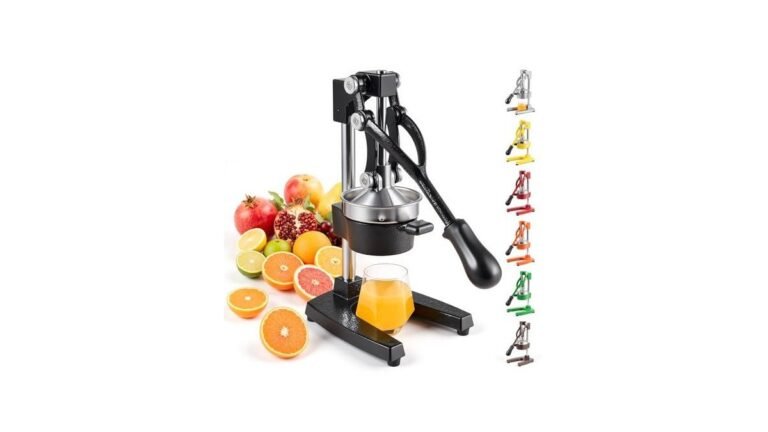
This is a hand press, not a sieve. A cast iron frame with a long lever does the work, and non-slip rubber feet keep it steady on the counter while you pull. The listing names oranges, lemons, pomegranates, and grapefruit, and describes the long lever as making a single pull enough to prepare lemonade or grapefruit juice.
The juice path is thought through. A removable 304 stainless steel strainer catches seeds and excess pulp, and the large pressing bowl is sized for different fruit. A funnel then directs the juice into your serving container instead of down the side of the press. The listing says the food-contact parts are dishwasher safe, which matters after a session with sticky citrus.
NutriChef lists this for home bars and kitchens and also for commercial use in cafés and restaurants. The trade-off is that it’s a citrus press — it’s built around halved fruit, not berries, nut milk, or stock.
Snapshot:
- Cast iron frame with a long lever and non-slip rubber feet
- Listed for oranges, lemons, pomegranates, and grapefruit
- Removable 304 stainless steel strainer catches seeds and pulp
- Large pressing bowl sized for different fruit
- Funnel directs juice into your serving container
- Food-contact parts are dishwasher safe
9. Also Worth Considering
Three more options that didn’t make the main list, each with a clear job. The Zulay Kitchen Fine Mesh Strainer is a 3.35 inch 304 stainless steel sieve aimed at tea, cocktails, juicing, matcha, and coffee — a compact bar-and-kitchen tool in the same size class as the Homestia above. The COKUMA Fine Mesh Strainers is a 3.35 inch stainless steel hand sieve with a handle, listed for cocktails, tea, coffee, and juice, so it covers the small-pour jobs in a single size rather than a set. The NbutWynee Fine Mesh Strainer takes a different route: a set of reusable cloth strainer bags with steel handles, listed for nut milk, juicing, coffee, and Thai tea — a fabric option for anyone who prefers squeezing a bag to pressing a basket.
The Decision Filter
Start with one question: are you straining solids out of liquid, or squeezing liquid out of solids? Those need different tools, and mixing them up is the main reason people end up with something that doesn’t work.
If you’re straining — stock, sauce, tea, pasta water — you want a basket or a cone that sits still while you pour. If you’re squeezing — nut milk, pulp, cooked fruit — you want a bag or a press that lets you apply force.
Then ask about volume. Drinks and small batches point to a compact sieve. Pots and jars point to a stand or a set of sizes. Bottle necks point to a funnel.
Most people miss this: the mesh count and the shape do different jobs. A fine mesh in a flat basket clogs fast under pulp, while a coarser mesh in a cone drains quickly.
Decide your job and your volume, and the list drops to two.
The Quick Checklist
- Will you use this weekly, or only when a recipe calls for it?
- Does anyone else in the house need to use it without instructions?
- What will it sit on — a pot, a bowl, a jar, or a shaker?
- Does it have to handle hot liquid, or only cold?
- Will you wash it by hand, or does it need to be dishwasher safe?
- If it turns out to be the wrong size, can you still use it for something?
Three Regrets Worth Avoiding
Regret #1: Buying a strainer that needs a second pair of hands. A basket sieve has to be held while you pour, and a bag has to be squeezed. Neither is wrong, but both ask something of you mid-task. The fix is deciding up front whether you want a tool that stands on its own — a tripod stand or a pitcher-based kit — or one you’re happy to hold.
Regret #2: Assuming one mesh fits every job. The listings here separate coarse from fine for a reason: 100 mesh for pulpy juice, 200 for nut milk, 300 for the finest work. Buy one density and you’ll either clog it with pulp or watch thin liquid run straight through. The fix is picking the mesh your most common job needs, not the finest one on the page.
Regret #3: Forgetting where the liquid lands. A strainer that fits your pot but not your storage jar means a second pour and a second mess. The fix is measuring the container you’ll strain into before you choose — the Ocapind set names wide-mouth jars, the Kalave funnel names bottles, and the Norpro stand names pots from 4 to 10 quarts.
What to Look for in a Juice Strainer
Match the tool to the job you do most, not the one you do once a year.
| If you want… | Look for | Avoid |
|---|---|---|
| Nut milk and cold brew | Cloth or nylon bag with drawstring | Flat basket that can’t be squeezed |
| Stock and sauce in volume | Conical sieve with a stand | Small handheld sieve |
| One tool for many jobs | Graduated set of three sizes | Single fixed size |
| Yogurt and everyday filtering | Kit with pitcher and press | Bare sieve with no catch vessel |
| Filling bottles cleanly | Funnel with detachable mesh filter | Wide-mouth colander |
| Citrus without electricity | Hand press with lever and strainer | Mesh sieve alone |
Frequently Asked Questions
Will a fine mesh strainer work for nut milk?
It can, but it depends on the mesh and the shape. A bag-style strainer is the better fit because you can gather the material and squeeze it, which is how you get the milk out of the pulp. The PRINKROOMY listing assigns 200 and 300 mesh to nut milk specifically, with 100 mesh for pulpy juice. A flat basket sieve will catch some solids, but you can’t press it the same way.
What size strainer fits a standard mason jar?
That depends on the jar’s mouth, so check whether yours is wide-mouth or regular before choosing. The Ocapind listing specifically names wide-mouth glass jars as a fit for its sizes. A better approach is to measure the jar’s inner diameter and compare it against the strainer’s outer rim. A strainer that rests on the rim lets you filter straight into storage, which saves a pour and a cleanup step.
Can I use these strainers for hot liquids?
Check the material before you do. Stainless steel strainers like the Norpro, YLYL, and Homestia are listed for hot jobs — the YLYL handles are described as staying cool over hot pots, and the Norpro stand is built to hold over pots and Dutch ovens.
How do I clean a nylon or cloth strainer bag?
Rinse it first, then wash. The PRINKROOMY listing says the smooth mesh surface prevents residue buildup and that you simply invert and rinse under running water, with every size drying quickly. The Marsrut kit includes a brush specifically for its filter, described as easier than cleaning a particle filter bag. For nut milk in particular, rinse before the pulp dries, because dried pulp works into the weave.
Do I need a stand, or is a handheld strainer enough?
It comes down to volume and whether you need both hands. A handheld sieve is fine for a single drink, a small batch of tea, or sifting flour. Once you’re straining a pot of stock or pressing cooked fruit, you want the strainer to hold itself up. The Norpro’s tripod stand is listed to fit pots and bowls from 4 to 10 quarts.
What’s the difference between mesh counts on these strainers?
Higher mesh means finer filtration and slower flow. The PRINKROOMY listing lays it out clearly: 100 mesh for pulpy juices and cold brew, 200 mesh for nut milks and coffee, 300 mesh for silky nut milks and herbal tinctures. The Kalave funnel uses 200 mesh for fine grains and particles. Pick the count for your most common job — going finer than you need just means waiting longer for the same result.
Are these strainers dishwasher safe?
Some are, and the listings say so directly. The YLYL set, the Homestia strainer, the Kalave funnel set, and the dishwasher-safe parts of the NutriChef juicer are all listed as dishwasher safe. The Norpro chinois recommends hand washing instead. The Marsrut kit is rinsed and brushed rather than dishwashed. If dishwasher convenience matters to you, check the care line on the specific listing before you commit.
Closing
When two picks still look equal, apply this rule in ten seconds: choose the one that matches the container you already own. A strainer that fits your pot, jar, or shaker gets used. One that needs a different vessel to work properly sits in the drawer. That single check settles most ties.
Then do one thing before you buy. Walk to your kitchen and look at the pot, bowl, or bottle you’ll actually strain into, and note how wide it is. Match that measurement against the sizes in the listings above.