How To Start A Nutribullet Blender: Lock, Press, Blend
Twisting the cup onto the base until it clicks is how to start a Nutribullet blender — the motor only runs when the cup is locked in and you press it down. There’s no on button. Most drinks blend in 30 to 60 seconds.
What changes that for you: which Nutribullet model you own (600, 900 Pro, or a full-size combo), what you’re blending, and how much liquid you put in first. The rest of this page covers each of those.
Who this page is for
Three kinds of people type this into a search box. The first just unboxed a Nutribullet and wants the cup on right without forcing anything. The second has a Nutribullet that won’t start, and suspects they’re doing something wrong — usually they are, and it’s the lock-in.
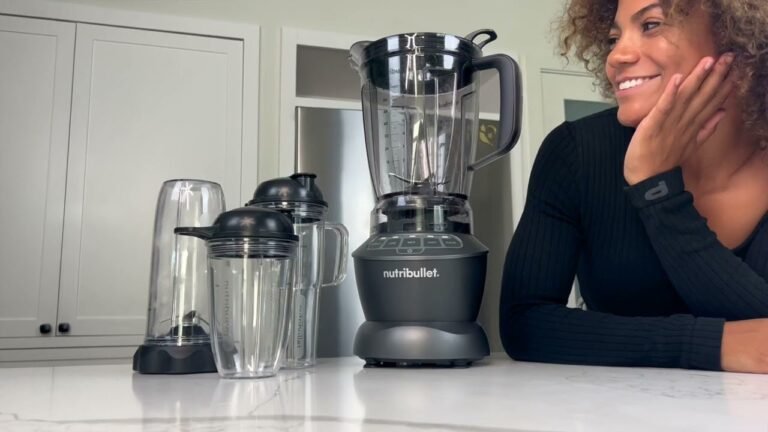
This page serves the first two best: the hands-on steps, the lock-in, the order to put things in the cup. If you’re shopping and haven’t bought yet, the model differences here will help, but a dedicated buying guide is a better fit. Everything below assumes a standard personal-size Nutribullet with a sealed cup and blade you twist together, not the Magic Bullet, which is a different machine.
What changes the result
Four things decide whether your first blend works.
Model. The Nutribullet 600 runs a 600-watt motor; the Pro 900 runs 900 watts. The cups and blades aren’t interchangeable between them. Check the wattage printed on the base of your motor unit — that tells you which manual to follow and what your machine can handle.
What you’re blending. Soft fruit and liquid take under a minute. Frozen fruit, ice, or raw hard vegetables take longer and need more liquid, or the blade spins in an air pocket and does nothing. If your mix won’t move, you need more liquid, not more time.
Order in the cup. Liquid goes in first, then soft ingredients, then powders or seeds, then frozen items on top. Get this backwards and the blade spins against frozen fruit before anything can circulate.
Fill line. Every Nutribullet cup has a max fill line engraved on the side. Past it, liquid can leak into the blade housing or out the top. This is the one people get wrong most often — the cup looks roomy, so they fill it to the brim.
If you don’t know your model’s limits, check the manual that came with it or the guide printed inside the cup’s packaging. Nutribullet publishes model-specific instructions on its own support pages.
How do you start a Nutribullet blender?
Set the base on a dry, flat counter near an outlet. Then work through these steps.
- Plug the base into a wall outlet. Don’t use an extension cord if you can avoid it. The light or switch on some models shows the unit has power.
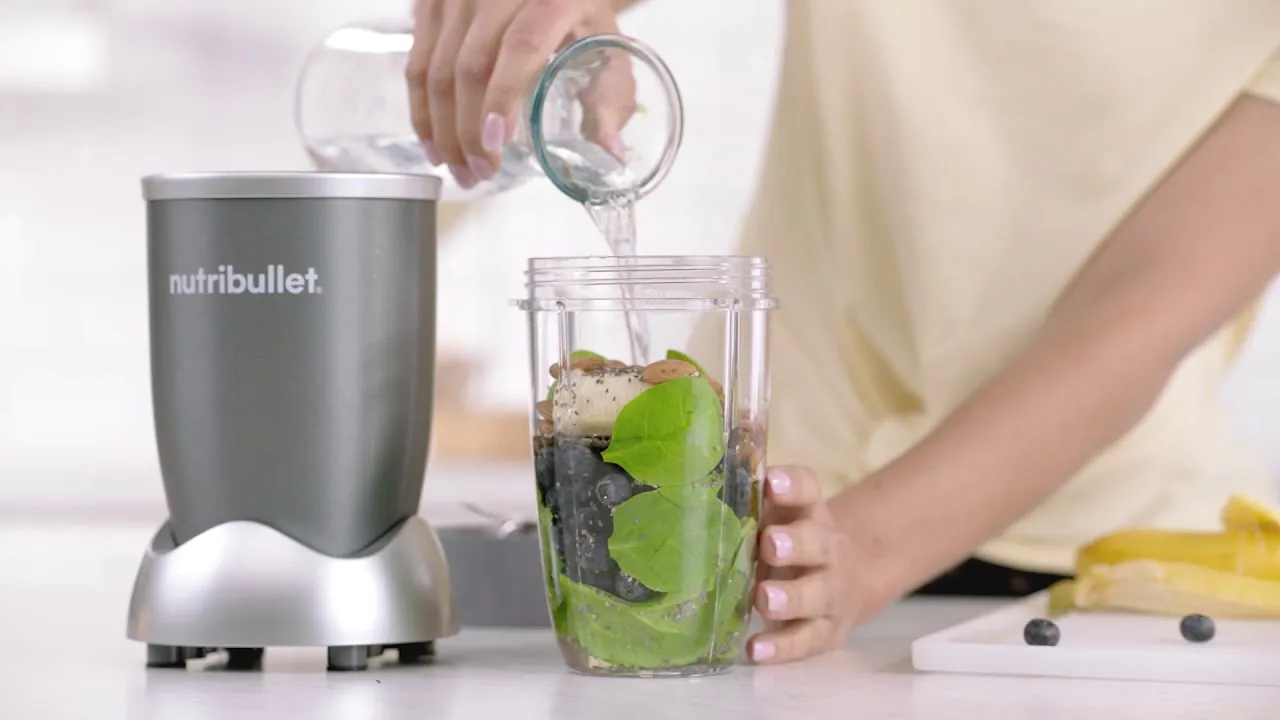
- Add liquid first. Pour in 8 to 12 oz (about 1 to 1.5 cups) of water, milk, or juice — enough to cover the blades once everything’s in.
- Add soft ingredients. Banana, berries, yogurt, spinach. Keep the total below the max fill line.
- Add powders and small dry items. Protein powder, oats, chia. Sitting them on the liquid stops them gluing to the bottom.
- Add frozen or hard ingredients last. Frozen fruit, ice cubes, or a few raw nuts go on top, where the blade reaches them after the liquid is already moving.
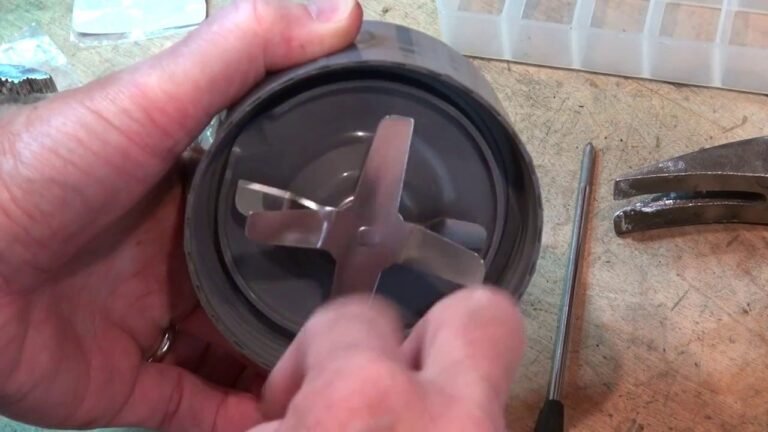
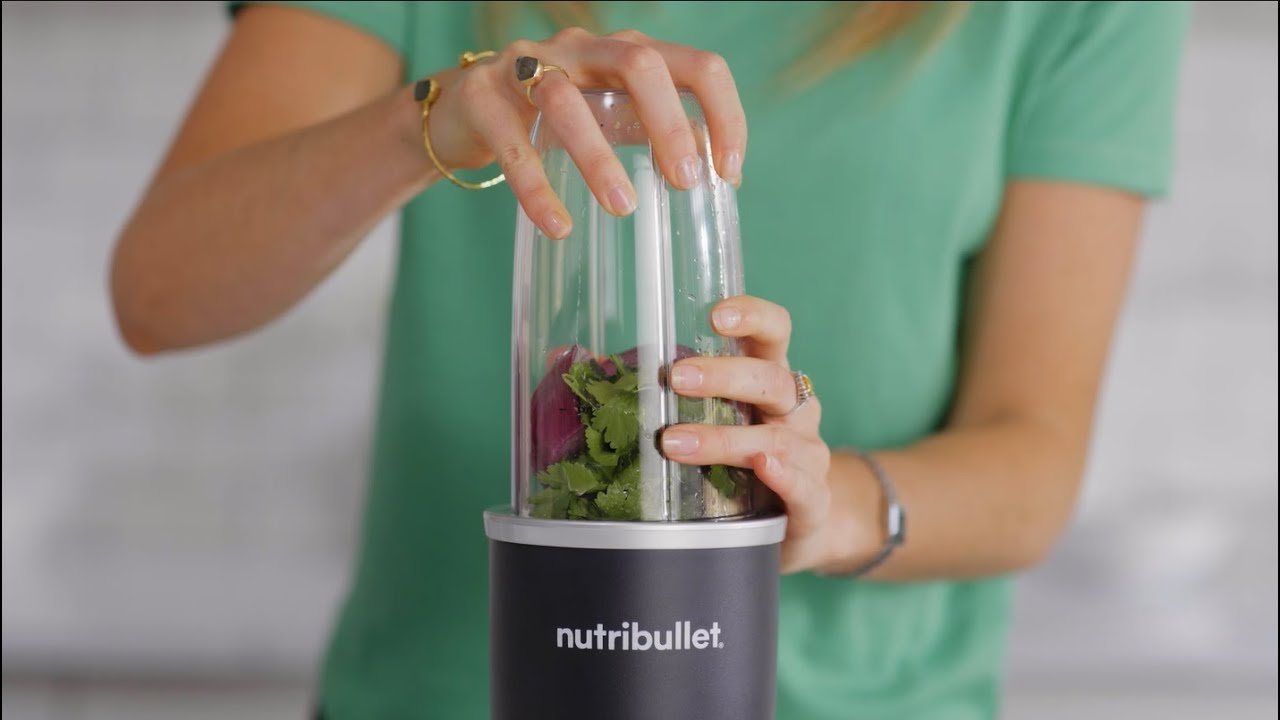
- Screw the blade assembly onto the cup. Turn it clockwise until it’s snug — firm hand-tight, not wrench-tight.
- Flip the cup over and seat it on the base. Line up the tabs, then twist clockwise. You’ll feel it click and drop slightly into the locked position.
- Press to run. Push the cup down into the base — the motor starts. Hold it there and shake the cup gently side to side so the mix keeps moving.
- Blend in short bursts. Run 30 seconds, release, check the texture, then run up to another 30 seconds. If it’s still chunky, add 2 oz of liquid, not more time.
- Release, lift, flip, and pour. Stop the motor first, lift the cup off the base, flip it right side up, unscrew the blade, and pour.
The judgement call is the shake in step 8. A blend that looks finished but has a frozen lump riding above the blades isn’t done — tilt and jiggle the cup while it runs so everything drops into the blades.
If the motor strains or the mix doesn’t move at all within 10 seconds, stop, lift the cup off, and add liquid. Never run the motor longer than one continuous minute; the manual for every Nutribullet model says the same, because the small motor overheats.
One line you shouldn’t cross: never put the blade assembly, the motor base, or a cup with liquid in it in the dishwasher beyond what your model’s manual allows, and never run the blender with nothing in the cup. If the base itself won’t power on and it isn’t the outlet, that’s a repair job — contact Nutribullet’s customer service, don’t open the housing.
Situations at a glance
Different starting points need different handling. Here’s the quick version.
| Situation | What to do | What it takes | What to watch for |
|---|---|---|---|
| First use out of the box | Wash cup and blade, then follow the steps | 5 minutes | Remove all packaging from the blade |
| Frozen fruit smoothie | 10–12 oz liquid, frozen on top, shake while running | 60–90 seconds | Blade spinning in an air pocket |
| Ice crush | Small cubes, plenty of liquid, short bursts | About 60 seconds | Not for the 600-watt model |
| Thick protein shake | Powder on liquid, add 2 oz more liquid if it stalls | Under 60 seconds | Mix seizing above the blade |
| Baby food or sauce | Cook ingredients soft first, blend 30 seconds | 2 minutes | Cool before sealing any container |
| Won’t start | Re-seat cup, twist until it clicks | 10 seconds | Tabs misaligned with the slots |
What experienced users do differently
Two habits separate a smooth first blend from a frustrating one.
Preparation
Experienced users fill the cup in the right order before it ever touches the base, and they add liquid past the blade line — roughly 8 oz minimum for a standard 24 oz cup. They also check the seal: the rubber gasket on the blade assembly should sit flat in its groove.
A gasket that’s popped out or twisted leaks from the bottom of the cup, and it’s the single most common cause of a mess under the base. Wipe the base’s drive sockets dry before every use; moisture there gums up the connection.
While it runs
They don’t walk away. The first 10 seconds tell you everything: if the mix circulates and pulls down toward the blades, it’ll finish. If the blade hums but nothing moves, stop and add liquid rather than burning motor time.
And they pulse frozen loads — 20 seconds on, a pause, 20 seconds on — instead of one long run, which keeps the motor cool and chops more evenly. What they deliberately leave alone: the max fill line, and the urge to press harder. Pressing past the click adds nothing; the switch is already engaged.
Troubleshooting: what you notice and the fix
Most starting problems trace back to the lock-in or the load. Match what you’re seeing here.
| What you notice | What it usually means | What to do first | How to stop it happening again |
|---|---|---|---|
| Motor won’t run at all | Cup not locked in | Lift off, re-seat, twist until it clicks | Line up tabs before twisting |
| Motor hums, blades don’t move | Too little liquid, or overload | Stop, add 2–4 oz liquid | Liquid first, always |
| Smell of hot plastic | Motor overheated | Unplug, wait 30 minutes | Run max 60 seconds at a stretch |
| Leaking under the base | Gasket out of place or cup overfilled | Check the blade’s rubber seal | Fill below the max line |
| Cup won’t screw onto blade | Cross-threaded | Back off, start the thread straight | Hold blade flat while turning |
| Starts then stops mid-blend | Thermal cutoff tripped | Unplug and let it cool | Shorter runs, more liquid |
If the base won’t run even with the cup correctly seated and a known-live outlet, stop there. That’s an internal fault, and opening the housing is a repair-shop or warranty-claim job — Nutribullet’s customer service handles it under the model’s warranty.
The rules that apply
Every Nutribullet ships with a safety sheet, and the rules on it come from Nutribullet’s own published guidance, so check the insert in your box for the version that matches your model.
The consistent ones across models: don’t run the motor more than one continuous minute without a rest; don’t blend hot liquids or carbonated drinks in a sealed cup, because pressure builds; keep the cord and base away from water; and don’t put the motor base in the dishwasher or submerge it.
The one-minute limit is the rule people break most, and it breaks the machine rather than the drink. Thick mixtures — frozen fruit with little liquid, nut butters, hummus — load the motor hardest, so pulse in short bursts instead of holding the button down.
If the base feels hot to the touch or smells like hot plastic, stop and let it cool for at least fifteen minutes before the next run. That smell is the motor telling you it’s working past its design.
Blending hot soup or canning with one is outside what these machines are designed for — Nutribullet’s guidance is explicit that the cups aren’t for hot contents. If you want hot blends, that’s a full-size heated blender or a stovetop pot, not this machine.
One more: never run it empty. With nothing in the cup there’s no load to absorb the speed, and the blade assembly spins faster than it does with food against it.
What it costs you
The blender itself is the fixed cost, and it varies by model and retailer — check current prices on Nutribullet’s own site or major retailers, because they change often. What people forget is the running cost, and it’s small: a 600-watt motor run for one minute uses about 10 watt-hours of electricity, so a daily smoothie costs pennies a month at typical US rates.
The real currency is time and waste. A badly loaded cup costs you a restart, 2 extra minutes, and often a poured-out gritty drink. Frozen fruit bought in bags costs less per pound than fresh and saves the ice — but check the price per ounce at your own store, because it moves with the season. The cost that actually bites is a burned-out motor from long runs, which isn’t covered if the manual’s run-time rule was broken.
Keeping it right afterwards
Clean the cup and blade right after each use — rinse both under warm water, add a drop of dish soap and some warm water to the cup, twist on the blade, run it 20 seconds, and rinse. That’s the whole routine, and it takes under two minutes. Let everything air-dry with the blade standing upright.
The sign that needs attention is a gasket that looks flattened, cracked, or keeps slipping out of its groove — replacement blade assemblies with new seals are sold by Nutribullet and its retailers, and swapping one takes seconds. Check the seal whenever you notice a leak.
If you use the blender daily, a weekly deep check takes 30 seconds: gasket flat, no cracks in the cup, drive sockets on the base clean and dry. Don’t store the cup locked onto the base with the blade compressed against the seal for long periods; keep them separate in a drawer.
When a Nutribullet is the wrong tool
Three situations call for something else. If you’re crushing ice or frozen fruit several times a week for a household, the 600-watt model will strain — a full-size blender with a 1,000-watt-plus motor and a wide jar handles that load better and lasts longer. If you want hot soups or sauces blended from raw ingredients, a Nutribullet can’t take hot contents; you need a heated blender like the ones made for soup, or a pot and an immersion blender.
And if you’re blending big batches — more than about 24 oz at a time — the personal cups max out fast; a countertop blender with a 64 oz jar is the honest alternative. For any repair beyond cleaning and the blade seal, that’s Nutribullet’s service center or an appliance repair shop, not a DIY job.
Frequently asked questions
How do I turn on a Nutribullet if there’s no button?
There isn’t one — the switch is built into the base. Seat the cup on the base, then press down until the motor starts. Release or untwist and it stops. If twisting doesn’t start it, the cup isn’t aligned with the tabs on the base.
Why won’t my Nutribullet start at all?
Nine times out of ten the cup isn’t locked in. Lift it off completely, seat it on the tabs, and twist until you feel the click. If it still won’t run, try another outlet and check that the drive sockets on the base are clean and dry. Beyond that, contact Nutribullet’s customer service.
How long should I blend a smoothie?
About 30 to 60 seconds total, in one or two runs, for a soft-fruit smoothie in a 600- or 900-watt model. Frozen loads take 60 to 90 seconds with a shake between runs. Never run the motor longer than one continuous minute — let it rest before going again.
Is it safe to put hot liquid in a Nutribullet?
No. Nutribullet’s own guidance says the sealed cups aren’t designed for hot contents, because heat builds pressure that can pop the lid off. Let food cool to warm first, or blend hot drinks in a vented, purpose-built heated blender.
What happens if I overfill the cup?
Liquid rides above the seal and leaks out the bottom of the blade assembly or sprays from the top. You’ll also lose blending power, because the mix can’t circulate. Fill to the max line or below — everything else can be blended in a second batch.
Can I put ice in a Nutribullet?
Yes, but with conditions. The 900-watt Pro and similar models handle a few small cubes with plenty of liquid; the 600-watt model isn’t built for ice and may stall or wear early. Either way, liquid goes in first and you run short bursts, not one long press.
Does it matter which order I put ingredients in?
Yes, it’s the difference between a smooth blend and a stalled one. Liquid first, then soft items, then powders and seeds, then frozen or hard items on top. That order lets the blades pull everything down into circulation instead of spinning against a frozen lump.
How long do I have to wait if the motor overheats?
Unplug it and wait at least 30 minutes, until the base feels cool to the touch. The motor has a thermal cutoff that stops it before damage, and it resets as it cools. If it shuts down again quickly after that, the runs are too long or the load is too thick.
Your first blend, today
Start with the easiest load there is: 8 oz of milk, one banana, and a handful of berries. Follow the ten steps, twist until you feel the click, and run it 30 seconds — you’ll know it worked when the mix swirls down toward the blades with no chunks riding on top.
If the motor hums but nothing moves, stop, add 2 oz of liquid, and go again; that one fix handles most stalls without any repair.
Frozen fruit is the other common stall, and it needs a different fix. Let the fruit sit out for 10 minutes first so it softens before it goes in the cup. Cold blocks of fruit just sit there while the blades spin underneath.
One mistake costs people the whole batch: filling past the max line to save a second pour. The pitcher needs that empty space for the vortex to form. Overfill it and you get a still, chunky jar every time.