How Much Is an Oster Blender? Typical Prices Explained
An Oster blender typically costs between $20 and $250, with the vast majority of models selling in the $25 to $60 range. That spread covers everything from a basic 2-speed “beehive” jar blender at Walmart to a high-performance 1,200-watt reverse-crush machine with a stainless steel blade and a 6-cup glass jar.
Key Takeaways
- Most Oster blenders cost $25–$60. The classic 3-speed and 2-speed models sit at the bottom; the Pro, Master, and Reverse Crush lines sit above them.
- The single biggest price driver is wattage. A 450-watt Oster runs about $25–$35; a 1,200-watt Oster can run $90–$180.
- Jar material matters more than most shoppers expect. Glass jars cost more and last longer; plastic jars cost less and scratch, cloud, and stain over time.
- Refurbished and open-box Osters cut 25–45% off retail and are widely available through Oster’s own outlet and major retailers.
- Replacement parts are cheap, which is why a $30 Oster can outlive a $200 blender from another brand — a new blade assembly is often $10–$18 and a new jar is $15–$30.
- Where you buy changes the price by $10–$20. Big-box stores and Amazon undercut department stores and specialty kitchen shops on identical models.
What You Actually Pay for an Oster Blender
Oster has been selling blenders since the 1920s, and the brand’s identity is built on two things: low prices and near-indestructible motors. That combination is why you can find an Oster for the price of two takeout dinners and also find one that costs as much as a mid-range Vitamix.
Here is the honest breakdown by tier.
| Tier | Typical Price | Wattage | Jar | Best For |
|---|---|---|---|---|
| Basic / Classic | $20–$35 | 350–500W | 5–6 cup plastic or glass | Smoothies, shakes, light blending |
| Mid-range | $35–$70 | 600–800W | 6 cup glass | Frozen drinks, soups, daily use |
| High-performance | $70–$130 | 900–1,200W | 6–8 cup glass or Tritan | Ice crushing, nut butters, heavy duty |
| Premium / Pro lines | $130–$250 | 1,200W+ | 8 cup+ | Commercial-style blending, large batches |
The sweet spot for most households is $40–$60. That buys a 700–800-watt motor, a glass jar, and a blade assembly that will handle frozen fruit and ice without complaint.
If you only make protein shakes and the occasional pancake batter, the $25 model is genuinely fine. You aren’t being cheap; you’re being correctly calibrated.
How Much Is an Oster Blender at Each Major Retailer?
Prices shift constantly, but the retailer ranking is stable. Here is where Oster blenders tend to be cheapest, based on typical listings.
| Retailer | Typical Oster Price Range | Notes |
|---|---|---|
| Walmart | $20–$90 | Cheapest baseline; exclusive lower-cost models |
| Amazon | $25–$150 | Widest selection; frequent 15–30% discounts |
| Target | $30–$100 | Good in-store availability, fewer deep discounts |
| Best Buy | $35–$120 | Carries the higher-wattage models |
| Bed Bath & Beyond / similar | $40–$130 | Higher list prices, more coupon eligibility |
| Oster.com (direct) | $30–$200 | Refurbished outlet; occasional bundles |
| Costco / Sam’s Club | $50–$100 | Bundles, often includes extra jar or accessories |
Walmart and Amazon are almost always the cheapest for identical models. If a specific Oster is $59 at Target, expect $45–$50 at Walmart for the same SKU.
Pro Tip: Check the model number, not the product name. Oster reuses names like “Classic” and “Pro” across several generations, and a retailer will happily sell you a 450-watt “Pro” while a competitor sells a 700-watt one under the same word.
The Models Most People Are Actually Pricing
These are the Oster blenders that show up most often in searches, with realistic street prices.
| Model | Typical Price | Wattage | Why People Buy It |
|---|---|---|---|
| Oster 2-Speed Beehive | $20–$30 | 350–450W | Cheapest entry, retro look, tiny footprint |
| Oster 3-Speed Classic | $25–$40 | 450–600W | The default budget blender for decades |
| Oster 8-Speed | $40–$60 | 600–700W | More control, glass jar option |
| Oster Pro 1200 | $80–$120 | 1,200W | Ice crushing, frozen drinks, heavy use |
| Oster Master Series | $60–$100 | 800–1,000W | Mid-tier workhorse |
| Oster Reverse Crush | $70–$110 | 1,000W | Dual-direction blades, less cavitation |
| Oster Versa | $100–$200 | 1,000–1,400W | High-performance blending, larger jar |
| Oster Blender with Food Processor Attachment | $50–$80 | 600–800W | Two appliances, one base |
The Oster Pro 1200 is the model most often compared to a Vitamix, and it’s the one where the price gap matters most: roughly $90–$120 versus $400–$550 for the Vitamix. It isn’t the same machine, but for frozen fruit and ice it’s far closer than the price difference suggests.
What Drives the Price Up or Down
Five features account for nearly all of the price variation.
Wattage and Motor Quality
Wattage is the headline number. Under 500 watts, you’re blending soft ingredients and hoping ice behaves. Between 600 and 800 watts, you can crush ice reliably. Above 1,000 watts, you can do nut butters, frozen whole fruit, and long continuous runs without the motor smelling hot.
Every $20–$30 jump in price usually corresponds to a meaningful wattage step.
Jar Material and Size
A glass jar adds roughly $8–$15 to the price of an otherwise identical blender. It’s worth it. Glass doesn’t scratch, doesn’t hold onto garlic or curry smells, and doesn’t cloud after a year of dishwasher cycles.
Plastic and Tritan jars are lighter and cheaper, and Tritan is genuinely durable — but it still scratches, and scratched plastic is where odors live.
Blade Assembly
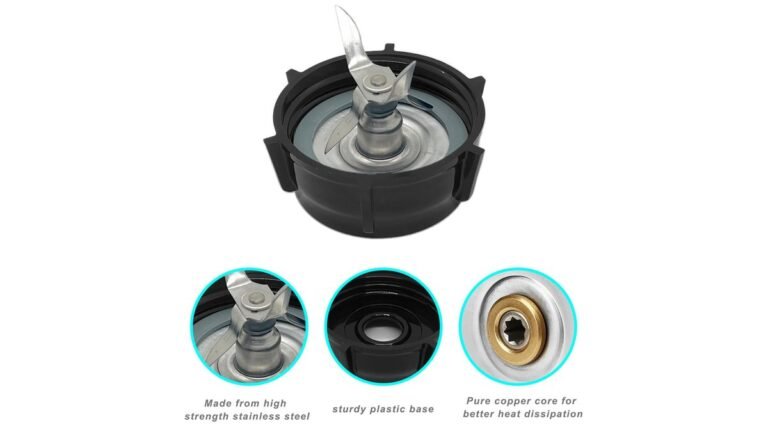
Oster’s signature is the six-point Star Blade, a design the brand has used for decades. Replacement assemblies run $10–$18. Higher-end models use heavier-gauge stainless and, in the Reverse Crush line, a blade that changes direction to pull ingredients down instead of letting them spin in place.
Speed Settings and Programs
A 2-speed blender costs less than an 8-speed one, and a model with preset programs (smoothie, salsa, ice crush, pulse) costs more again. Presets are convenience, not power. If budget is tight, buy wattage over presets every time.
Accessories and Bundles
Extra jars, travel cups, food processor attachments, and spatulas add $10–$40 to the box price. Bundles are usually a better deal than buying the parts separately, but only if you’ll actually use them.
Warning: A “blender system” bundle with a food processor attachment often uses a smaller motor than the standalone blender at the same price. Check the wattage before you buy the bundle.
Is a Cheap Oster Blender Worth It?
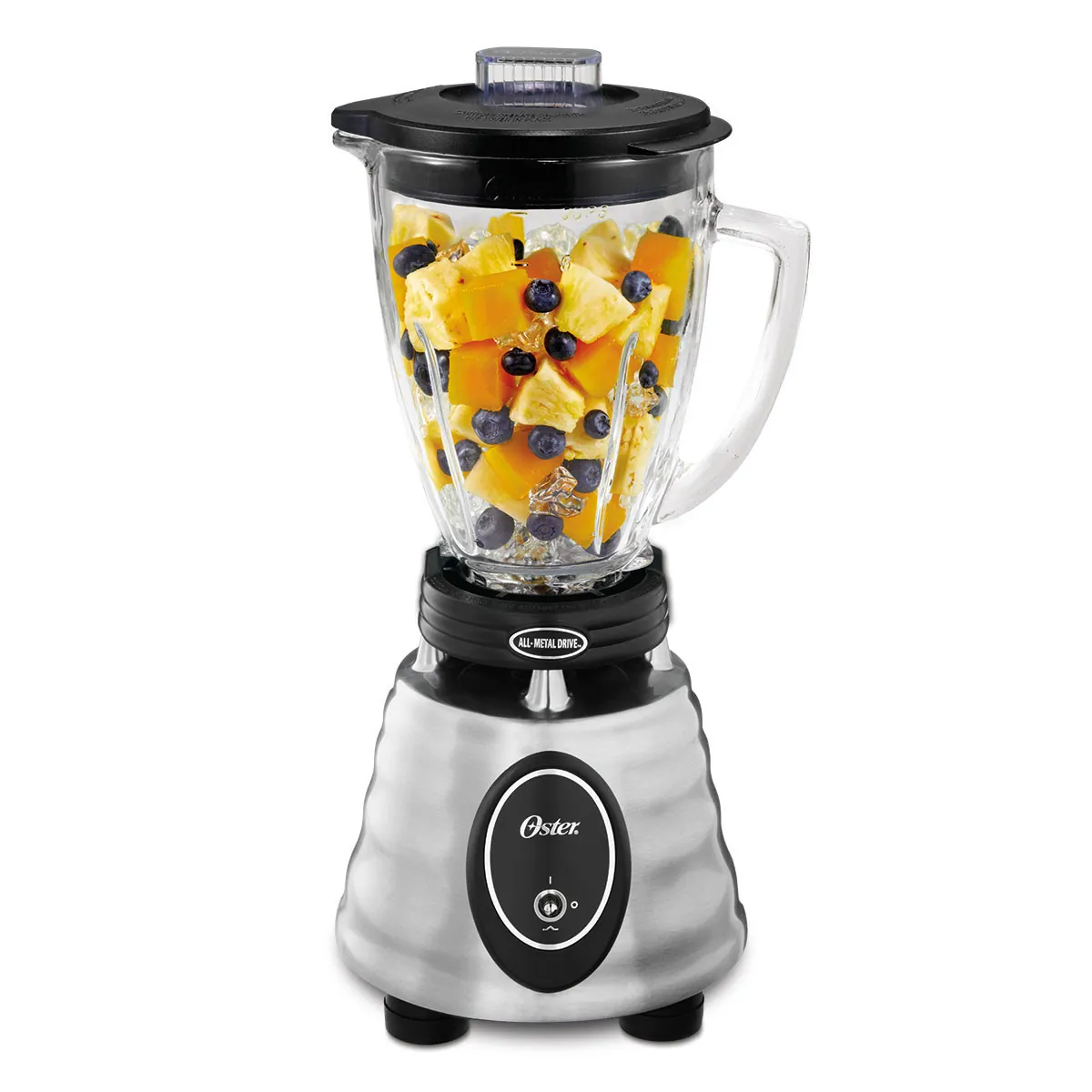
Yes, with one condition: you have to match the blender to the job.
An Oster 3-Speed Classic at $30 is a genuinely good appliance for:
- Protein shakes and smoothies with fresh or soft-frozen fruit
- Pancake and waffle batter
- Pureed soups (cooled, in batches)
- Baby food
- Salad dressings, sauces, and marinades
- Milkshakes and cocktails
It’s a bad appliance for:
- Crushing a full tray of ice cubes at once
- Nut butters
- Hot liquids straight from the pot
- Grinding grains or coffee
- Anything you need to run for more than about 60 seconds continuously
The reason cheap Osters have a good reputation is that they’re repairable and their parts are cheap. A $30 Oster with a burned-out blade assembly is a $12 fix. A $200 blender with a cracked jar can be a $70 fix or a dead appliance, depending on whether the brand still sells that jar.
That repairability is the real value proposition, and it’s why so many Osters from the 1990s are still running.
New vs. Refurbished vs. Used
| Option | Typical Discount | Warranty | Risk |
|---|---|---|---|
| New, retail | — | 1–3 years | None |
| New, on sale | 15–30% off | 1–3 years | None |
| Manufacturer refurbished | 25–45% off | 90 days–1 year | Low |
| Open-box | 20–40% off | Varies, often full | Low |
| Used (marketplace) | 50–70% off | None | Medium–high |
Manufacturer-refurbished is the best value for most buyers. Oster’s refurbished units are inspected, and the discount is real. The trade-off is a shorter warranty, usually 90 days to a year instead of the full term.
Pro Tip: If you buy used, ask for a photo of the blade assembly and the jar base. A worn blade assembly is the most common failure point, and a cloudy, scratched jar means the previous owner blended a lot of ice in it. Both are cheap to replace, but they’re leverage for a lower price.
Where to Buy and How to Pay Less
- Walmart — lowest baseline prices, exclusive budget SKUs, rollback pricing on the Classic line
- Amazon — widest selection, frequent coupons, Warehouse Deals for open-box units
- Target — good in-store stock, Circle offers stack occasionally
- Best Buy — carries the higher-wattage models, price-matches major competitors
- Costco and Sam’s Club — bundles with extra jars, strong return policy
- Oster.com — refurbished outlet and direct-only bundles
- Home goods and discount department stores — hit-or-miss, but clearance Osters show up at 40–60% off
Three reliable ways to pay less:
- Buy the previous generation. When Oster refreshes a model, the old SKU drops 20–35% and works identically.
- Shop after major gift holidays. January and July see the deepest small-appliance markdowns.
- Buy the base, not the bundle. If you only need the blender, the standalone version is usually $10–$25 cheaper than the bundle.
Warning: Third-party marketplace sellers sometimes list discontinued Oster models above original retail. If a “rare” Oster is priced at $180, check whether a current 1,200-watt model costs less. It usually does.
What Replacement Parts Cost
This is where Oster separates itself from nearly every competitor.
| Part | Typical Price |
|---|---|
| Blade assembly (Star Blade) | $10–$18 |
| Glass jar (6 cup) | $20–$30 |
| Plastic jar (6 cup) | $12–$20 |
| Jar lid and cap | $6–$12 |
| Base gasket / sealing ring | $5–$9 |
| Drive coupling / gear | $6–$12 |
| Full jar + blade + lid set | $25–$40 |
A $12 blade assembly is the single most common repair, and it restores a blender that has started leaving chunks. If your Oster is leaking from the bottom of the jar, the gasket is usually the culprit at under $10.
Compare that to a premium blender brand where a replacement jar can cost $80–$150, and the economics of buying a cheap Oster become obvious.
How Oster Compares on Price
| Brand | Typical Entry Price | Typical Mid-Range | Typical High-End |
|---|---|---|---|
| Oster | $20–$35 | $40–$70 | $90–$250 |
| Hamilton Beach | $20–$35 | $35–$60 | $70–$120 |
| Ninja | $60–$90 | $90–$150 | $150–$250 |
| NutriBullet | $50–$80 | $80–$130 | $130–$180 |
| Vitamix | $300–$400 | $400–$500 | $500–$700 |
| Breville | $130–$200 | $200–$300 | $300–$500 |
Oster and Hamilton Beach occupy the same budget tier. Ninja and NutriBullet sit one step up. Vitamix and Breville are a different category entirely, and comparing an Oster to a Vitamix is only fair if you compare the Oster Pro 1200 to a Vitamix at four times the price.
The honest summary: an Oster at $50 does about 80% of what a $400 blender does, for frozen drinks and smoothies. The remaining 20% — silky nut butters, hot soup programs, 10-year warranties, and the ability to run for five minutes straight — is what you pay the extra $350 for.
Questions to Ask Before You Buy
- How many watts? Under 500W for soft ingredients, 600–800W for ice, 1,000W+ for heavy duty.
- Glass or plastic jar? Glass costs $8–$15 more and is worth it.
- How many speeds? Two is enough if you mostly make smoothies. Eight gives you control for salsa and soups.
- Is the blade assembly replaceable and cheap? With Oster, almost always yes.
- Does the jar fit under your cabinets? Check height before you buy — some 8-cup jars are tall.
- What is the warranty? Oster typically offers 1–3 years depending on the model.
- Do you need a tamper? High-performance models usually include one; budget models usually do not.
Frequently Asked Questions
How much does the cheapest Oster blender cost?
The least expensive new Oster blenders sell for about $20 to $30, usually the 2-speed beehive or a basic 3-speed model with a plastic jar. These appear regularly at Walmart and Amazon, and they drop to around $18–$22 during holiday sales. They’re functional for smoothies and shakes but not for crushing ice in volume.
Is an Oster blender as good as a Vitamix?
No, but the gap is narrower than the price suggests. An Oster Pro 1200 at roughly $90–$120 handles frozen fruit, ice, and smoothies well. A Vitamix at $400–$550 adds a far longer warranty, hotter soup capability, smoother nut butters, and the ability to run continuously for minutes. For daily smoothies, most people won’t notice the difference.
Why are some Oster blenders so cheap?
Oster keeps costs down with simpler motors, fewer speed settings, plastic jars on entry models, and enormous production volume. The brand has also used the same blade and jar designs for decades, so tooling costs are long paid off. Cheap doesn’t mean disposable here — parts are widely available and inexpensive.
How much is a replacement Oster blender jar?
A replacement glass jar typically costs $20 to $30, and a plastic jar runs $12 to $20. Complete sets that include the jar, blade assembly, and lid usually sell for $25 to $40. Always match the jar to your base model number, since thread sizes and locking tabs differ between generations.
Does wattage really matter on a blender?
Yes, more than any other spec. Wattage determines how much torque the motor can deliver under load. A 450-watt motor stalls on frozen fruit; a 1,000-watt motor powers through it. If you blend ice or frozen ingredients regularly, buy the highest wattage your budget allows and ignore the preset buttons.
Where is the best place to buy an Oster blender?
Walmart and Amazon consistently have the lowest prices on identical models, often $10–$20 below department stores. Costco and Sam’s Club are best if you want a bundle with extra jars and a generous return policy. Oster’s own site is the best source for refurbished units at 25–45% off.
Conclusion
An Oster blender is one of the few kitchen appliances where the budget option is genuinely a good decision rather than a compromise. Decide what you actually blend — shakes and smoothies, or ice and nut butters — pick a wattage that matches, and buy the model that hits that number at the lowest price you can find. Start by checking current pricing on the Oster Pro 1200 and the 3-Speed Classic, since those two bracket the range most shoppers actually need.