Can You Blend Spices In A Nutribullet? Yes, Here’s How
Yes, you can blend spices in a Nutribullet, and for most whole dry spices it works surprisingly well — but only if you use the right blade, keep the load small, and accept that hard seeds like nutmeg and cinnamon bark won’t come out perfectly fine.
Key Takeaways
- A Nutribullet will grind whole dry spices like cumin, coriander, peppercorns, and dried chiles into a usable powder, usually in 20–40 seconds.
- You must use the flat milling blade (sometimes sold as the “milling blade” or “grinding blade”), not the standard extractor blade meant for smoothies.
- Fill the cup no more than one-third full and grind in short pulses; overfilling stalls the motor and leaves chunks.
- Very hard spices — nutmeg, cinnamon sticks, star anise, and whole cloves — will crack and coarse-grind but rarely reach a fine, store-bought texture.
- Clean the cup and blade immediately after grinding, or the oils in the spice will set and leave a permanent aroma.
- A dedicated spice or coffee grinder still beats a Nutribullet for volume and fineness, but for small batches the Nutribullet is genuinely fine.
Can You Blend Spices In a Nutribullet?
Short answer: yes, with conditions. The Nutribullet is a high-speed blender, and high-speed blenders grind dry spices all the time. The catch is that the standard Nutribullet package ships with an extractor blade designed to pull liquids through fruits and vegetables, not to pulverize hard, dry seeds. If that’s the only blade you own, you’ll get uneven results — some powder, some whole seeds bouncing around the cup.
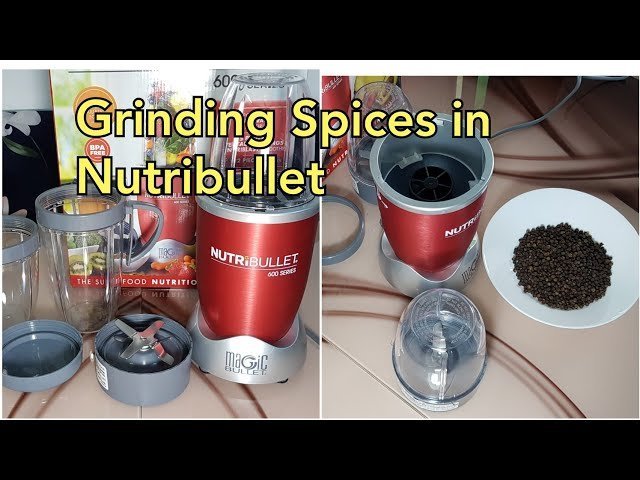
The fix is the milling blade, a flat two-pronged blade that Nutribullet sells separately for most of its models. It’s designed exactly for dry ingredients: coffee beans, grains, nuts, and spices. With that blade installed, a Nutribullet becomes a legitimate small-batch spice grinder.
There’s also a capacity ceiling. Nutribullet cups are small by design, and dry spices behave differently from liquids — they don’t flow, they just sit in a pile under the blade. That means you can only grind a few tablespoons at a time, no matter how big the cup looks.
If you own a Nutribullet Pro, Pro 900, Magic Bullet, or the original 600-watt model, the same principles apply. Wattage affects speed, not capability: a 900-watt motor grinds faster and handles harder spices better than a 250-watt Magic Bullet, but both will do cumin.
Which Blade You Actually Need
This is the single most common reason people give up on grinding spices in a Nutribullet. They use the wrong blade, get a chunky mess, and conclude the machine can’t do it.
| Blade type | Designed for | Works for dry spices? | Notes |
|---|---|---|---|
| Extractor blade (standard) | Smoothies, shakes, liquids | Poorly | Tall blade creates a vortex that needs liquid; dry spices just scatter |
| Milling blade (flat) | Coffee, grains, nuts, spices | Yes | The correct choice; sold separately for most models |
| Pitcher blade / large cup blade | Big batches of liquid | Poorly | Too large for the small volume of spice you’re grinding |
| Baby bullet blade | Small soft foods | Marginally | Small cup helps, but motor is weak for hard seeds |
Pro Tip: If you can’t find a milling blade for your specific Nutribullet model, check the manufacturer’s accessory page directly rather than buying a third-party blade. Blade threading and cup fit vary between Nutribullet generations, and a mismatched blade won’t seal.
Do You Really Need the Milling Blade?
You can get acceptable results with an extractor blade if you’re grinding something soft and oily, like dried chiles, sun-dried tomatoes, or already-cracked peppercorns. You won’t get acceptable results with an extractor blade on whole coriander or cumin seed. The blade simply pushes them around the cup instead of trapping them against the base.
What Grinds Well and What Doesn’t
Not all spices are equal. Some turn to powder in fifteen seconds; others will fight you for a full minute and still leave grit.
| Spice | Grind difficulty | Typical time | Result quality |
|---|---|---|---|
| Cumin seed | Easy | 20–30 sec | Fine powder |
| Coriander seed | Easy | 20–30 sec | Fine powder |
| Black peppercorns | Easy | 20–30 sec | Fine to coarse, your choice |
| Dried chiles (stemmed) | Easy | 15–25 sec | Flakes to powder |
| Fennel seed | Moderate | 25–35 sec | Mostly fine, some husk |
| Mustard seed | Moderate | 30–40 sec | Coarse powder |
| Dried ginger slices | Moderate | 30–45 sec | Powder with some fiber |
| Cardamom pods (green) | Moderate | 30–40 sec | Husk separates; sift if needed |
| Whole cloves | Hard | 40–60 sec | Coarse powder, oily |
| Star anise | Hard | 45–60 sec | Coarse, fibrous |
| Cinnamon sticks | Very hard | 60+ sec | Shards and dust, never fine |
| Whole nutmeg | Very hard | Not recommended | Chips and dust; grate instead |
Warning: Don’t put whole nutmeg or full cinnamon sticks in a Nutribullet cup and run it for two minutes straight. The motor will overheat, the plastic cup can scar, and you still won’t get a fine powder. Break cinnamon sticks into small pieces with a hammer or heavy pan first, and grate nutmeg on a fine grater.
The Hard Spice Workaround
For cinnamon and nutmeg, the honest advice is to skip the blender. A Microplane or fine box grater handles nutmeg in seconds and gives you a far better result. For cinnamon, buy it as ground cinnamon or as cinnamon chips, which grind more readily than full quills. If you insist on whole sticks, break them into half-inch pieces, freeze them for 15 minutes to make them more brittle, then pulse in small batches and sift out the shards.
Step-by-Step: Grinding Spices in a Nutribullet
Here is the process that actually works, in order.
- Fit the milling blade to a dry, clean cup. Make sure the gasket is seated and undamaged.
- Add spice to no more than one-third of the cup. For a standard 24-ounce cup, that’s roughly 3–4 tablespoons of whole seed. Less is better than more.
- Seal the cup and lock it onto the power base.
- Pulse, don’t hold. Run 3–5 seconds, stop, shake the cup, repeat. Continuous running heats the spice and can melt the oils, which makes a paste.
- Check at 20 seconds. Open the cup, stir with a dry spoon, look for whole seeds at the edges.
- Continue pulsing until you reach the texture you want, usually 20–40 seconds total for easy spices.
- Let the dust settle for 30 seconds before opening. Spice dust is fine and will puff into the air.
- Empty immediately into a jar with a tight lid, away from light and heat.
- Clean the cup and blade right away — see the cleaning section below.
Why Pulsing Matters More Than Power
A blender motor running continuously builds heat. Spices are full of volatile oils — that’s where their flavor lives. Heat drives those oils off, which means a spice you ran for 90 seconds straight will smell amazing in the cup and taste flat in the food. Short pulses keep the temperature down and preserve the aroma.
How to Get a Finer, More Even Grind
If your first attempt came out uneven, these adjustments fix almost every case.
- Grind less at a time. Halving the load often doubles the consistency.
- Toast first, cool completely. Toasting whole spices in a dry pan for 1–2 minutes makes them brittle and easier to break. Cool them fully before grinding, or they will steam and clump.
- Freeze hard spices. Fifteen minutes in the freezer makes peppercorns, cloves, and cinnamon pieces shatter instead of bounce.
- Add a pinch of coarse salt when grinding hard seeds. The salt acts as an abrasive and helps the blade catch the seeds. Adjust your recipe for the added salt.
- Sift through a fine mesh strainer after grinding. Return the coarse bits to the cup and pulse again.
- Shake between pulses. Spice piles up in the corners; shaking redistributes it into the blade path.
- Dry your spices. Any moisture — from a damp cup or freshly washed seeds — turns powder into paste.
Pro Tip: If you’re grinding a blend, grind the hardest spice first, remove it, then grind the softer ones, and combine at the end. Grinding cumin and cinnamon together means the cumin turns to powder while the cinnamon is still shards.
Making Spice Blends in a Nutribullet
Blends are where the Nutribullet earns its keep, because you can grind and combine in one cup. A few that work well:
- Taco seasoning: cumin seed, dried oregano, dried garlic, dried onion, chile powder, black pepper.
- Garam masala: coriander seed, cumin seed, black peppercorns, green cardamom, cloves, cinnamon piece, bay leaf.
- Ras el hanout: cumin, coriander, cinnamon, ginger, turmeric, black pepper, cardamom, nutmeg (pre-grated).
- Baharat: black pepper, coriander, cumin, cloves, cinnamon, cardamom, paprika.
- Jerk seasoning: allspice berries, black pepper, dried thyme, cinnamon, nutmeg (pre-grated), dried chile, dried garlic.
The order matters. Grind the hardest ingredients first, pulse them down, then add the soft ones. Whole dried garlic and onion are relatively soft and will turn to paste if over-blended, so add them last and pulse briefly.
A Note on Ratios
Most spice blends follow a rough pattern: one dominant spice at 4 parts, two or three supporting spices at 2 parts each, and strong spices like cloves or nutmeg at 1 part or less. Write down what you used the first time. You won’t remember.
Cleaning and Storing
Spice oils are persistent. A cup that smells like cumin will make your next smoothie taste like cumin.
- Rinse immediately with hot water after emptying. Don’t let residue dry.
- Wash with warm soapy water and a soft brush. Don’t use abrasive pads on the plastic cup.
- Remove the gasket from the blade assembly occasionally and wash underneath it. This is where the smell hides.
- Deodorize by blending a paste of baking soda and water for 10 seconds, then rinsing thoroughly.
- Air dry completely before storing, with the cup upside down.
- Store ground spices in small glass jars with tight lids, in a cool dark cabinet, for up to 6 months. Whole spices keep 2–3 years.
Warning: Never put the blade assembly in a dishwasher unless the manufacturer says it’s dishwasher-safe. Most Nutribullet blades are hand-wash only, and dishwasher heat degrades the gasket and bearing.
Nutribullet vs. Dedicated Spice Grinders
Is it worth buying a separate grinder? It depends on how much you grind.
| Factor | Nutribullet with milling blade | Dedicated spice/coffee grinder |
|---|---|---|
| Price | Blade costs roughly $15–$30 if bought separately | Grinder costs roughly $20–$60 |
| Batch size | 2–4 tablespoons | 2–4 tablespoons (blade type) to 1 cup (burr type) |
| Fineness | Good for most spices, poor for cinnamon and nutmeg | Very fine, consistent |
| Speed | 20–40 seconds | 10–20 seconds |
| Flavor carryover | High; cup and gasket hold aroma | Lower, but still present in blade grinders |
| Best for | Occasional grinding, small blends | Frequent grinding, large blends, coffee |
If you grind spices once a month, the Nutribullet plus a milling blade is the cheaper, space-saving choice. If you grind weekly, a dedicated grinder pays for itself in convenience — and you can keep it solely for spices so your coffee never tastes like cumin.
Common Problems and Fixes
| Problem | Likely cause | Fix |
|---|---|---|
| Spice stays whole | Wrong blade (extractor) | Switch to milling blade |
| Uneven grind, powder plus chunks | Overfilled cup | Reduce to one-third full, pulse and shake |
| Spice turns to paste | Over-blending, heat, or moisture | Pulse in shorter bursts; dry cup and spices fully |
| Motor stalls or smells hot | Too much hard spice, continuous run | Grind less, pulse, let motor rest 5 minutes |
| Cup smells permanently | Oils absorbed into plastic | Baking soda paste, wash gasket, sun-dry |
| Blade won’t turn | Overloaded or mis-seated cup | Empty half, reseat cup on base |
| Dust puffs everywhere | Opening too soon | Wait 30 seconds after the last pulse |
Frequently Asked Questions
Can I grind coffee beans in a Nutribullet?
Yes, with the milling blade. Coffee beans are moderately hard and grind in 15–25 seconds of pulsing. The result is closer to a coarse grind than an espresso-fine grind, so it suits drip, French press, and cold brew better than espresso. Clean thoroughly afterward, or your next spice blend will taste like coffee.
How full should I fill the cup for spices?
No more than one-third full. For a standard 24-ounce Nutribullet cup, that’s about 3–4 tablespoons of whole spice. Filling higher leaves the top layer sitting above the blade’s reach, so you get powder at the bottom and whole seeds at the top.
Can I grind wet spices or make a paste?
Yes, but that’s a different job. Wet pastes — ginger-garlic paste, curry paste, chile paste — use the extractor blade, not the milling blade, and need some liquid to circulate. Add a tablespoon of oil or water and scrape down the sides between pulses.
Will grinding spices void my Nutribullet warranty?
Grinding dry spices with the correct milling blade is a normal use of the accessory and shouldn’t void a warranty. Grinding large amounts of hard material with the wrong blade, or running the motor continuously until it overheats, can cause damage a warranty won’t cover. Check your model’s manual for what counts as intended use.
How long do freshly ground spices last?
Ground spices lose potency faster than whole ones. Expect 3–6 months at good strength in a sealed glass jar in a cool, dark cabinet, versus 2–3 years for whole spices. If a ground spice smells weak when you open the jar, it will taste weak in the food.
Can I grind salt and dried herbs in a Nutribullet?
Coarse salt grinds fine in a milling blade, though it can scratch the plastic cup over time. Dried herbs like oregano, thyme, and rosemary grind well but are light and fly up, so pulse briefly and expect to shake the cup often. Combine salt and herbs for a quick seasoned salt.
Conclusion
You don’t need a separate appliance to start grinding your own spices — fit the milling blade, keep the load small, pulse in short bursts, and clean the cup the moment you’re done. Pick one whole spice you already use often, grind a small batch this week, and compare it against the jar in your cabinet; the difference in aroma will tell you whether the Nutribullet deserves a permanent spot in your spice routine.