How Many Watts Is an Oster Blender? Find Your Model’s Rating
An Oster blender’s wattage depends on the model, and most Oster blenders sold today sit between 600 and 1,200 watts. The number is printed on the rating label under the base, next to the model number — that label is the only figure you can trust for your own machine.
Capacity, jar type, and motor design change the answer too. A 5-cup blender from the 1990s and a 2024 Oster Pro 1200 look similar on a shelf and pull very different power. This page shows you where to find your number, what it means, and how to use it.
Who actually needs the wattage number
Three kinds of people type this question. The first is standing in a store, comparing two Oster boxes, and wants to know if the higher-watt one is worth the extra money. They need a straight range and a reason to pick one over the other.
The second already owns an Oster and is troubleshooting. The motor smells hot, the blades stall on ice, or a fuse keeps tripping. They need the label location and what the number means for their specific unit.
The third is replacing a dead blender and wants the same power they had before. They usually don’t know their old model number, which is the real problem.
This page serves the second and third readers best. If you’re choosing between two models in a store right now, the box and the Oster website will tell you more in two minutes than any article can. The rest of this page assumes you have an Oster blender in front of you, or you’re trying to match one you used to own.
What changes the wattage answer
Model and production year. Oster has sold blenders under the same names for decades, and the wattage changed between runs. A “Osterizer” from 1985 and one from 2005 share a name and not much else. The rating label is the only place the real number lives.
Motor type. Cheaper Oster models use a brushed motor, which is loud and wears down. Higher-end models use a better-built motor that runs cooler and quieter at the same wattage. Two blenders rated 1,000 watts can feel very different in use.
Jar size and blade design. A 6-cup jar full of frozen fruit loads the motor harder than a 5-cup jar of soup. The wattage rating is a maximum, not a promise — the motor draws less when the load is light.
Voltage where you live. US models are rated for a specific voltage. If you’re using a US Oster on a different supply, you need a proper step-down converter that supplies the rated voltage; otherwise the motor can be damaged.
The one people get wrong most often is the model year. They search the model name, find a number online, and assume it applies to their unit. It often doesn’t.
How to find how many watts your Oster blender uses
- Unplug the blender. Pull the cord from the wall socket completely. Don’t work around a live plug.
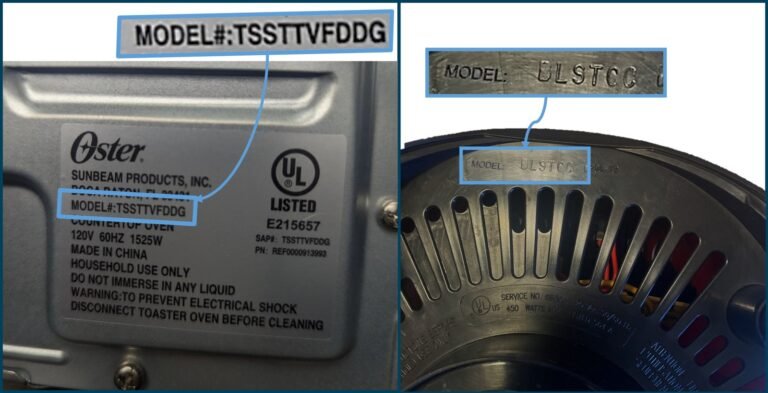
- Turn the base upside down on a towel so the rubber feet face up. The label sits flat on the bottom.
- Find the rating label. It’s a silver or white sticker, usually 2–3 inches wide, printed with small text.
- Read the wattage line. It says “W” or “Watts” next to a number — for example, “450W” or “1000W”. Write the number down.
- Check for a model number nearby. It’s usually 3–6 characters, like “BLSTPB” or “6811”. Photograph the whole label with your phone so you have both.
- If the label is worn or missing, look for the manual. Search the model number on Oster’s official site. The spec sheet lists wattage.
- Confirm the voltage. The label also states “120V” or “220V”. Match this to your wall supply before trusting the wattage.
The judgement call is whether to trust a worn label. If you can read the model number but not the wattage, the model number is the more useful find — it gets you the full spec from Oster directly. A blurry wattage figure alone tells you less than a clear model number.
Oster blender wattage by model family
| Model family | Typical wattage | What it handles | What to watch for |
|---|---|---|---|
| Osterizer classic | 450–600W | Smoothies, soups, soft ice | Stalls on frozen fruit |
| Oster Pro 1200 | 1,200W | Ice, nuts, thick blends | Loud at full speed |
| Oster Blend-N-Go | 250–400W | Single smoothies only | Not for ice or nuts |
| Oster Versa | 1,000–1,400W | Heavy daily use | Needs counter space |
| Oster Counterforms | 600–800W | General kitchen tasks | Jar can crack if dropped |
| Oster Heritage | 500–700W | Retro look, light use | Parts harder to find |
Wattage figures vary by year of manufacture. Check the label on your own unit or the Oster website for your exact model.
What a good result looks like
Reading the label correctly
The wattage on the label is the motor’s rated input, not its output. A 1,000-watt Oster doesn’t deliver 1,000 watts of blending force — some is lost as heat and noise. Experienced buyers compare wattage between models of the same brand, not across brands.
They also check the duty cycle. Some Oster motors are rated for continuous use, others for 1 minute on, 1 minute off. That detail sits in the manual, not on the box.
Matching the blender to the job
A 450-watt Osterizer handles soup, pancake batter, and soft smoothies without complaint. It struggles with frozen fruit and nut butter. A 1,200-watt Oster Pro handles all of those, but it’s heavier and louder.
Experienced users pick the lower wattage for light jobs and save the high-watt machine for heavy ones. Running a 1,200-watt blender for a single banana is wasted power and unnecessary noise.
Common Oster blender problems and fixes
| What you notice | What it usually means | What to do first | How to stop it happening again |
|---|---|---|---|
| Motor smells hot | Overloaded or running too long | Stop, unplug, let cool 15 min | Blend in smaller batches |
| Blades spin but nothing moves | Jar not seated on base | Lift jar, reseat, twist clockwise | Check seating before each use |
| Blender trips the breaker | Too much load on one circuit | Move to a different outlet | Don’t share circuit with microwave |
| Loud grinding noise | Worn blade assembly or bearing | Replace blade assembly | Don’t run empty |
| Ice stays in chunks | Wattage too low for the load | Pulse in 5-second bursts | Crush ice in smaller amounts |
| Blender won’t start | Lid not locked or base not powered | Check lid tab and outlet | Confirm lid click before pressing |
If the motor smells burnt rather than warm, stop using it. That’s a sign of winding damage, and a technician should look at it — not something to fix at home.
The rules that apply to small appliances
In the US, blenders sold for household use carry a UL or ETL listing mark, which shows the appliance met safety standards set by Underwriters Laboratories. That mark is on the label next to the wattage.
The wattage figure itself is a manufacturer’s rating; IEC 60335 is the international safety standard for household appliances. If a blender claims a wattage that seems too high for its size, the claim is probably peak power, not continuous.
Warranty terms vary by model and country. Oster’s official site lists the warranty length for each model under its product page. Keep your receipt — most claims need proof of purchase.
If your blender is under warranty and the motor fails, don’t open the base. That voids the warranty and exposes you to a capacitor that can hold a charge even when unplugged. Contact Oster support instead.
What this costs you
A replacement Oster blender is inexpensive relative to the alternative, depending on the model and where you buy it. Prices change often — check Oster’s site or a retailer for today’s price.
The cheaper path is often to keep the blender you have. A worn blade assembly costs far less than a new base, and it fixes most “weak motor” complaints. Look up the part number for your model on Oster’s site before you shop for a whole new unit.
If you’re paying an electrician because your blender trips a breaker, the cost is much higher than the blender itself. That’s usually a circuit problem, not a blender problem. Test the blender on another outlet first.
Keeping your Oster running
Wash the jar and blade assembly after every use with warm soapy water. Don’t put the base in water — wipe it with a damp cloth only. Food residue on the base can block airflow and make the motor run hot.
Check the blade assembly periodically. How often depends on your use, and the owner’s manual is the authority. If the blades wobble or the seal looks cracked, replace it. A worn blade makes the motor work harder and shortens its life.
The sign your blender needs attention again is a change in sound — a motor that used to hum smoothly and now rattles is telling you something. Fix the blade first. If that doesn’t help, the motor itself is the issue, and at that point a new blender is usually cheaper than a repair.
When a different blender makes more sense
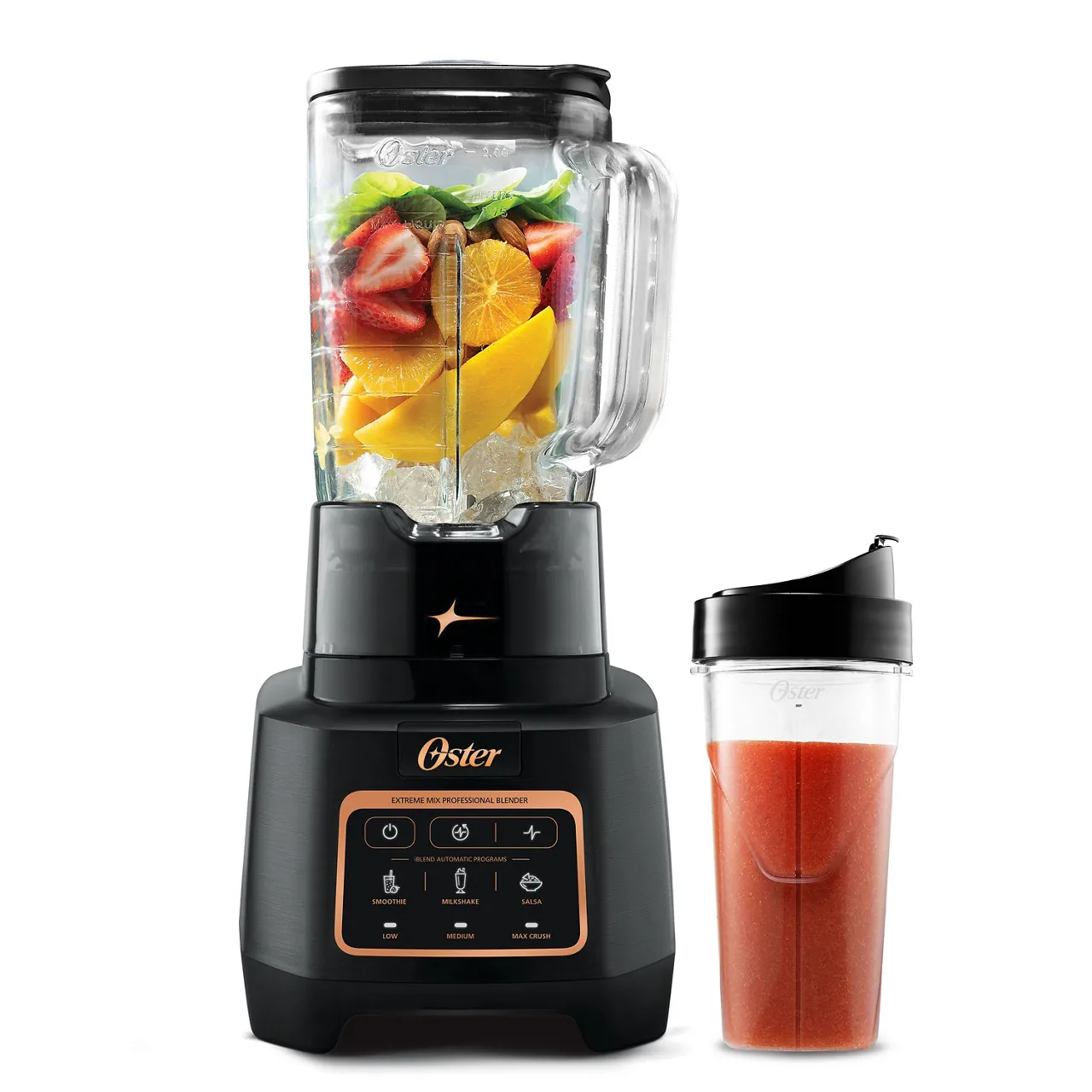
If you’re blending frozen fruit or nut butter daily, a 450-watt Osterizer isn’t the right tool. A high-wattage blender from Oster or another brand will last longer and do the job faster. Buying a cheap blender twice costs more than buying one that fits.
If you need a blender for a commercial kitchen, a household Oster isn’t rated for that. Look at commercial-rated blenders with a duty cycle built for continuous use.
If your Oster is under warranty and the motor has failed, don’t try to repair it yourself. Opening the base voids the warranty and exposes you to a capacitor that can hold a lethal charge even when unplugged. Contact Oster support or a qualified appliance technician.
Related guides
Frequently asked questions
How many watts is a typical Oster blender?
Most Oster blenders sold today are rated between 600 and 1,200 watts. Basic models like the Blend-N-Go sit lower, around 250–400 watts. The exact figure for your unit is on the rating label under the base.
Can I use a 1,200-watt Oster blender in a 220-volt country?
No, not directly. A US Oster is rated for a specific voltage. Running it on a different voltage without a proper step-down converter will damage the motor. Have a technician check the electrical measurement before plugging it in anywhere.
Why does my Oster blender smell hot after 30 seconds?
The motor is overloaded or the blend is too thick. Stop, unplug, and let it cool for 15 minutes. Blend in smaller batches and add liquid to thin the mixture. If the smell returns, the motor may be failing.
Is a higher-watt Oster blender always better?
No. Higher wattage means more power for hard jobs like ice and frozen fruit. For soups and soft blends, a 450-watt Osterizer works fine and uses less electricity. Match the wattage to what you actually blend.
How long should an Oster blender last?
Oster doesn’t publish a lifespan figure, and it varies with use. A blender used daily for frozen drinks wears faster than one used weekly for soup. The sign it’s near the end is a motor that rattles or smells hot under light loads.
What happens if I run my Oster blender empty?
Running it empty for more than a few seconds can overheat the motor and damage the blender. Always have liquid or food in the jar before you press start. If you ran it empty and it now rattles, replace the blade assembly.
Does wattage affect how fast my blender crushes ice?
Yes, but blade sharpness matters just as much. A sharp blade matters as much as wattage when crushing ice.
Can I replace a 450-watt Oster motor with a stronger one?
No. The motor, base, and wiring are matched as a set. Swapping in a stronger motor isn’t a supported repair and creates a fire risk. If you need more power, buy a higher-wattage model instead.
Start with the label, not the internet
Turn your Oster upside down and read the rating label before you do anything else. That number — with the model number beside it — is the only figure that describes your blender. Expect a range of 600 to 1,200 watts for most current models, and a clear answer from Oster’s site if you have the model number.
Write the model number down and keep it. Blenders that look identical on the shelf can carry different motors, and the label is the only place the difference shows. Searching by appearance gets you a wattage for somebody else’s machine.
If the label is worn past reading, photograph it under bright light before you scrub at it. Rubbing takes off what is left.
If the motor smells burnt, trips the breaker on every outlet, or rattles under a light load, stop using it and contact Oster support or a qualified technician — that’s past the point where a home fix is safe.