Can You Juice With a Nutribullet Blender? Yes, Here’s How
Yes, you can juice with a Nutribullet blender, but it makes a thick, fiber-rich drink rather than the clear, pulp-free juice a dedicated juicer produces. The machine blends whole fruits and vegetables into a smoothie-style “juice” that you drink in full, and for most people that’s exactly the point.
Key Takeaways
- A Nutribullet blends whole produce into a smooth, drinkable juice with all the fiber intact; it doesn’t separate pulp from liquid the way a centrifugal or masticating juicer does.
- You need to add liquid — water, coconut water, or juice — because the blades can’t move dry, hard produce on their own.
- The 600-watt and 900-watt Nutribullet models handle soft and medium produce well; hard items like whole carrots, beets, and ice need smaller cuts and more liquid.
- Chop fibrous and hard ingredients into 1-inch pieces, and remove large seeds, thick skins, and pits before blending.
- Leafy greens, berries, citrus flesh, cucumber, and melon blend into smooth results; whole apples, unpeeled ginger chunks, and fibrous celery leave grit unless you strain.
- A nut milk bag or fine-mesh strainer turns a Nutribullet blend into clear juice if you want a juicer-style result.
What a Nutribullet Actually Does
A Nutribullet is a high-speed blender with a compact, inverted cup design. You load the cup, screw on a blade assembly, flip it onto the motor base, and press down to run the blades. The motor spins the extractor blade at high rpm, and the shape of the cup forces the contents back down into the blade path instead of letting them sit at the top.
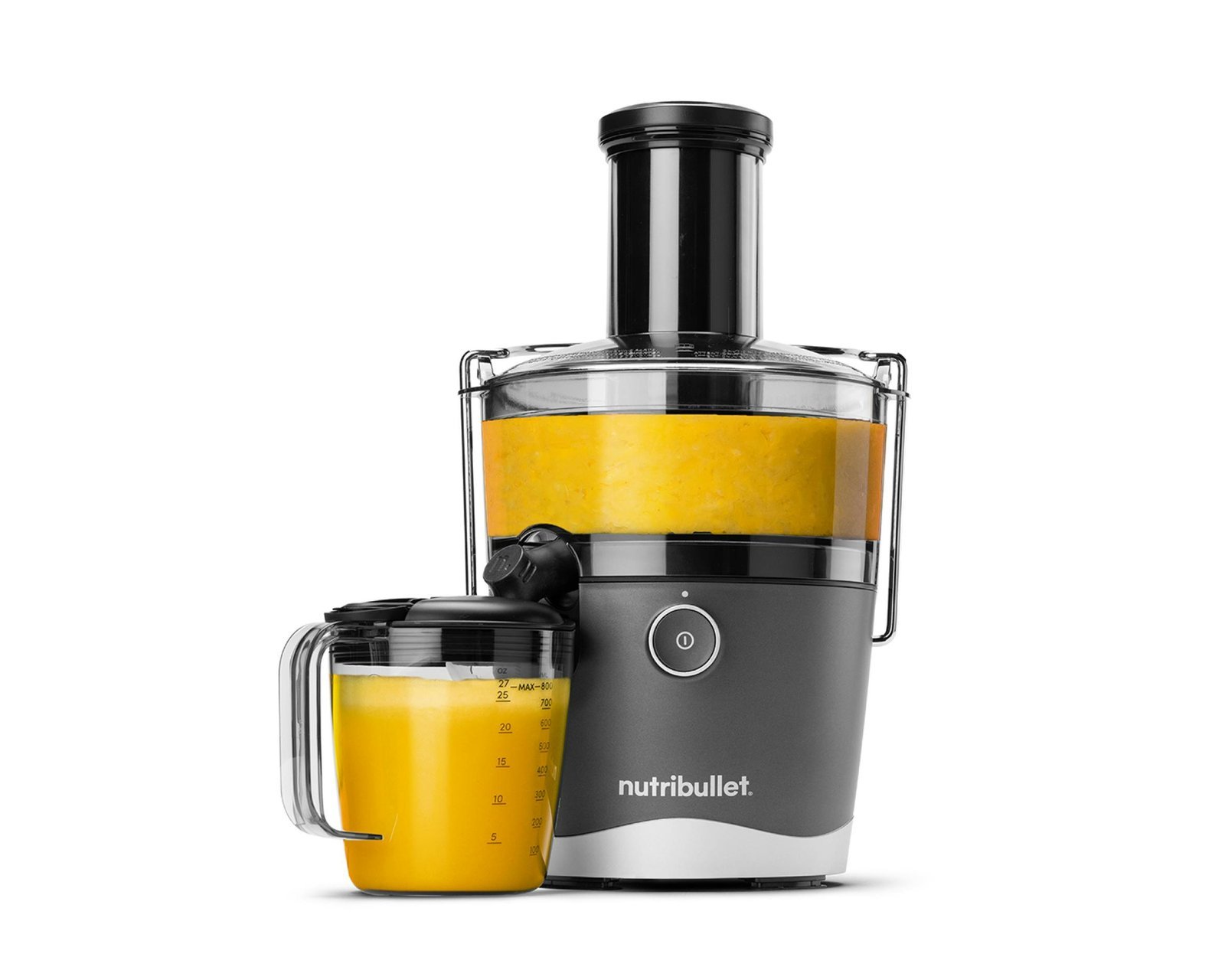
That design is excellent at pulverizing soft and medium produce into a uniform liquid. It isn’t designed to separate solids from liquids. There’s no pulp ejection chute, no spinning basket, and no waste container. Everything you put in the cup ends up in your glass.
The result is a drink that sits somewhere between a smoothie and a juice. Nutritionally, it’s closer to eating the whole fruit than to drinking pressed juice, because the fiber, skin particles, and much of the pulp remain suspended in the liquid. That’s a feature for most people. Fiber slows the absorption of natural sugars and keeps you full longer.
Where it falls short is texture. If you want crystal-clear apple juice or pulp-free orange juice, a Nutribullet alone won’t get you there without a straining step.
Nutribullet vs Juicer: The Real Difference
The clearest way to understand the trade-off is to compare the two machines side by side.
| Feature | Nutribullet Blender | Dedicated Juicer |
|---|---|---|
| Output style | Thick, whole-produce drink | Clear juice with pulp removed |
| Fiber content | Full fiber retained | Most fiber removed |
| Prep work | Chop into chunks, add liquid | Feed whole or roughly cut pieces |
| Liquid required | Yes, always | No |
| Waste produced | None (you drink it all) | Pulp leftover |
| Yield per pound of produce | Higher, since nothing is discarded | Lower, since pulp is thrown out |
| Best for | Smoothies, thick juices, leafy greens | Clear juices, large batches |
| Cleanup | Rinse cup and blade | Disassemble and scrub basket |
The yield difference is worth emphasizing. A juicer discards a significant portion of every fruit or vegetable as pulp. A Nutribullet keeps all of it, so the same two apples produce more drinkable volume. You’re paying for less produce per glass.
Pro Tip: If you want the best of both worlds, blend in the Nutribullet first, then pour the mixture through a nut milk bag or a fine-mesh strainer. You get clear juice plus the option to compost or cook with the leftover pulp.
Which Nutribullet Models Can Juice
Not every Nutribullet is built the same. Motor wattage determines how well the machine handles dense, hard produce.
| Model | Motor Wattage | Juicing Capability | Notes |
|---|---|---|---|
| Nutribullet 600 | 600 watts | Soft and medium produce | Best for berries, banana, spinach, cucumber |
| Nutribullet Pro 900 | 900 watts | Soft, medium, and most hard produce | Handles carrot and beet in small pieces |
| Nutribullet Pro+ 1200 | 1200 watts | Hard produce and ice | Closest to juicer performance |
| Nutribullet Baby | 200 watts | Soft purees only | Not suitable for juicing |
| Nutribullet Select | 700-1000 watts | Soft and medium produce | Good mid-range option |
The pattern is simple: more watts means more torque, and more torque means the blades can cut through dense fiber without stalling. If you own a 600-watt model, you can still juice, but you should pre-chop aggressively and lean on softer ingredients.
Warning: Never run a Nutribullet continuously for more than about a minute at a time. The motor heats up, and the manual for every model specifies short pulses rather than long continuous runs. Let it rest between batches.
Step-by-Step: How to Juice in a Nutribullet
Follow this sequence and you’ll get a smooth, drinkable result rather than a chunky mess.
Step 1: Wash and Prep Your Produce
Rinse everything under cold water. Cut produce into pieces roughly 1 inch across. This isn’t optional for hard items — a whole carrot or a whole beet will simply bounce around while the blade spins.
Remove:
- Pits from cherries, peaches, plums, and mangoes
- Large seeds from apples and pears (small seeds are fine)
- Thick skins from citrus, pineapple, and melon
- Stems from kale and collards
- Tough cores from cabbage and cauliflower
Leave the skins on apples, cucumbers, zucchini, and berries. The skin holds much of the fiber and many of the nutrients, and it blends fine.
Step 2: Add Liquid First
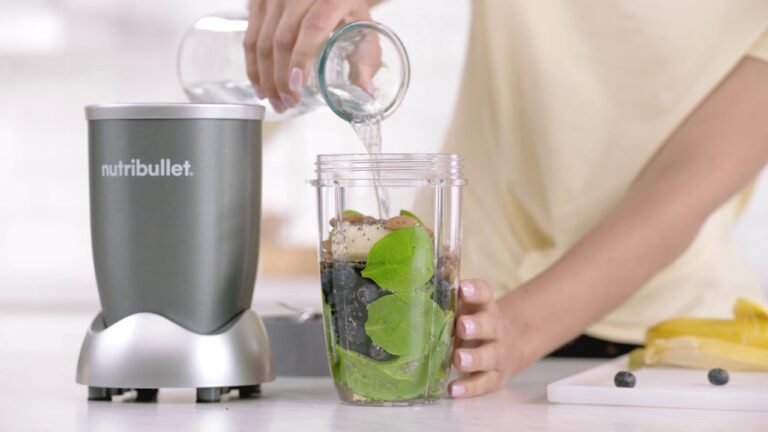
Pour your liquid into the cup before the produce. This matters because the liquid creates a vortex that pulls solids down into the blade. Without it, dry ingredients just cake against the walls.
Good liquid choices:
- Water
- Coconut water
- Unsweetened almond milk
- Apple juice or orange juice
- Green tea, cooled
For a single 24-ounce cup, start with about 1 cup of liquid. Add more if the blend stalls.
Step 3: Layer Soft and Hard Ingredients
Add soft items like berries, banana, and spinach first, then firmer items like carrot, beet, and apple on top. The soft items break down quickly and create a liquid base that helps the harder pieces circulate.
Step 4: Fill to the Max Line
Don’t overfill. Every Nutribullet cup has a max fill line, and exceeding it causes leaks and stalls. Leave headroom for the liquid to move.
Step 5: Blend in Short Pulses
Press down and run the machine in 10- to 15-second bursts. Between bursts, lift the cup and shake it to redistribute the contents. Repeat for 45 to 60 seconds total, or until the texture is uniform.
Step 6: Strain If You Want Clear Juice
If you want juicer-style clarity, pour the blend through a nut milk bag, a fine-mesh strainer, or several layers of cheesecloth set over a bowl. Squeeze or press the pulp to extract as much liquid as possible. Discard or repurpose the pulp.
Best Fruits and Vegetables to Juice
Not all produce behaves the same in a high-speed blender. This table sorts common ingredients by how well they work.
| Produce | Blends Well? | Prep Needed | Notes |
|---|---|---|---|
| Spinach, kale | Yes | Remove thick stems | Blends into a smooth green base |
| Berries | Yes | None | Seeds blend in; strain for smooth texture |
| Banana | Yes | Peel | Adds creaminess |
| Cucumber | Yes | Cut into chunks | High water content, blends easily |
| Watermelon | Yes | Remove rind | Almost pure liquid already |
| Orange | Yes | Peel, keep flesh | Remove pith for less bitterness |
| Apple | Yes | Core, cut into chunks | Skin blends; strain for clear juice |
| Carrot | Yes, with care | Cut into 1-inch pieces | Needs 900W+ and plenty of liquid |
| Beet | Yes, with care | Peel, cube | Stains plastic cups; blend with citrus |
| Celery | Partially | Cut into short lengths | Fibrous strings remain; strain |
| Ginger | Partially | Peel, grate or mince | Small amounts only; fibrous |
| Pineapple | Yes | Peel, core, chunk | Blends well; can be foamy |
The general rule: the more water a produce item contains, the easier it blends. Watermelon, cucumber, and citrus are nearly effortless. Dense root vegetables and fibrous stalks require more patience and more liquid.
Juicing Recipes That Work
These combinations are built around what a Nutribullet handles well. Each makes one 24-ounce cup.
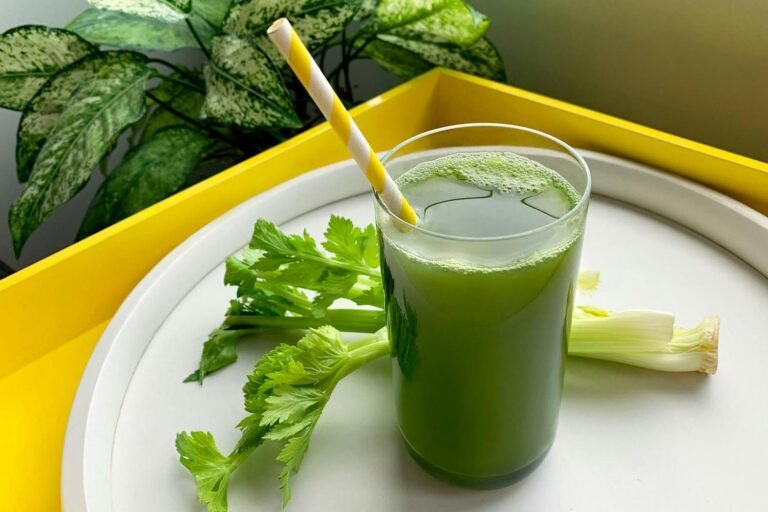
Green Juice
- 2 cups spinach
- 1/2 cucumber, chunked
- 1 green apple, cored and chunked
- 1 celery stalk, cut small
- 1 cup cold water
- Squeeze of lemon
Blend 60 seconds, then strain if desired. The apple and cucumber provide enough liquid to carry the spinach.
Berry Beet Juice
- 1 cup strawberries
- 1/2 small beet, peeled and cubed
- 1/2 cup blueberries
- 1 cup coconut water
- 1/2 orange, peeled
The orange and coconut water mask the earthy beet flavor and give the blades enough liquid to work with.
Tropical Carrot Juice
- 2 carrots, cut into 1-inch pieces
- 1 cup pineapple chunks
- 1/2 inch fresh ginger, peeled and minced
- 1 cup water
- 1/2 lemon, juiced
This one needs a 900-watt model or better. Pulse in short bursts and shake between them.
Citrus Cooler
- 2 oranges, peeled and segmented
- 1 grapefruit, peeled and segmented
- 1 cup cold water
- Fresh mint leaves
Blend 30 seconds and strain for a clear, refreshing juice. This is the closest a Nutribullet gets to a true juicer result.
Pro Tip: Freeze leftover juice in ice cube trays and drop the cubes into future blends instead of ice. You add flavor and chill without watering anything down.
How to Get Smoother Results
If your juice comes out gritty or stringy, the problem is usually technique rather than the machine.
- Add more liquid. A thick blend can’t circulate, so the blades spin without cutting. Thin it out.
- Chop smaller. One-inch pieces are the maximum for hard produce. Half-inch is better.
- Blend longer in pulses. Short bursts with shaking in between beat one long run.
- Strain the fibrous items. Celery, ginger, and pineapple core leave strings behind. Strain them out.
- Use ripe fruit. Underripe fruit has tougher cell walls and blends less smoothly.
- Work in batches. Overloading the cup is the single most common cause of a bad result.
Common Problems and Fixes
| Problem | Likely Cause | Fix |
|---|---|---|
| Chunky texture | Pieces too large, not enough blending time | Chop smaller, pulse longer, shake between bursts |
| Machine stalls | Too much hard produce, too little liquid | Remove half, add liquid, blend in batches |
| Leaking cup | Overfilled past max line, blade not tight | Fill less, tighten blade assembly firmly |
| Bitter taste | Pith and seeds left in | Peel citrus fully, remove seeds |
| Gritty mouthfeel | Fibrous items like celery or ginger | Strain through a nut milk bag |
| Separation after sitting | Natural, no stabilizers added | Stir or shake before drinking |
| Motor smells hot | Continuous running | Stop, let cool 10 minutes, use shorter pulses |
Warning: If your Nutribullet smells like burning rubber or the motor slows noticeably, stop immediately. That’s a sign of overheating, and continuing can damage the motor permanently.
Cleanup and Storage
Clean the cup and blade assembly immediately after use. Pulp dries hard and becomes much harder to remove after an hour. Fill the cup halfway with warm water, add a drop of dish soap, screw on the blade, and run it for 10 seconds. Rinse and air dry.
Store fresh juice in a sealed container in the refrigerator. Because a Nutribullet juice contains all the fiber and pulp, it separates as it sits — that’s normal. Shake before drinking. For best flavor and nutrient retention, drink within 24 to 48 hours.
Don’t store juice in the blending cup with the blade attached. Transfer it to a separate bottle or jar.
Frequently Asked Questions
Can you juice with a Nutribullet blender?
Yes, but the result is a thick, whole-produce drink rather than clear, pulp-free juice. A Nutribullet blends everything together instead of extracting liquid and discarding pulp. You add liquid, blend until smooth, and drink the entire mixture. If you want clear juice, strain the blend through a nut milk bag afterward.
Do you need to add water when juicing in a Nutribullet?
Yes, always. The blades can’t create a vortex with dry, solid produce alone, so the machine will stall or leave chunks. Start with about 1 cup of water, coconut water, or juice per 24-ounce cup, and add more if the blend stops circulating. The liquid also controls how thick the final drink is.
Can a Nutribullet juice carrots and beets?
It can, but only with the right technique. Cut carrots and beets into 1-inch cubes, use a 900-watt model or higher, and add extra liquid. Pulse in short bursts and shake the cup between them. Expect a thick result rather than thin juice, and strain if you want a smoother texture.
What is the difference between Nutribullet juice and juicer juice?
A juicer separates liquid from pulp and discards the pulp, producing clear juice with most fiber removed. A Nutribullet keeps everything, so the drink retains all the fiber, skin particles, and pulp. Nutribullet juice is more filling and has a thicker texture; juicer juice is lighter and clearer.
Can you juice leafy greens in a Nutribullet?
Yes, and it handles them well. Remove thick stems from kale and collards, then pack the leaves loosely into the cup with liquid at the bottom. Spinach and baby kale blend into a smooth green base in about 30 seconds. Strain if you dislike the slight fiber texture.
Why is my Nutribullet juice gritty?
Grit usually comes from fibrous produce like celery, ginger, pineapple core, or unpeeled tough-skinned fruit. Chop those items smaller, blend longer in pulses, and strain the finished juice through a fine-mesh strainer or nut milk bag. Adding more liquid also helps the blades cut cleanly instead of tearing.
Conclusion
If you already own a Nutribullet, start with the Green Juice recipe above, using soft ingredients and a full cup of water, then adjust the liquid until the blend moves freely. Once you have the texture dialed in, experiment with harder produce one item at a time so you learn exactly what your model can handle.